ID AND LOCATION
| Stanford #
| 11fgh |
| AG1980 #
| 11f-h |
| PM1960 #
| 543 b-d |
| Slab #
| VII-7 |
| Adjoins
| 11e 11i |
CONDITION
| Located
| true |
| Incised
| true |
| Surviving
| true |
| Subfragments
| 3 |
| Plaster Parts
| 0 |
| Back Surface
| smooth |
| Slab Edges
| 2 |
| Clamp Holes
| 3 |
| Tassello
| no |
TECHNICAL INFO
|
|
|
|
|
|
|
|
|
Photograph (Mosaic) (805 KB)
Note about photographs | |
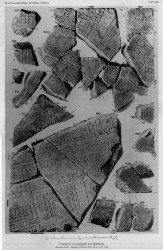
PM 1960 Plates: 12 53
AG 1980 Plates: 10 54
|
|
| IDENTIFICATION |
| SE slope of the Viminal Hill (collis Viminalis) including the Vicus Patricius (vicus Patricius), the area Candidi?, a warehouse (horrea), and possible headquarters (schola) for a local organization (collegium)
|
|
| INSCRIPTION |
| None |
|
|
3D Data Not Yet Available |
|
|
| ANALYSIS
|
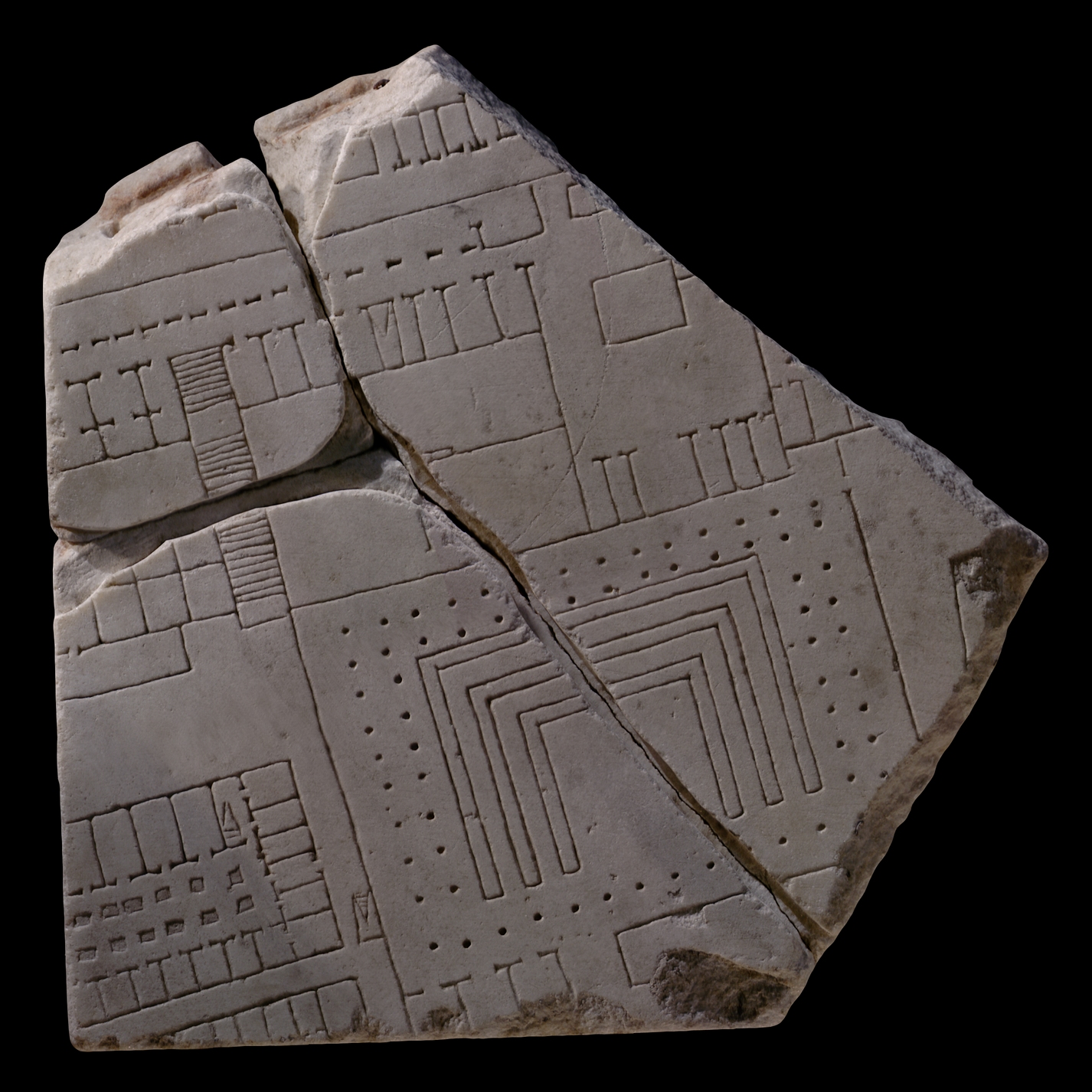
| Description This group of fragments constituted the corner of a slab; three clamp holes are visible. A horizontal street traverses the top of the fragments. It is flanked above by a row of small tabernae. Below, a wall separates the street from the architecture below (D. Reynolds [1996, fig. 3.32] suggests this line denotes a sidewalk, not a wall). Beyond this line, and parallel to it, lies an arcade. To the right, the arcade is blocked by a small room. Behind the arcade and facing it is a row of tabernae, separated in the middle by a long, stepped ramp. The shops on the left of the ramp have back rooms, and back onto what seems to be another row of shops with back rooms; those on the right are plain and back onto a large, rectangular space, perhaps open, which is divided into three compartments. To the right of this space lies a large building, accessed only through a small opening in the upper left corner. In the back, six irregularly sized rooms face the center of the building. Two larger rectangles with two smaller square features right next to them are placed in the center and towards the front of the building. Behind this secluded building, and occupying most of the lower right corner of the fragment group, lies a large porticoed structure. Its only access seems to be through a small opening in the upper right corner. A colonnade, double except along the bottom, surrounds three clamp-shaped features in the center of the building. These open up towards the bottom. A row of small rooms on the left and an elongated feature on the right, barely preserved, face the single colonnade at the bottom. The bottom left corner of the fragment group is a large, open space in which a partial building is visible. The long ramp seems to connect this open space to the arcade at top. Another set of stairs, placed along the right wall of this space, perhaps provided access to the top of the porticoed building to the right. The partially visible structure in this open space consists of three rows of rooms that face inwards towards a central, narrow courtyard lined with columns. These columns are rendered with recessed squares. The corner of another building, perhaps similar, is visible in the lower left corner of the fragment.
Identification: Vicus Patricius E. Rodríguez-Almeida located this fragment group and the joining frs. 11e and 11i in the bottom left corner of slab VII-7, based on the similarities (such as marble color, thickness, smooth back, and sawing irregularities) between these fragments and those already securely placed in the top of the slab (Rodríguez-Almeida 1975-76, pp. 274-75, and fig. 8; 1992, pp. 66-68, figs. 15-16). In addition to these similarities, certain features, such as the horizontal street and the porticoed structure in this fragment group, correspond exactly to excavated remains between the Viminal and Cispian Hills (see Rodríguez-Almeida 1975-76, fig. 8). The horizontal street in this fragment can therefore be identified as the vicus Patricius, the street that marked the border between the fourth and the sixth Augustan regions of the city (Rodríguez-Almeida 1975-76, p. 274; LTUR V, p. 183). The vicus Patricius started at the clivus Suburanus in the south and ran north between the Cispian and Viminal Hills to the Viminal Gate in the Republican city walls (corresponding to modern Via Urbana)(see map in LTUR III, fig. 190). The majority of the architecture depicted in this group must have been located on the lower SE slope of the Viminal Hill. This would explain the long ramp that leads from the bottom of the hill, off the the vicus Patricius, towards the top.
Identification: A schola? The restricted access to the rectangular building in the upper right corner of this fragment group suggests it was semi-private in nature. It does not, however, seem like a residential unit. Can we perhaps associate it with the headquarters schola of one of Rome's many professional or religious organizations (collegia)? A collegium of either sort would have required a large room for meetings and communal dining, perhaps a sacellum or altar for the worship of the patron god, and the ability to restrict access to members only. The hall in this fragment seems to fulfill these requirements.
Identification: Area Candidi? The large, rectangular structure in the lower right corner of the fragment group defies identification. The authors of PM 1960, p. 148, suggest tentatively that the double rows of dots that surround the center of the building on three sides represent trees as opposed to colonnades. The three central clamp-like features are identified as arbors or hedges, similar to those that surround the Temple of Claudius in fragment group 5. Remains of this structure have been excavated at the foot of the Viminal Hill; with the exception of the circular structure in the center of the building (a fountain or a temple?), the remains correspond surprising well with the depiction in this fragment group (see Rodríguez-Almeida 1975-76, fig. 8 or LTUR I, fig. 63). The circular feature is perhaps a post-Severan addition to the structure (Rodríguez-Almeida 1975-76, p. 275). The building is sometimes referred to as the Palace of Decius (palatium Decii) but has also been associated with the area Candidi. Known from written sources only, both buildings were situated on the Viminal Hill (LTUR I, p. 114). The discovery of two statues of Greek poets in the building is occasionally quoted as support for the thesis that the building is to be identified with the area Candidi, perhaps a structure built by Ti. Iulius Candidus who was proconsul of Acaia (Greece) between 134 and 137 CE (LTUR I, p. 114). This identification must remain tentative at best.
Identification: Horrea Although R. A. Staccioli does not list the building in the left corner of this fragment among his examples of horrea on the Marble Plan (Staccioli 1962), it fits his Type 2 perfectly. Warehouses of this type have at least three rows of rooms facing a central courtyard, which is often colonnaded (Staccioli 1962, pp. 1432-1434 with examples in fig. 1). Rickman (1971, pp. 120-121) confirms its identification as a warehouse. Or might it represent a macellum or a small, specialized market?
Significance Rodríguez-Almeida's positioning of these fragments provides us with a vivid picture of a little-known, non-monumental neighborhood that seems to have been a mix of multi-storey apartment complexes, luxurious single-family residences, shops with courtyards (fr. 11e), of an elaborate public garden(?), warehouses or a market, and perhaps the headquarters of a local organization. |
|
| HISTORY OF FRAGMENT |
| Like the majority of FUR fragments, these pieces were discovered in 1562 in a garden behind the Church of Saints Cosmas and Damian. They were transferred to the Palazzo Farnese and stored there. Renaissance engravers reproduced the fragments in 16th-c. drawings that are now kept in the Vatican (Cod. Vat. Lat. 3439), and Giovanni Pietro Bellori included them in his 1673 publication. In 1742, they were moved to the Capitoline Museums and exhibited with some of the other known fragments in wooden frames along the main staircase. Since then, the fragments have been stored with the other known FUR fragments in various places: the storerooms of the Capitoline Museums (1903-1924), the Antiquarium Comunale (1924-1939), the Capitoline Museums again (1939-1955), the Palazzo Braschi (1955-1998), and since 1998 in the Museo della Civiltà Romana in EUR under the auspices of the Sovraintendenza ai Beni Culturali del Comune di Roma. (The history of these fragments corresponds to Iter A' as summarized in PM 1960, p. 56.)
Text by Tina Najbjerg |
|
| KEYWORDS
|
| garden, horrea, market, tabernae, colonnade, trees, hedges, ramp, altar, fountain, Palace of Decius, vicus, cispian, viminal, candidus, warehouse, schola |
|
 Prev
Prev