| [FRAGMENT ANALYSIS IN PROGRESS]
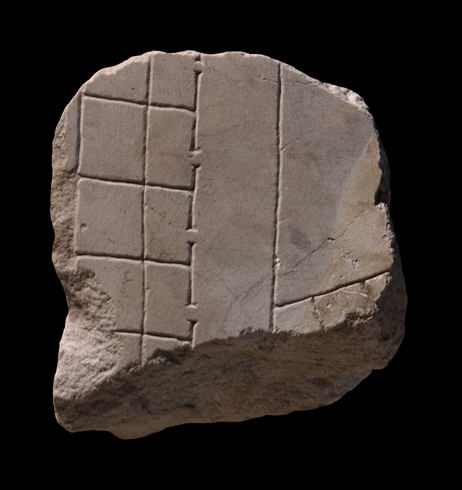
Description A vertical row of tabernae with back rooms traverses the fragment on the left. Although no openings are visible between the front and the back rooms of the tabernae, these must surely have been there in reality (unless they were on a different level). The shops face a street and a large enclosure or courtyard. Attached to it at the bottom, in an oblique angle, is another row of tabernae.
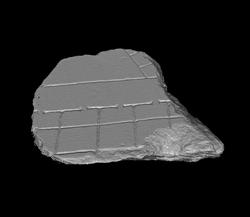
Identification E. Rodríguez-Almeida joined this fragment to fr. 667 based on the rough back of both (Rodríguez-Almeida 1992, pp. 62-63). Using computer algorithms, D. Koller of this Stanford project has in addition matched this fragment with fr. 156 (Koller-Levoy 2005). The match is confirmed by the aligning architecture, the similar ductus and thickness, the rough backs, the fracture angle of the bottom surface, and a distinct two-tone colored band in the marble of all three fragments. Together, the three pieces show a row of shops facing a street and a triangular or trapezoidal courtyard or open space. The tabernae also seem to back onto a large courtyard. The most common type of tabernae on the Plan consists of a single room that opens directly onto a street. This type of shop could function as a shop, as a dwelling, or, probably more commonly, as a combination of the two. In single-room shops, a wooden loft probably served as the actual dwelling area (Reynolds 1996, pp. 158-9). This fragment may depict a type of tabernae that had an additional room in the back. Such structures have been found in both Ostia and Pompeii. The back room was either used as the family residence or, if the front room had a loft, as a work and/or storage space. Other examples of such tabernae can be seen in frs. 11a, 11c, and 11fgh (Reynolds 1996, fig. 3.13).
Significance This fragment is typical of non-identified pieces of the Map. It depicts a type of mixed residential and commercial architecture that probably existed in all Roman neighborhoods outside the monumental and administrative center.
|
 Prev
Prev