ID AND LOCATION
| Stanford #
| 156 |
| AG1980 #
| 156 |
| PM1960 #
| 156 |
| Slab #
| unknown |
| Adjoins
| 667 |
CONDITION
| Located
| false |
| Incised
| true |
| Surviving
| true |
| Subfragments
| 1 |
| Plaster Parts
| 0 |
| Back Surface
| rough |
| Slab Edges
| 2 |
| Clamp Holes
| 1 |
| Tassello
| no |
TECHNICAL INFO
|
|
|
|
|
|
|
|
|
|
|
| ANALYSIS
|
| [FRAGMENT ANALYSIS IN PROGRESS]
Description
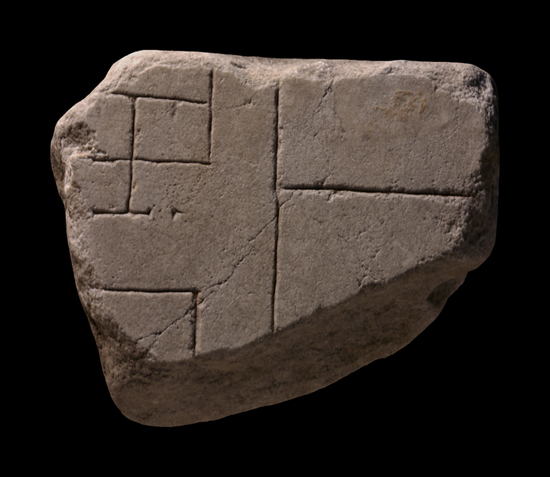
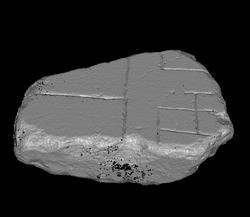
Fragment has the original corner of slab with slab edges on two sides (top and right side). A part of a clamphole is visible on the right edge.
A street runs top to bottom, and is intersected by a left-right street creating a T-crossing. A cluster with buildings is visible in top left corner with several rooms of unclear function. This cluster continues into fragments 667
and 134
in the same set-up: single room buildings (tabernae) opening to the street with a single room located behind. Although no openings are visible between the front and the back rooms of the tabernae, these must surely have been there in reality (unless they were on a different level). The shops face a street and a large enclosure or courtyard. The bottom corner room seems either unfinished or open (?).
Two larger spaces are visible on the right of the fragment, their function is also unclear. The bottom left part shows the corner of a new building or block.
Identification: commercial quarter on flat land
Fragment 156 was connected to fragments 667
and 134
with boundary incision matching at Stanford University (Koller-Levoy 2005, fig. 5-7). The output from the matching algorithm assigned high matching scores to each pairwise combination of these 3 fragments; upon manual review, the configuration shown in fig. 6 was determined to be the most likely. E. Rodríguez-Almeida had previously confirmed the join between fragments 667 and 134 (Rodríguez-Almeida 1992, pp. 62-63).
The regularity of the streets and buildings on this fragment and on frs. 667/134 indicates flat land.
Together, the three pieces show a row of shops facing a street and a triangular or trapezoidal courtyard or open space. The tabernae also seem to back onto a large courtyard. The most common type of tabernae on the Plan consists of a single room that opens directly onto a street. This type of shop could function as a shop, as a dwelling, or, probably more commonly, as a combination of the two. In single-room shops, a wooden loft probably served as the actual dwelling area (Reynolds 1996, pp. 158-9). This fragment may depict a type of tabernae that had an additional room in the back. Such structures have been found in both Ostia and Pompeii. The back room was either used as the family residence or, if the front room had a loft, as a work and/or storage space. Other examples of such tabernae can be seen in frs. 11a, 11c and 11fgh (Reynolds 1996, fig. 3.13).
Significance
This piece is a typical example of unidentified fragments of the Plan. No monumental buildings are represented, and the fragment instead provides a view of a lesser known commercial area.
|
|
| HISTORY OF FRAGMENT |
| Like the majority of FUR fragments, this piece was discovered in 1562 in a garden behind the Church of Saints Cosmas and Damian. From here, it was transferred to the Palazzo Farnese and stored there. It was not among the fragments that were reproduced in the Renaissance drawings that are now kept in the Vatican, but Giovanni Pietro Bellori included it in his 1673 publication. In 1742, the fragment was moved to the Capitoline Museums and exhibited with some of the other known fragments in wooden frames along the main staircase. Since then, it has been stored with the other FUR fragments in various places: the storerooms of the Capitoline Museums (1903-1924), the Antiquarium Comunale (1924-1939), the Capitoline Museums again (1939-1955), the Palazzo Braschi (1955-1998), and since 1998 in the Museo della Civiltà Romana in EUR under the auspices of the Sovraintendenza ai Beni Culturali del Comune di Roma. (This fragments history corresponds to Iter E as summarized in PM 1960, p. 56.)
Text by Tina Najbjerg and Lidewijde de Jong |
|
| KEYWORDS
|
| Tabernae, street, flat land, boundary incision matching |
|
 Prev
Prev