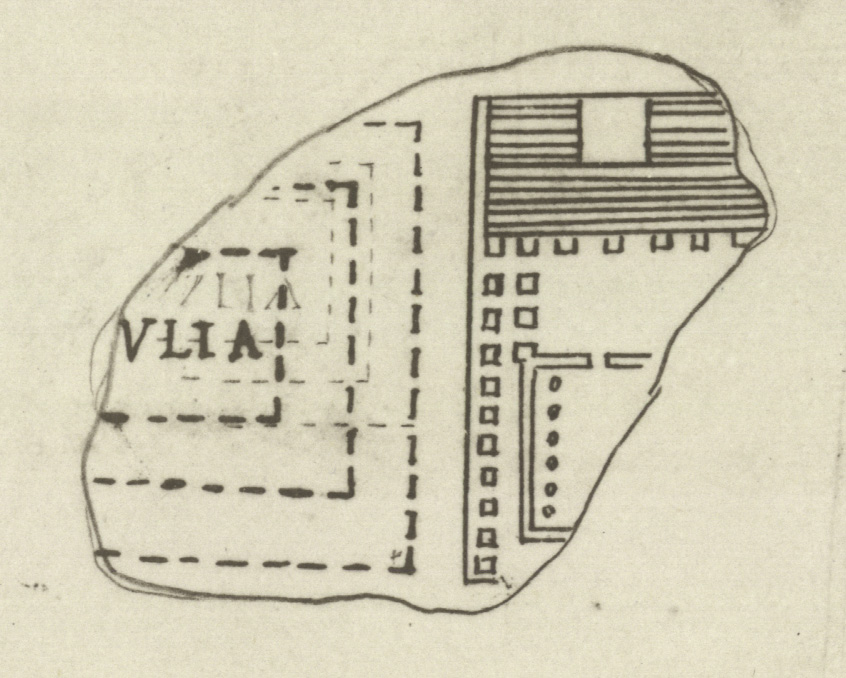
| Description Fr. 18b is now lost, but Renaissance drawing Cod. Vat. Lat. 3439 - Fol 19r shows it as it looked shortly after its discovery (see detailed photo above or PM 1960, pl. 9, no. 9). According to this drawing, the still surviving fr. 18c was once part of this larger fragment. In 1742, a marble copy was made of the missing fragment based on this drawing (see reconstruction in PM 1960, pl. 21 or AG 1980, pl. 13), and fr. 18c was incorporated into this copy (see fr. 18bc). On the right, two thirds of a temple appeared. It was a podium temple with a wide frontal staircase and central platform or altar, a deep pronaos, and a small cella with interior columns along the sides. The temple seemed to be octastyle, with eleven columns along the sides. The columns in front were rendered as if they were part of the edge of the podium; those along the sides were placed at a small distance from the edge. On the left was another structure, separated from the temple by a narrow street. It consisted of three rows of arcades, wrapped around a central space in which the letters VLIA appeared. Vague pencil marks show that the Renaissance draftsman originally drew this building on a much smaller scale.
Identification: Aedes Castoris The octastyle podium temple is identified by an inscription on the nearby fragment 18a as the Temple of Castor in the Roman Forum (PM 1960, p. 75). Livy (2.20.12, 2.42.5) and Dionysius of Halicarnassus (Ant. rom. 6.13) reveal the early history of the building: Vowed in 499 or 496 BCE by the dictator Postumus, the Temple was dedicated in 484 BCE by his son in the very spot where Castor and Pollux had appeared after the battle of Lake Regillus (LTUR I, p. 242). The Temple was restored in 117 BCE and 74 BCE, it was rebuilt by Tiberius, converted into a vestibule for Caligula's palace, and restored by Claudius. It served as a meeting place for the senate and as a bank; rooms in the foundation functioned as shops; and the platform in front was for a long period the Forum's main tribunal for judicial and legislative gatherings (LTUR I, pp. 242-243).
The representation of the Temple of Castor in this Renaissance drawing generally matches what is known from excavations: The temple's location next to the Basilica Iulia (see below), the podium, the number of columns along the front and the sides, the shape of the cella, and perhaps even the small columns lining the inside of the cella (LTUR I, p. 244-245). However, excavation has shown that the temple was peripteral, yet this drawing depicts no columns behind the cella. E.M. Steinby used this fact, among other things, to argue that fr. 18a, which depicts the rest of the obviously peripteral temple, did not belong to the Severan Marble Plan but to an earlier Vespasianic plan (Steinby 1989, p. 27). A close look at the drawing, however, suggests that the fragment was damaged here, so the apparent discrepancy may not be a real one. In addition, the Renaissance draftsmen were often less than careful when drawing the outlines of fragments - a notable example is the drawing of fr. 4b (The Temple of the Divine Claudius) in which the straight slab edge of the fragment is rendered with a uneven, curved line and incisions are added that do not exist (compare with PM 1960, pl. 7, top). The true fragment edge of the now missing fr. 18b may have been much closer to the corner of the podium, in which case the rear columns would not have been visible in the fragment itself. If the Renaissance draftsman was slightly sloppy in his rendering of the fragment edge in this spot, it would look as if there were no columns at the rear of the podium at all. Harder to reconcile with the evidence of excavation is the front staircase. The Plan shows what must have been a post-Augustan but pre-Severan restructuring. The remains of the Augustan temple include a wide platform or tribunal, accessed by lateral stairs and placed below the equally wide staircase that led to the pronaos. At some point before the carving of the Severan Plan, however, these were merged into one wide, frontal staircase (LTUR I, p. 245).
Identification: Basilica Iulia The tail end of an inscription identifies the arcaded or colonnaded building next to the Temple of Castor as the Basilica Iulia in the Roman Forum (PM 1960, p. 75). Julius Caesar began the construction of this building in 54 BCE along the SW side of the Forum, between the vicus Tuscus and the vicus Iugarius, on the site of the earlier, 2nd-century basilica by T. Sempronius Gracchus (basilica Sempronia), and it was inaugurated, still incomplete, in 46 BCE. Augustus finished the building, and in 12 BCE he reconstructed it after a fire and dedicated it in the names of his grandsons, Gaius and Lucius (LTUR I, p. 177). In 283 CE it was again destroyed by fire, and it was reconstructed by Diocletian and Maximinus. In addition to providing space for sessions of the centumviral court, the building seems to have served as a venue for banking and other financial business (LTUR I, p. 177).
The foundation of the Basilica is still visible today. It shows that the marble-revetted building measured 101 x 49 m., and that it consisted of a central nave surrounded by two arcaded aisles with second-storey galleries above. Tabernae flanked it along the back. The representation of the building in this fragment and in the also lost fr. 18d matches this layout. Missing from the Marble Plan, however, are the stairs along the entire front of the Basilica on the Forum side and the elongated tabernae that lined it on the Palatine side (see LTUR I, fig. 93).
Identification: Vicus Tuscus
The street that separates the Temple of Castor from the Basilica Iulia has been identified as the vicus Tuscus, or "Etruscan Street" (PM 1960, p. 75), the main route between the Roman Forum and the lower Forum Boarium, and from there to the Circus Maximus (Richardson 1992 p. 429).
Significance The political, religious, monumental and symbolic core of ancient Rome, the Roman Forum is a crucial area for our knowledge of Roman topography. Unfortunately, the part of the Marble Plan that depicted this area was largely destroyed in the early 5th cent. when the wall of the aula was perforated here to create a passageway (AG 1980, p. 21; schematic rendering of the wall in PM 1960, p. 180). The drawing of this fragment is important because it depicts a section of this nodal point in Rome. |
 Prev
Prev