ID AND LOCATION
| Stanford #
| 18bc(*) |
| AG1980 #
| 18b-c |
| PM1960 #
| 18 b c |
| Slab #
| VI-6 |
| Adjoins
| 18b |
CONDITION
| Located
| true |
| Incised
| true |
| Surviving
| true |
| Subfragments
| 1 |
| Plaster Parts
| 1 |
| Back Surface
| sawn off |
| Slab Edges
| 0 |
| Clamp Holes
| 0 |
| Tassello
| no |
TECHNICAL INFO
|
|
|
|
|
|
BIBLIOGRAPHY
- AG 1980, pp. 96-97, fig. 22, pl. 13
- LTUR I: Basilica Iulia (C.F. Giuliani - P. Verduchi), pp. 177-179; Castor, aedes, templum (I. Nielsen), pp. 242-245, fig. 93
- LTUR II: Forum Romanum (G. Tagliamonte, N. Purcell, C. F. Giuliani - P. Verduchi), pp. 313-343
- LTUR V: Vicus Tuscus (E. Papi), pp. 195-197
- PM 1960, pp. 75-76, 108, pls. 9, 21, 62
- Reynolds 1996
- Richardson 1992, pp. 52-53 (Basilica Iulia), pp. 74-75 (Castor, Aedes), pp. 170-174 (Forum [Romanum or Magnum]), p. 429 (Vicus Tuscus)
- Steinby 1989
|
|
|
|
|
| ANALYSIS
|
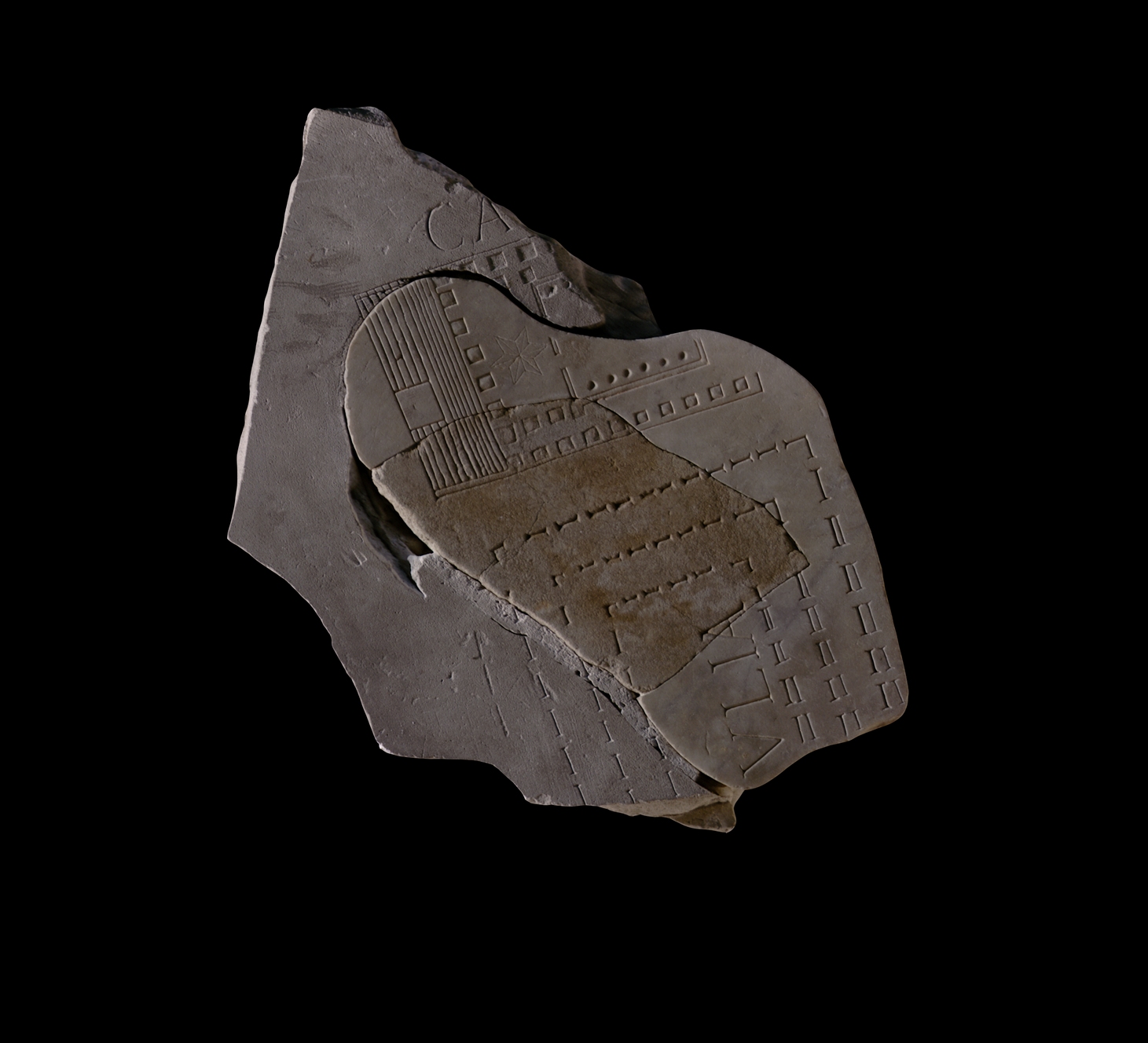
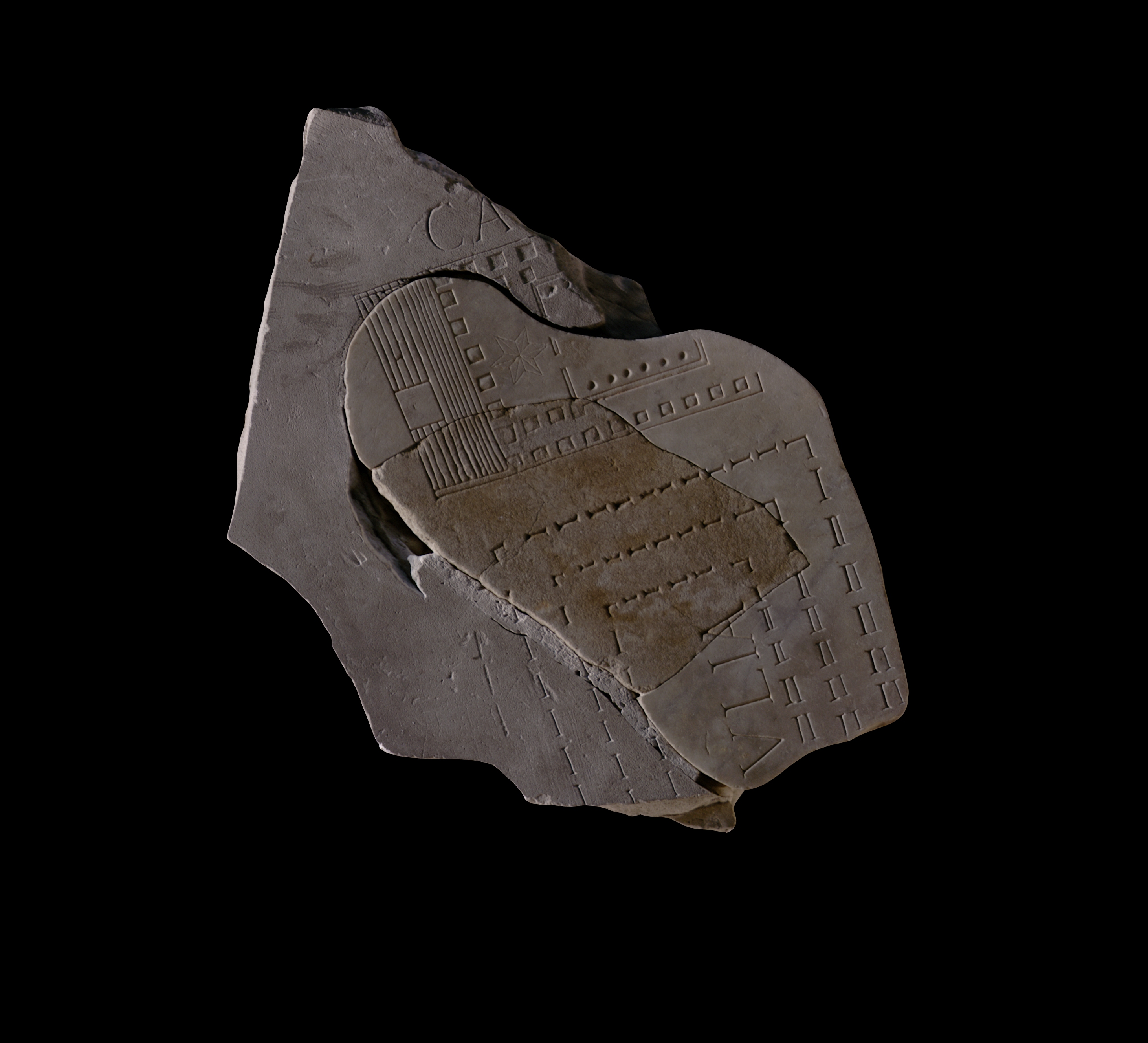
| Description Only the central, somewhat discolored piece of this group is ancient; this is fragment 18c and includes the letter A. Fragment 18b, known in the 17th c. but now lost, has been recreated in plaster here (note the six-pointed star that identifies this kind of recreation). It is the lighter piece below and to the right of the ancient piece and includes the letters VLI. The piece on the left and above the ancient fragment, including the letters CA, is also modern and made of plaster, but since it is a projection based on the other two pieces and does not itself correspond to any known fragment, this piece has no number.
The top half of this group depicts a podium temple fronted by a wide flight of eleven steps. In the center of the lowest five steps sits an altar or platform. Eight columns stand in front of the cella and there are eleven along the sides. On the drawing of the lost fr. 18c, there are no columns behind the cella, either because that was the situation on the lost fragment, or because the fragment was damaged at this point. The rows of columns are doubled along each side of the pronaos. Inside the cella, small columns stand along the long sides. The exterior columns and the cella walls were carved in outline and recessed; they would have stood out clearly on the Plan, as they were originally filled with red inscription paint.
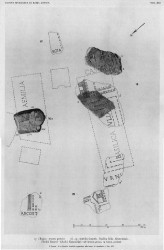
Below the temple and across a street lies a large, rectangular building that consists of two colonnades surrounding a central nave. In the central nave the letters VLIA are inscribed. (The modern plaster reconstruction does not replicate the errors or corrections of scale visible on the Renaissance drawing of the lost fragment 18b [PM 1960, pl. 9], but it does contain errors and corrections of its own, visible in the double marks depicting single colonnades on the right side of the building.)
Identification: Aedes Castoris This octastyle podium temple is identified by an inscription on the nearby fragment 18a as the Temple of Castor in the Forum Romanum (PM 1960, p. 75). Livy (2.20.12, 2.42.5) and Dionysius of Halicarnassus (Ant. rom. 6.13) reveal the early history of the building: Vowed in 499 or 496 BCE by the dictator Postumus, the temple was dedicated in 484 BCE by his son in the very spot where Castor and Pollux had appeared after the battle of Lake Regillus (LTUR I, p. 242). The building was restored in 117 BCE and in 74 BCE, it was rebuilt by Tiberius, converted into a vestibule for Caligula's palace, and restored by Claudius. It served as a meeting place for the senate and as a bank; rooms in the foundation functioned as shops; and the platform in front was for a long period the main tribunal in the Forum for judicial and legislative gatherings (LTUR I, pp. 242-243).
Most parts of this representation match what is known from excavations: the temple's location next to the Basilica Iulia, the podium, the number of columns along the front and the sides, the shape of the cella, and perhaps even the small columns lining the inside of the cella (LTUR I, p. 244-245). Excavations have also shown that the temple was peripteral, but the drawing of the lost fragment 18b depicts no columns behind the cella. A close look at the Renaissance drawing (see PM 1960, pl. 9, above) suggests that the fragment was damaged here, so the apparent discrepancy may not be a real one. Harder to reconcile with the evidence of excavation is the front staircase. The Plan shows what must have been a post-Augustan but pre-Severan restructuring. The remains of the Augustan temple include a wide platform or tribunal, accessed by lateral stairs and placed below the equally wide staircase that led to the pronaos. At some point before the carving of the Severan Plan, however, these were merged into one wide, frontal staircase (LTUR I, p. 245).
Identification: Basilica Iulia The colonnaded building below the Temple of Castor is the Basilica Iulia in the Roman Forum (PM 1960, p. 75). Julius Caesar began the construction of this building in 54 BCE along the SW side of the Forum, between the vicus Tuscus and the vicus Iugarius, on the site of the earlier, 2nd-century basilica by T. Sempronius Gracchus (basilica Sempronia), and it was inaugurated, still incomplete, in 46 BCE. Augustus finished the building, and in 12 BCE he reconstructed it after a fire and dedicated it in the names of his grandsons, Gaius and Lucius (LTUR I, p. 177). In 283 CE it was again destroyed by fire, and it was reconstructed by Diocletian and Maximinus. In addition to providing space for sessions of the centumviral court, the building seems to have served as a venue for banking and other financial business (LTUR I, p. 177).
The foundation of the Basilica is still visible today. It shows that the marble-revetted building measured 101 x 49 m., and that it consisted of a central nave surrounded by two arcaded aisles with second-storey galleries above. Tabernae flanked it along the back. The representation of the building in this fragment and in the missing frs. 18b and 18d matches this layout. Missing from the Marble Plan, however, are the stairs along the entire front of the Basilica on the Forum side and the elongated tabernae that lined it on the Palatine side (see LTUR I, fig. 93).
Identification: Vicus Tuscus
The street that separates the Temple of Castor from the Basilica Iulia has been identified as the Vicus Tuscus, or "Etruscan Street" (PM 1960, p. 75), the main route between the Roman Forum and the lower Forum Boarium, and from there to the Circus Maximus (Richardson 1992 p. 429).
Significance The political, religious, monumental and symbolic core of Rome, the Roman Forum is a crucial area for our knowledge of Roman topography. Unfortunately, the section of the Marble Plan that depicted this area was largely destroyed in the early 5th cent. when the wall of the aula was perforated here to create a passageway (AG 1980, p. 21; schematic rendering of the wall in PM 1960, p. 180). This fragment is important because it is one of the very few surviving pieces of the Plan that depicts a section of this nodal point in the ancient city.
|
|
| HISTORY OF FRAGMENT |
| Like the majority of FUR fragments, both frs. 18b and c were discovered in 1562 in a garden behind the Church of Saints Cosmas and Damian. From here, they were transferred to the Palazzo Farnese and stored there. Renaissance engravers reproduced them in 16th-c. drawings that are now kept in the Vatican (Cod. Vat. Lat. 3439), and Giovanni Pietro Bellori included them in his 1673 publication. The whereabouts of fragment 18b after this date are unknown. (This fragments history corresponds to Iter D as summarized in PM 1960, p. 56.) In 1742, fr. 18c was moved to the Capitoline Museums and exhibited with some of the other known fragments in wooden frames along the main staircase. In 1903, museum curators included the piece in a reconstruction of the FUR on a wall behind the Palazzo dei Conservatori (1903-1924). Since then, the fragment has been stored with the others in various places: the storerooms of the Antiquarium Comunale (1924-1939), the Capitoline Museums again (1939-1955), the Palazzo Braschi (1955-1998), and since 1998 in the Museo della Civiltà Romana in EUR under the auspices of the Sovraintendenza ai Beni Culturali del Comune di Roma. (This fragments history corresponds to Iter B as summarized in PM 1960, p. 56.)
Text by Tina Najbjerg and Jennifer Trimble |
|
| KEYWORDS
|
| basilica, temple, cella, podium, steps, pronaos |
|
 Prev
Prev