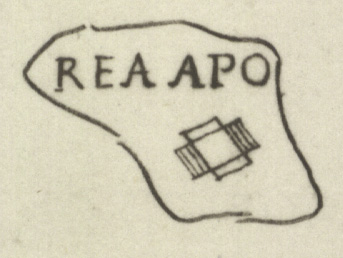
ID AND LOCATION
| Stanford #
| 20e |
| AG1980 #
| 20e |
| PM1960 #
| 469 a |
| Slab #
| VII-12 |
| Adjoins
| 20fg |
CONDITION
| Located
| true |
| Incised
| true |
| Surviving
| false |
| Slab Edges
| 0 |
| Clamp Holes
| 0 |
| Tassello
| no | |
|
|
|
|
|
BIBLIOGRAPHY
- AG 1980, pp. 99-100, pl. 14
- Cecamore 1994-95
- LTUR I: Area Apollinis, pp. 112-113; Area Apollinis (Palatium)(E. Rodríguez-Almeida), p. 113
- LTUR IV: Roma Quadrata (F. Coarelli), pp. 207-209
- PM 1960, p. 143, pls. 13, 50
- Richardson 1992, p. 31 (Area Apollinis); p. 333 (Roma Quadrata)
|
|
|
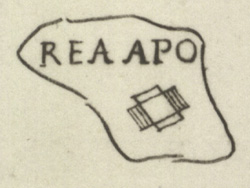
Detail from Cod. Vat. Lat. 3439 - Fo 22r,
reproduced from PM 1960, pl. 13 | |
PM 1960 Plates: 13 50
AG 1980 Plates: 14
|
|
| IDENTIFICATION |
| Renaissance drawing: Platform with dual stairs (the Roma Quadrata?) in the Area of Apollo (area Apollinis) on the Palatine
|
|
| INSCRIPTION
Epigraphic conventions used |
| Transcription |
| None; most of the fragment is missing
|
| Renaissance Transcription |
| [---]REA APO[---]
|
| Reconstruction |
| [A]REA APO[LLINIS] (PM 1960; AG 1980)
|
|
|
|
|
|
| ANALYSIS
|
| Description The fragment is lost but Renaissance drawing Cod. Vat. Lat. 3439 - Fo 22 r shows it as it looked before it broke off from fr. 20fg (see detailed photo above or PM 1960, pl. 13, no. 22). It depicted an open space with the letters [---]REA APO[---] at top. Below the inscription a small rectangle was visible. The rest of this feature is visible in fr. 20fg. It shows cruciform structure that seems to have consisted of a raised platform that was approached from two sides by wide steps. The other two sides were either rectangular additions to the square platform or represented two more sets of steps (with the individual steps missing from the drawing).
Identification: Area Apollinis The inscription area Apollinis does not label the square feature but seems to identify the space around it as belonging/dedicated to Apollo (PM 1960, p. 143). Although the Regionary Catalogues place the area Apollinis et Splenis in Regio 1 (LTUR I, pp. 112-113), E. Rodríguez-Almeida has located this fragment, the joining fr. 20fg, and fr. 20h on in slab 50 which covers the Palatine. The similar thickness and veining direction of frs. 20fg and 20h to other FUR pieces from the Palatine area confirm this location (AG 1980, p. 99). Proposing that the letters [---]INI[---] in fr. 20h are part of the [A]REA APO[LLINIS] inscription, Rodríguez-Almeida suggests that the colonnade visible in fr. 20h surrounded the square, stepped feature in this and in fr. 20fg. He further identified this colonnaded area as the Phoebi porticus mentioned by Propertius (2.31.1-2) or the porticus ad Apollinis mentioned by Suetonius (Aug. 29.4), by Augustus (R. Gest. div. Aug. 19.1), and by Cassius Dio (53.1)(LTUR I, p. 113). He situates the cruciform structure in this fragment in front of the Temple to Apollo but admits that a major problem with this interpretation is that excavations on the Palatine in front of the temple have not revealed any remains that might match this structure (LTUR I, p. 113). C. Cecamore has solved this problem by sliding FUR frs. 20e, 20fg and 20h slightly north (down and to the left on the map); in this position, the cruciform feature matches foundations discovered SW of the Temple to Apollo (Cecamore 1994-95, p. 28, fig. 21). She points out that this adjusted position also aligns the colonnade visible in fr. 20h with the corner of the colonnade seen south of the libraries in the missing fr. 20b.
Identification: Roma Quadrata? Rodríguez-Almeida suggests that the cruciform structure in this fragment either represented an altar or the monumental statue base that was decorated with the armenta Mironis (Prop. 2.31.5-8)
and/or carried the large statue of Apollo Citharedus (Prop. 2.31.5-8), shown on an Augustan coin (AG 1980, pp. 99-100; LTUR I, p. 113). Cecamore's repositioning of the fragment, however, makes this association impossible. A convincing thesis has been proposed by F. Coarelli, who identifies the feature as the Roma quadrata, a name that seemingly defines both the augural area on the Palatine, the borders of which were laid out by Romulus, and a shrine in the area Apollinis that supposedly consisted of a raised platform (LTUR IV, p. 209).
Significance Rodríguez-Almeida and Cecamore's positioning of this missing fragment helps identify the feature depicted in it and greatly improves our knowledge of the complicated archaeology around the Temple of Apollo on the Palatine. |
|
| HISTORY OF FRAGMENT |
| Originally part of a larger piece, this fragment was discovered in 1562 in a garden behind the Church of Saints Cosmas and Damian. From here, it was transferred to the Palazzo Farnese and stored there. Renaissance engravers reproduced the fragment in its entirety in 16th-c. drawings that are now kept in the Vatican (for more information about the creation and accuracy of these drawings, see Cod. Vat. Lat. 3439), and Giovanni Pietro Bellori included it in his 1673 publication. Some time thereafter the piece broke in three and only sections 20fg survived. The whereabouts of this fragment, section e, after this date are unknown. (This fragments history corresponds to Iter D as summarized in PM 1960, p. 56.)
Text by Tina Najbjerg
|
|
| KEYWORDS
|
| steps, cruciform structure, platform, staircases, open area, augural area, temple to Apollo, monument, shrine, altar? statue base? |
|
 Prev
Prev