ID AND LOCATION
| Stanford #
| 20fg |
| AG1980 #
| 20f-g |
| PM1960 #
| 469 b c |
| Slab #
| VII-12 |
| Adjoins
| 20e |
CONDITION
| Located
| true |
| Incised
| true |
| Surviving
| true |
| Subfragments
| 2 |
| Plaster Parts
| 0 |
| Back Surface
| smooth |
| Slab Edges
| 0 |
| Clamp Holes
| 0 |
| Tassello
| no |
TECHNICAL INFO
|
|
|
|
|
|
BIBLIOGRAPHY
- AG 1980, pp. 99-100, pl. 14
- Cecamore 1994-95
- LTUR I: Area Apollinis, pp. 112-113; Area Apollinis (Palatium)(E. Rodríguez-Almeida), p. 113
- LTUR IV: Roma Quadrata (F. Coarelli), pp. 207-209
- PM 1960, p. 143, pls. 13, 50
- Richardson 1992, p. 31 (Area Apollinis); p. 333 (Roma Quadrata)
|
|
|
|
|
| ANALYSIS
|
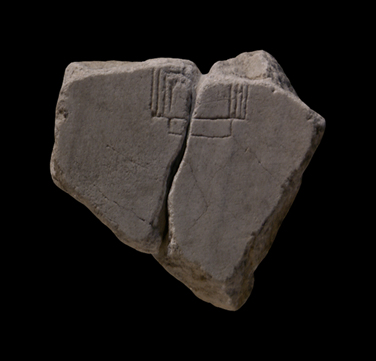
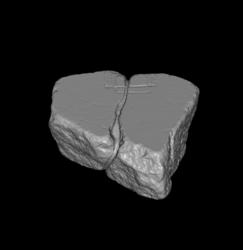
| Description The joining fragments depict an open space with a square platform at top center. The platform was approached from two sides by wide steps and seems to have had a small, rectangular addition at the bottom.
Identification: Area Apollinis As visible in Renaissance drawing Cod. Vat. Lat. 3439 - fo 22r, the now missing fragment 20e
joined with this fragment and thus depicted the rest of the platform. The drawing shows that the bottom addition was mirrored by one at top, giving the entire structure its cruciform shape. The two rectangular additions perhaps represented two more sets of staircases with the individual steps omitted. The Renaissance drawing also shows that the partial inscription [---]REA APO[---] appeared above the platform at top. The inscription, identified by C. Hülsen as [A]REA APO[LLINIS], did not label the platform, however, but seemed to have designated the area around it (PM 1960, p. 143). The Regionary Catalogues place an area Apollinis et Splenis in Regio 1, but a similar name is believed to have designated the area around or near the Temple of Apollo on the Palatine (LTUR I, pp. 112-113; PM 1960, p. 143). According to PM 1960, p. 143, there is not enough evidence to locate this fragment in either of those areas; E. Rodríguez-Almeida, however, has placed this fragment, the joining fr. 20fg, and the nearby fr. 20h in slab 50 which covers the Palatine. The similar thickness and veining direction of these fragments to other FUR pieces from the Palatine area confirm this location (AG 1980, p. 99). Proposing that the letters [---]INI[---] in fr. 20h belong to the [A]REA APO[LLINIS] inscription, Rodríguez-Almeida suggests that the colonnade visible in fr. 20h surrounded the platform depicted here and in fr. 20fg, and he identifies this colonnaded area as the Phoebi porticus mentioned by Propertius (2.31.1-2) or the porticus ad Apollinis mentioned by Suetonius (Aug. 29.4), by Augustus (R. Gest. div. Aug. 19.1), and by Cassius Dio (53.1)(LTUR I, p. 113). He situates the cruciform structure in this fragment directly in front of the Temple to Apollo but admits that excavations on the Palatine in front of the temple have not revealed any remains that might match this structure (LTUR I, p. 113). C. Cecamore has solved this problem by sliding FUR frs. 20e, 20fg and 20h slightly north (down and to the left on the map); in this position, the cruciform feature matches foundations discovered SW of the Temple to Apollo (Cecamore 1994-95, p. 28, fig. 21). She points out that this adjusted position also aligns the colonnade visible in fr. 20h with the corner of the colonnade seen south of the libraries in the missing fr. 20b.
Identification: Roma Quadrata? Rodríguez-Almeida has suggested that the cruciform structure in this fragment either represented an altar, the monumental statue base that was decorated with the armenta Mironis (Prop. 2.31.5-8), or a statue base that carried the large statue of Apollo Citharedus (Prop. 2.31.5-8) as shown on an Augustan coin (AG 1980, pp. 99-100; LTUR I, p. 113). Cecamore's repositioning of the fragment, however, makes this association unlikely. A more convincing thesis has been proposed by F. Coarelli, who identifies the feature as the Roma quadrata, a name that seemingly defined both the augural area on the Palatine, the borders of which were laid out by Romulus, and a shrine in the area Apollinis that supposedly consisted of a raised platform (LTUR IV, p. 209).
Significance Rodríguez-Almeida and Cecamore's positioning of this missing fragment helps identify the feature depicted in it and greatly improves our knowledge of the complicated archaeology around the Temple of Apollo on the Palatine.
|
|
| HISTORY OF FRAGMENT |
| Renaissance drawing Cod. Vat. Lat. 3439 - fo 22r shows that these fragments were originally part of a larger fragment (fr. 20e) that was discovered in 1562 in a garden behind the Church of Saints Cosmas and Damian like the majority of FUR fragments. From here, it was transferred to the Palazzo Farnese and stored there. As mentioned, Renaissance engravers reproduced the fragment in 16th-c. drawings that are now kept in the Vatican and and Giovanni Pietro Bellori included it in his 1673 publication. At some point after that, the piece sustained damage and the upper part disappeared. In 1742, the two remaining pieces were moved to the Capitoline Museums and exhibited with some of the other FUR fragments in wooden frames along the main staircase. Since then, the fragments have been stored with the other known FUR fragments in various places: the storerooms of the Capitoline Museums (1903-1924), the Antiquarium Comunale (1924-1939), the Capitoline Museums again (1939-1955), the Palazzo Braschi (1955-1998), and since 1998 in the Museo della Civiltà Romana in EUR under the auspices of the Sovraintendenza ai Beni Culturali del Comune di Roma. (The history of these fragments corresponds to Iter B as summarized in PM 1960, p. 56.)
Text by Tina Najbjerg |
|
| KEYWORDS
|
| steps, cruciform structure, platform, staircases, open area, augural area, temple to Apollo, monument, shrine, altar?, statue base? |
|
 Prev
Prev