ID AND LOCATION
| Stanford #
| 21a |
| AG1980 #
| 21a |
| PM1960 #
| 21 a |
| Slab #
| VII-14 |
| Adjoins
| 21b 21c 21d |
CONDITION
| Located
| true |
| Incised
| true |
| Surviving
| true |
| Subfragments
| 1 |
| Plaster Parts
| 0 |
| Back Surface
| smooth |
| Slab Edges
| 1 |
| Clamp Holes
| 1 |
| Tassello
| no |
TECHNICAL INFO
|
|
|
|
|
|
|
|
|
|
|
| ANALYSIS
|
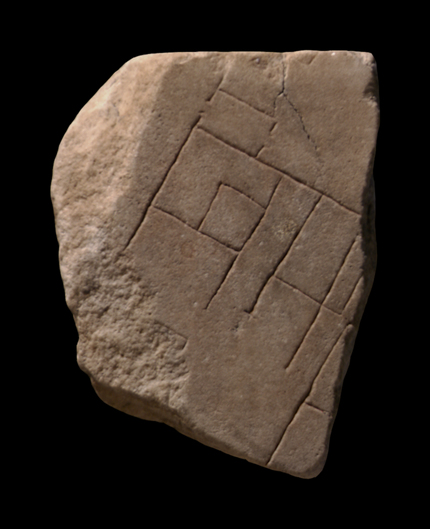
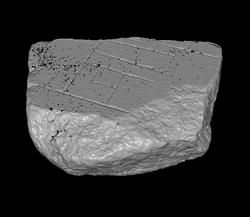
| Description The fragment was part of a slab edge; a partial clamp hole is visible. It depicts a rectilinear structure with smaller, internal rooms of varying sizes and shapes. Three of these show no means of access, while an elongated room in the center rear opens onto a larger open space, shaped as an L, at the bottom of the fragment. The left side of the structure seems to face a street. A large room with a small entry hall in the lower left corner adjoins the multi-roomed structure at top left, although there does not seem to have been ready access between the two.
Identification: The Baths of L. Licinius Sura The fragment joins with frs.
21b (missing),
21c, and
21d
to form the corner of a slab. The two clamp holes in the group (one in this fragment, another in fr. 21d) locate the ensemble precisely in the upper right corner of slab VII-14 (PM 1960, p. 79). This location is further confirmed by the inscription in frs. 21b and c which identifies the building depicted here as the balneum Surae, a bathing complex known from the Regionary Catalogues to have been situated in Regio XIII, on the Aventine Hill. In the Regionary Catalogues, the bath is listed under the name thermas Surae/Syres, while an inscription discovered during the reconstruction of the Convent of Santa Sabina (CIL 6.40690) refers to it as the balneum Surae, the name also used on the Severan Plan (LTUR V, p. 65). L. Richardson also attributes the inscription CIL 6.1703, which mentions a cella tepidaria, to this complex although this thesis is not generally accepted (Richardson 1992, p. 396). According to ancient sources, the baths were built by L. Licinius Sura, friend of the emperor Trajan, or by Trajan in honor of his friend, and they were later restored by Gordian III (LTUR V, p. 65). Traditionally, the balneum Surae is associated with remains of a bath structure of Trajanic date uncovered north of the Via di Santa Prisca; and the large street running in front of the baths (visible in frs. 21b, c and d) is generally identified as the clivus Publicus, modern Via di Santa Prisca (LTUR V, p. 65; Richardson 1992, p. 396). A different proposal locates the complex to an area south of the Via di Santa Prisca, more precisely in the corner of Via di Santa Prisca and Via di Santa Sabina, where it would coincide with the remains of a bath structure of similar layout to what is depicted on the FUR fragments (LTUR V, p. 65).
As revealed by FUR fragment group 21, the bath complex consisted of a rectangular (?) structure, faced on the south by a row of outward-facing tabernae. An entrance at either end of the shops led to the bath area proper; the one furthest south was a double entrance, easily surveilled from a small guard room on the right. The entrances led to a large, L-shaped space surrounded on three sides by porticoes, probably functioning as the palaestra. In the N corner of the complex lay a series of interconnected rooms, the baths proper, and a group of small, multi-storeyed rooms that probably functioned as the dressing and service area for that particular section of the baths (LTUR V, p. 65). The smaller L-shaped space seen in this fragment may have enclosed a natatio, the corner of which is just visible in the lower left corner here. The room in the upper right corner of this fragment may have served as an entrance to the baths from the opposite side. On the S short side, the palaestra was flanked by another series of interconnected rooms. This section of the baths seems to have been accessible from the palaestra only via one small opening, and from the street via another small opening in the southernmost corner room. May this section have functioned as a separate bathing section designated for women? The layout of the balneum Surae complex is often compared to the Central Baths in Pompeii, which also featured bathing rooms surrounding a central palaestra and a facade lined with tabernae (LTUR V, p. 65; Richardson 1992, p. 396). The Pompeian structure did not, however, have a separate section for women.
Significance Fragment group 21 illustrates well how the size and layout of smaller neighborhood baths were adjusted to fit into the surrounding cityscape. L. Licinius Sura may have demolished a house or two to build this bathing establishment, but this pales in comparison to the entire neighborhood which his friend Trajan must have destroyed in order to construct his gargantuan thermae in the Subura (see thermae Traiani). The fragments witness the continued importance of smaller neighborhood baths throughout the Imperial period in Rome.
|
|
| HISTORY OF FRAGMENT |
| This fragment was originally part of one large piece, consisting of frs. 21abcd, that was discovered in 1562 in a garden behind the Church of Saints Cosmas and Damian. The large piece was transferred to the Palazzo Farnese and stored there. Renaissance engravers reproduced it in 16th-c. drawings that are now kept in the Vatican (for more information about the creation and accuracy of these drawings, see Cod. Vat. Lat. 3439), and Giovanni Pietro Bellori included it in his 1673 publication of the Plan. At some point thereafter, the piece broke and section 21b disappeared. The remaining three pieces a, c, and d were moved to the Capitoline Museums and exhibited with some of the other known fragments in wooden frames along the main staircase. In 1903, museum curators included them in a reconstruction of the FUR mounted on a wall behind the Palazzo dei Conservatori (1903-1924). Since then, the three fragments have been stored with the other known FUR fragments in various places: the storerooms of the Antiquarium Comunale (1924-1939), the Capitoline Museums again (1939-1955), the Palazzo Braschi (1955-1998), and since 1998 in the Museo della Civiltà Romana in EUR under the auspices of the Sovraintendenza ai Beni Culturali del Comune di Roma (PM 1960, p. 79).
Text by Tina Najbjerg
|
|
| KEYWORDS
|
| baths, balneum, balnea, palaestra, columns, colonnade, shops, tabernae, street, guard's room, stairs |
|
 Prev
Prev