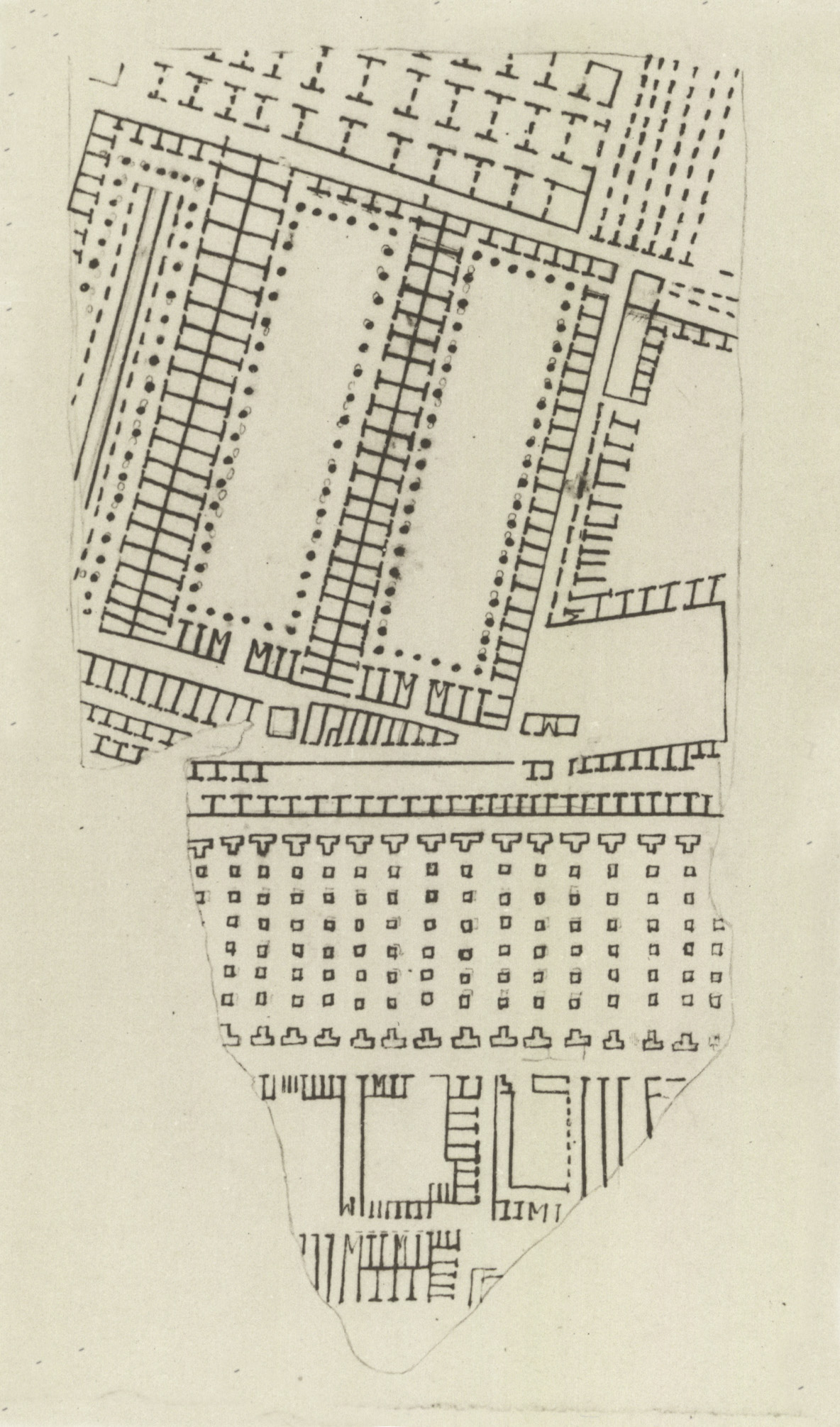
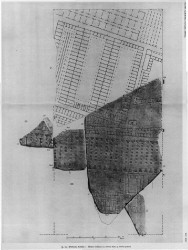
| Description This large fragment, now missing, made up the entire upper half of slab VII-18. Fortunately, a Renaissance drawing, Cod. Vat. Lat. 3439 - Fo 15r (see photo detail above or PM 1960, pl. 4), shows the piece as it looked when still joined with fr. 24c. The fragment depicted sections of four large buildings, engraved at an oblique angle across the marble piece. Narrow streets separated the buildings from each other. The structure in the top left corner was divided into three long rows of rooms by two narrow passages. The rooms in the central row had openings at both ends, while those in the top and bottom rows opened inwards. All rooms had access to each other via two openings in their side walls. A few of the rooms to the left in the bottom row also seemed to be accessible from the outside. Below this building lay a structure that consisted of three parallel, joining courtyards. Each courtyard was flanked on all sides by inward-facing rooms and by an inner colonnade. In the leftmost courtyard, a central feature rendered as a double track with a stipled line on each side, may have represented a water basin surrounded by arcades (AG 1980, p. 103). Stairs flanking the central openings at the bottom of the two courtyards on the right demonstrate that these were multi-storeyed. The building in the top right corner of the fragment consisted of six long, parallel arcades. Finally, the building below it was an open courtyard that was surrounded on at least three sides by inward-facing rooms. Some of the rooms on the left side also opened onto the arcade that flanked that side of the building. A double arcade faced it a top, and two rooms, one long and seemingly inaccessible, the other small with an opening into the top arcade, were situated in the top left corner.
Identification: Praedia et horrea Galbana The large structures visible in this lost fragment were part of a large imperial estate, the praedia Galbae or Galbana (PM 1960, pp. 81-82; AG 1980, pp. 102-105). Originally belonging to the family of Servius Sulpicius Galba, probably the praetor of 187 BCE, the private estate later became imperial property, most likely during the reign of Galba (LTUR III, p. 40). The proximity of a funerary monument (visible in fr. 24c) to a later family member of the same name, perhaps the consul of 144 BCE (Ferrea 1998) or of 108 BCE (F. Coarelli, LTUR III, p. 42) confirms the identity of the republican property, which may at an earlier state have been called the praedia Sulpicia and have incorporated the horrea Sulpicia, mentioned by Horace (Carm. 4.12.18)(LTUR II, p. 40). Archaeological evidence recorded by Lanciani and FUR fragments 24a, 24c, and, as suggested by E. Rodríguez-Almeida (1977-1978, pp. 18-21, figs. 3, 5), frs. 91 and 107 demonstrate that the enormous estate at the foot of the Aventine Hill during the Empire stretched from the porticus Aemilia in the north and to an unknown area beyond the Monte Testaccio in the south (LTUR II, p. 43; Rodríguez-Almeida 1977-1978, fig. 5). The abundant epigraphical evidence suggests that the residential spaces of the imperial complex gradually yielded to large warehouses for the storage of the public grain supply, and of oil, wine, food, clothing, and marble (LTUR II, p. 41; Richardson 1992, p. 193). The mountain of discarded amphoras that constitutes the nearby Monte Testaccio is a testimony to the large scale operation of these horrea. Inscriptions also suggest that the many warehouse workers, variously referred to as horrearii, operarii Galbenses, or Galbenses, to name a few, were organized into three cohortes, and that there were different collegia, or societies to which they could belong (LTUR II, p. 41; see also Bollmann 1998, cat. no. A21). The latter implies that the complex included scholae for the meetings of these collegia, and most likely also bathing establishments, both of which are probably included in the neighboring horrea Lolliana, visible in fr. 25.
The function of the three parallel buildings that occupy the bottom two thirds of this fragment has been disputed. G. Gatti suggested with some reservation that they constitute the actual warehouses (PM 1960, p. 81, n.4). E. Rodríguez-Almeida, however, proposed that they served as living quarters, ergastula, for the workers, and that THEY are the three cohortes mentioned in various inscriptions (Rodríguez-Almeida 1977-78, p. 20). He identified the two parallel lines in the courtyard of the easternmost structure (only visible in this fragment) as a wash basin (lavacrum) flanked by arcades, a feature that makes more sense in a residential unit than in a warehouse. The actual warehouses he situated further south, closer to the Monte Testaccio. This interpretation is accepted by F. Coarelli (LTUR III, pp. 41-42), yet it remains somewhat problematic. First of all, warehouses are likely to be situated as close to the Tiber as possible in order to minimize the effort of carrying the goods from the river to the storage areas. Their proximity to the dumping grounds of the Monte Testaccio must be of secondary concern. Secondly, the layout of these buildings is similar to horrea depicted and labeled elsewhere on the FUR (see fr. 25a) and to actual remains in Ostia (see Staccioli 1962). Third, the restricted and easily guarded accesses to these buildings suggest they contained valuable goods rather than functioned as residences for workers. Furthermore, if the elongated channel in the leftmost building is a wash basin for the workers, as proposed by Rodríguez-Almeida, why is there not one in each of the three units? In addition, the assumption that a water source is more useful in a residential unit than in a storage area for grain is not neccessarily true. Grain, when overheated, can easily burst into flames, and it would indeed be vital to have water close at hand to extinguish a small fire before it could spread to other compartments and potentially destroy the entire public grain supply. Finally, excavations of the easternmost court show that it had raised floors, a feature not likely to be found in the living quarters of slaves but essential for creating a draft underneath areas used for grain storage, as seen in several instances in Ostia and Portus (Rickman 1971, p. 103).
The small, rectangular feature in the bottom left corner of the large piazza has been identified as a neighborhood shrine (see Sartorio 1988, p. 32).
Significance The missing fragment and its reproduction in a Renaissance drawing are key to our knowledge of a large section of the praedia et horrea Galbana, in this case perhaps to some of the warehouses themselves or to the living quarters of the many workers on the imperial estate. The layout of the buildings in this fragment reveal a great deal about the organization of this enormous complex: The buildings are situated close to each other, with only narrow streets separating them, suggesting that space is scarce and valuable. The rectilinear grid of the buildings here indicates that they were constructed at the same time; their oblique angle to the porticus Aemilia to the NW, however, indicates that they were built later than this republican structure. They were probably part of the imperial expansion of the formerly private estate.
|
 Prev
Prev