ID AND LOCATION
| Stanford #
| 24b(*) |
| AG1980 #
| 24b |
| PM1960 #
| 24 b |
| Slab #
| VII-18 |
| Adjoins
| 23 24c |
CONDITION
| Located
| true |
| Incised
| true |
| Surviving
| true |
| Subfragments
| 1 |
| Plaster Parts
| 0 |
| Back Surface
| rough |
| Slab Edges
| 1 |
| Clamp Holes
| 1 |
| Tassello
| no |
TECHNICAL INFO
|
|
|
|
|
|
BIBLIOGRAPHY
- AG 1980, p. 102, pl. 16
- Gatti 1934
- LTUR II: Emporium (C. Mocchegiani Carpano), pp. 221-223
- LTUR IV: Porticus Aemilia (F. Coarelli), pp. 116-117, fig. 45
- PM 1960, pp. 81-82, fig. on p. 95, pls. 24, 62
- Reynolds 1996, pp. 74-44
- Richardson 1992, Emporium, pp. 143-144; Porticus Aemilia (1), p. 311
- Tuck 2000
|
|
|
|
|
| ANALYSIS
|
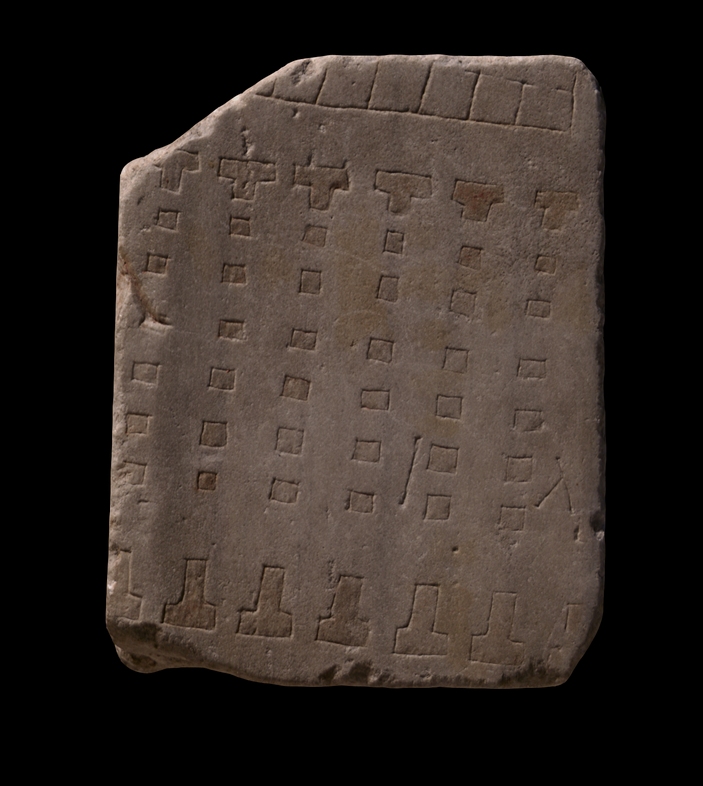
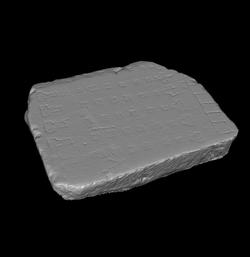
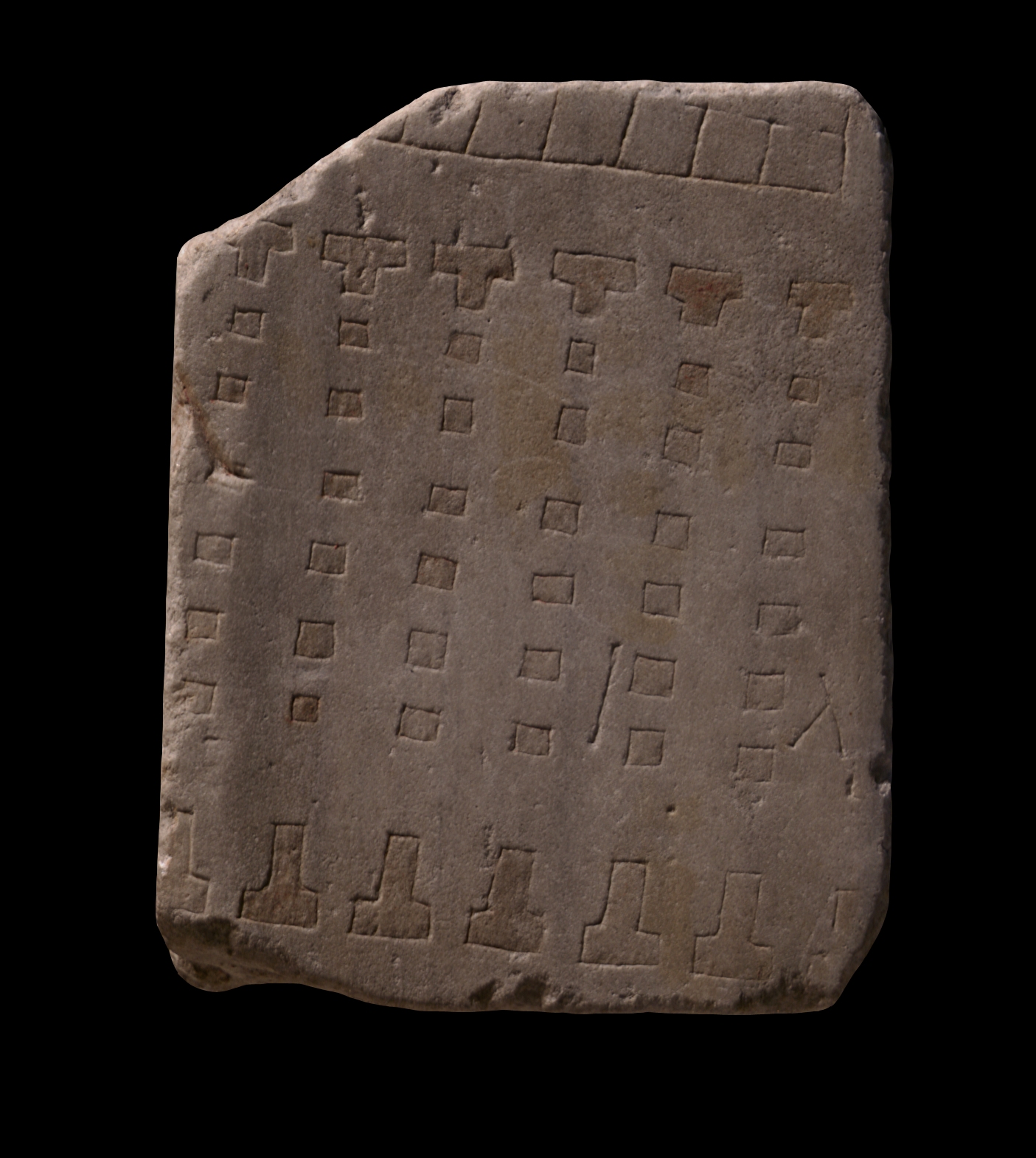
| Description The fragment was part of a slab edge; a clamp mark is partially visible in the lower left corner. A vertical row of tabernae with back rooms is visible at the top. Below these tabernae, and across a narrow street, lies a large structure, that seems to have consisted entirely of rows of square piers, eight sections deep and at least eight sections wide. Arcaded walls made up both the front and the back of the building. While the tabernae at top are drawn with a single line, as is usual on the Plan, all piers and the arcaded walls of the large building are rendered in outline and recessed. Traces of minium survive in these outlined piers. The right leg of a large letter, A?, is visible along the left edge, and there are faint traces of two, perhaps three, more letters below it, perhaps spelling [---]LIA. The latter were perhaps intended as a "draft" for the permanent inscription and intended to be fully erased (AG 1980, p. 102).
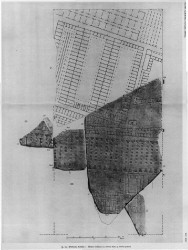
Identification: Porticus Aemilia Together with fragments 23, 24c, and the missing fr. 24a, this piece depicts a section of the porticus Aemilia (PM 1960, p. 81-82; AG 1980, p. 102). Formerly believed to represent the saepta Iulia, the structure was correctly identified by G. Gatti on basis of the inscription in fr. 23 and on his comparison of the architecture depicted here with the archaeological remains discovered between the Tiber and the Aventine Hill (Gatti 1934, pl. 2. See also LTUR IV, fig. 44). This interpretation is generally accepted now, with a few exceptions (see Richardson 1992, p. 143, and Tuck 2000).
The porticus Aemilia was constructed in 193 BCE by the aediles M. Aemilius Lepidus and M. Aemilius Paullus (Livy 35.10.12) and restored in 174 BCE by the censors Q. Fulvius Flaccus and A. Postumius Albinus (Livy 41.27.8) - probably as part of the large complex of warehouses and markets by the Tiber called the Emporium (LTUR IV, pp. 116-17). The present remains of the porticus Aemilia, stretching between Via B. Franklin and the Via Marmorata, between the Via G. Branca and the Via A. Vespucci, demonstrate that the gargantuan building measured 487 m. in length and 90 m. in width (LTUR IV, p. 117). It was constructed as a wide staircase on the downward gradient towards the Tiber, parallel to the river (Gatti's division of the structure into four wide steps is not indicated on the Marble Plan). Walls, pierced by arched openings, ran perpendicular to the long front and back walls and divided the building into 50 spaces; each space was covered by a barrel vault and backed and fronted by an arched opening in the long outer walls (see reconstruction in Gatti 1934, pl. 4 or LTUR IV, fig. 45). The function of the building is uncertain. Unless the many openings were separated by wooden partitions, it is unlikely to have served as a warehouse. Its architecture does not conform to what we normally associate with a porticus, which is a large, open space surrounded on three or four sides by covered colonnades. Why this building was highlighted on the Plan with rendering in outline and recessed areas, a technique usually reserved for temples (Reynolds 1996, pp. 74-77) and important public monuments, is also uncertain.
Significance Fragments 23, 24b, and 24c were key elements in securing the identification of the remains of a large republican building of opus incertum, discovered near the Tiber and south of the Aventine, as being those of the porticus Aemilia.
Why this building was highlighted on the Plan with rendering in outline and recessed areas, a technique usually reserved for temples (Reynolds 1996, pp. 74-77) and large-scale public monuments, is uncertain.
|
|
| HISTORY OF FRAGMENT |
| Like the majority of FUR fragments, this piece was discovered in 1562 in a garden behind the Church of Saints Cosmas and Damian. From here, it was transferred to the Palazzo Farnese and stored there. It was not among the fragments that were reproduced in the Renaissance drawings that are now kept in the Vatican, but Giovanni Pietro Bellori included it in his 1673 publication. In 1742, it was moved to the Capitoline Museums and exhibited with some of the other known fragments in wooden frames along the main staircase. In 1903, museum curators included the fragment in a reconstruction of the FUR mounted on a wall behind the Palazzo dei Conservatori (1903-1924). Since then, the fragment has been stored with the other known FUR fragments in various places: the storerooms of the Antiquarium Comunale (1924-1939), the Capitoline Museums again (1939-1955), the Palazzo Braschi (1955-1998), and since 1998 in the Museo della Civiltà Romana in EUR under the auspices of the Sovraintendenza ai Beni Culturali del Comune di Roma. (This fragment's history corresponds to Iter E as summarized in PM 1960, p. 56.)
Text by Tina Najbjerg and Jennifer Trimble |
|
| KEYWORDS
|
| piers, warehouse, market |
|
 Prev
Prev