ID AND LOCATION
| Stanford #
| 2b |
| AG1980 #
| 2b |
| PM1960 #
| 2 b |
| Slab #
| XI-10 |
| Adjoins
| 2a |
CONDITION
| Located
| true |
| Incised
| true |
| Surviving
| false |
| Slab Edges
| 2 |
| Clamp Holes
| 0 |
| Tassello
| no | |
|
|
|
|
|
|
|
|
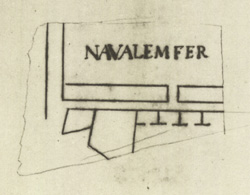
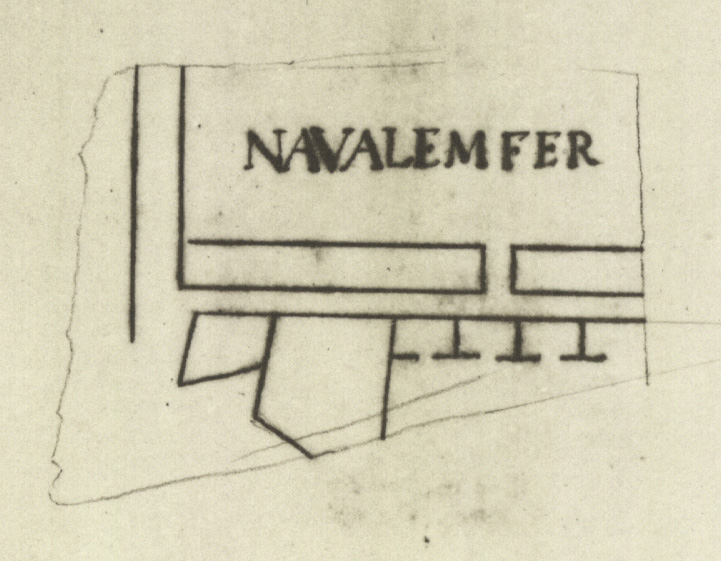
Detail from Cod. Vat. Lat. 3439 - Fo 18r,
reproduced from PM 1960, pl. 8 | |
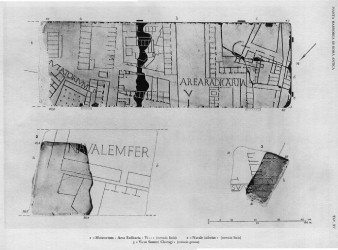
PM 1960 Plates: 8 15
AG 1980 Plates: 1
|
|
| IDENTIFICATION |
| Renaissance drawing: Lower military port (navale Inferius)?
|
|
| INSCRIPTION
Epigraphic conventions used |
| Transcription |
| None; the fragment itself is lost
|
| Renaissance Transcription |
| NAVALEMFER
|
| Reconstruction |
| NAVALE INFER(IUS) (PM 1960; AG 1980) |
|
|
|
|
|
| ANALYSIS
|
| Description The fragment is missing, but Renaissance drawing Cod. Vat. Lat. 3439 - Fo 18r shows it as it looked when still joined with fr. 2a (see photo detail above or PM 1960, pl. 8, no. 3). In its complete state, the fragment was part of a slab edge. It depicted a large, rectangular space in the upper right corner; here, the inscription NAVALEMFER[---] appeared. Two elongated, rectangular areas with no visible accesses bordered the bottom of this space. The opening between the two rectangles led to a parallel street below. Three adjoining structures backed onto this street; the two on the left were seemingly inaccessible and were of irregular shapes; the one on the right was flanked at top by a row of small rooms. To the left of these structures there was a wide, open space. A line that ran parallel to the left side of the large structure in the top right corner may have depicted a wall or the edge of a sidewalk.
Identification: Navale Inferius The inscription NAVALEMFER is tentatively reconstructed as NAVALE INFERIUS (PM 1960, p. 60). According to the Renaissance drawing, the inscription is complete; it should be noted, however, that the edges of fragments are not always correctly rendered in the 16th-century drawings (compare for example the lower edge of fr. 4b to the corresponding Renaissance drawing as reproduced in PM 1960, pl. 7). It is thus possible that the inscription is incomplete. If the reconstruction of the label is correct, it seemingly referred to a military ship yard whose nomenclature as inferius either positioned it along the "lower" course of the Tiber or distinguished it from a "greater" yard. Based on fr. 2a and the Renaissance drawing, the approximate height of the slab to which these fragments belonged can be calculated to be approximately 37 cm (i.e. similar to slab XI-6 whose height is preserved); it is thus generally placed in the top row of slabs, in the upper right corner of the map, as number XI-10 (PM 1960, p. 60). There are a number of problems associated with this identification and location, however: the only navalia known from literary sources is the great Republican yard, which was located along the Tiber in the Campus Martius (PM 1960, p. 60; LTUR III, p. 339). Although this yard may have gone out of use completely by the Severan period, when the map was carved, there is no evidence that a lesser (inferius) port was established along the Tiber beyond the Monte Testaccio, which is what the inscription and the location of the fragments suggest. Also problematic is the fact that this "lesser" or "lower" navalia seems to be situated somewhat far from the Tiber; plus, the buildings depicted here do not resemble a military port (Richardson 1992, p. 267). The authors of PM 1960 conclude that there is no reason to doubt the existence of a newer ship yard, called "inferius" to distinguish it from the earlier, larger port in the Campus Martius (PM 1960, p. 60). F. Coarelli disagrees (but does not offer any other explanation: LTUR III, p. 340).
Significance Together with fr. 2a, this missing fragment provides the only evidence for an unknown structure called the navale inferius that seems to have been located near the left bank of the Tiber, beyond the warehouses at the foot of the Aventine Hill. If the identification of the inscription and the location of the fragment are correct, the piece is key to our knowledge of the urban landscape in this section of Rome. |
|
| HISTORY OF FRAGMENT |
| Like the majority of FUR fragments, this piece was discovered in 1562 in a garden behind the Church of Saints Cosmas and Damian. From here, it was transferred to the Palazzo Farnese and stored there. Renaissance engravers reproduced the fragment in 16th-c. drawings that are now kept in the Vatican (for more information about the creation and accuracy of these drawings, see Cod. Vat. Lat. 3439), and Giovanni Pietro Bellori included it in his 1673 publication. The whereabouts of the piece after this date are unknown. (This fragments history corresponds to Iter D as summarized in PM 1960, p. 56.)
Text by Tina Najbjerg
|
|
| KEYWORDS
|
| river, ship yard, war ships, Tiber, courtyard, open space, inscription, military port |
|
 Prev
Prev