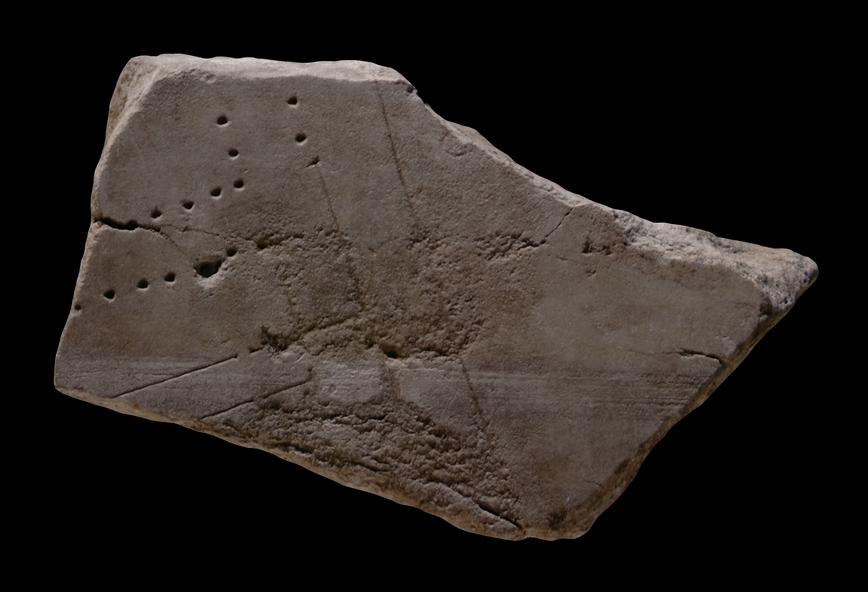
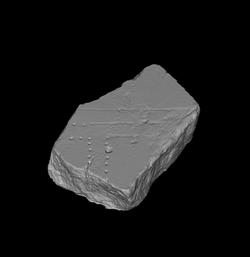
| Description The corners of two architectural units meet on the left side of the fragment. They are separated by two parallel walls that create a passageway between them; this is accessed from both sides by a narrow opening. A continuous wall constitutes the front of both buildings; in front of the upper structure it becomes the outer colonnade of a covered portico. To the right, a wall running parallel to the front wall separates these structures from a large open space.
Identification: Porticus Octaviae and Philippi The inscription in fr. 31u, [PORTI]CUS OCTAVIAE ET FIL[IPPI], identifies the two buildings in this fragment as the Porticus Octaviae and Philippi (PM 1960, pp. 91-92; AG 1980, p. 114. For a different reading of the inscription, see Richardson 1976, p. 63). Although the name implies a single building, it consisted of two separate quadriporticus that were placed side by side. This particular fragment shows the S junction of the two buildings and their joint facade. Augustus or his sister Octavia constructed the easternmost building, the Porticus Octaviae, which replaced an earlier structure, the Porticus Metelli (LTUR IV, p. 141; Richardson 1992, p. 317). It was rebuilt in the Severan period and may be the structure referred to twice in the Historia Augusta as the Porticus Severi (LTUR IV, p. 142). According to the Marble Plan (frs. 31u,
31vaa,
31bb, and the missing 31z) it consisted of an open courtyard surrounded by a covered, double row of colonnades in front and double colonnades and walls along the sides, also covered. The rear of the building is missing on the Plan but it presumably consisted of a covered, double colonnade with a wall behind it. Excavations have demonstrated that the porticoes were raised 1.70 m above the central courtyard (Ciancio Rossetto 1996, p. 267). The entrance (visible in frs. 31u and the missing 31z) was centered in the S portico. On the Plan, it is depicted as a double row of six columns on plinths, the front row projecting slightly out from the outer colonnade. Recent excavations have shown, however, that in the Severan period, the S portico was closed off with a wall (Ciancio Rossetto 1996, pp. 270, 273). At that time, the entrance was also changed into a monumental propylaeum (still visible today) whose front and back faces projected far out from the front and the rear of the S portico. Each face consisted of two antae that flanked four columns on plinths (Ciancio Rossetto 1996, pp. 267-270; LTUR IV, p. 144). This demonstrates that the Marble Plan depicted the Porticus Octaviae
in its Augustan, not Severan, phase (Ciancio Rossetto 1996, pp. 267).
In the center of the Porticus Octaviae stood the two temples to Iuno Regina and Iuppiter Stator (see frs 31u, 31z [missing], 31bb, and 31vaa).
Identification: Porticus Philippi The other porticoed structure visible in this fragment is the Porticus Philippi (PM 1960, pp. 91-92, pl. 29; AG 1980, p. 114, pl. 23). The identification is based on the inscription in fr. 31u and also upon the assumption that L. Marcius Philippus, Augustus' stepbrother, built it (and named it after himself) when he reconstructed the aedis Herculis Musarum, the temple enclosed in its center (see frs. 31bb, 31hh, and the missing 31ee, ff and gg; LTUR IV, p. 146).
The Porticus Philippi consisted of an open courtyard that was surrounded on all four sides by double porticoes. On the Marble Plan, a line separates the outer from the inner colonnade. Recent excavations have demonstrated that the outer portico was raised high (at least three meters) above the inner courtyard (LTUR IV, p. 147), and the line probably denotes the inner wall of this raised portico. The columns of the inner colonnade have been interpreted as trees because they do not line up with those of the outer colonnade (LTUR IV, p. 146). This, however, does not concur with the observation that the Marble Plan in general only depicts man-made, architectural features. The inner row of dots probably represents a covered colonnade that was built against the tall inner wall of the outer portico. This fragment shows that the Porticus Philippi and Octaviae shared party walls and a common front. Unlike the Octaviae, which was open in front, the facade of the Porticus Philippi was closed by a wall.
The function of the space between the sidewalls of the two porticoed structures is uncertain; as seen in this fragment it was accessible from both buildings by a small opening in the walls and also from the continuous portico that ran along the front of both buildings.
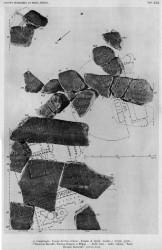
Identification: Circus Flaminius The wall that runs parallel to the joint facade of the Porticus Octaviae and Philippi in this fragment is the NE edge of the Circus Flaminius (AG 1980, p. 114; LTUR I, p. 271; Richardson 1992, p. 83). This circus, built in 221 BCE by C. Flaminius, was for years associated with remains excavated north of the Porticus Philippi, and fr. 31ii, which names the circus, was positioned accordingly on the Marble Plan (see PM 1960, pl. 28). In a series of articles in the 1960's and 70's, however, G. Gatti identified the correct location of the Circus Flaminius between the Tiber and the Porticus Octaviae and Philippi, and he discovered that fr. 31ii made a perfect match between this fragment and frs. 31u and 31z, thus reinforcing his location of the circus south of the Porticus Octaviae and Philippi (see AG 1980, pl. 23). The remains under the Palazzo Paganica he identified as those of the Theater of Balbus. Gatti's relocation of the Circus Flaminius was key to understanding why ancient authors referred to buildings like the Porticus Octaviae, the Porticus Philippi, the temples to Iuno Regina, to Iuppiter Stator, and to Hercules of the Muses as in circo: they faced the circus and were aligned with it (LTUR I, p. 270). This is clearly demonstrated by this fragment in conjunction with frs. 31ii and 31u: the line that represents the NE wall or edge of the Circus Flaminius is exactly parallel to the front of the Porticus Octaviae and Philippi and the temples in their centers (see AG 1980, pl. 23).
The ancient sources are unusually quiet about the design of the circus itself. This, and the fact that no visible remains have ever been unearthed, has brought scholars to suspect that the Circus Flaminius was simply an open space, kept free of clutter, with removable, wooden partitions like early theaters in Rome (LTUR I, p. 271). The depiction of the circus in this fragment seems to support the thesis that the Circus Flaminius was unlike other circuses in that it did not have banks of seats for spectators. It simply shows an open space delineated with a single straight line.
In 1961 Gatti argued, based on the discovery and identification of buildings around its perimeter, that the curved end of the circus was in the northwest, underneath the Monte dei Cenci. He also suggested that it was reduced to a square and paved in imperial times (LTUR I, pp. 270-271). The line in this fragment probably represents the edge of this paved area rather than a wall.
Significance These buildings lie at the S end of the Campus Martius and the N end of the Forum Boarium; they are situated under the Capitoline and adjacent to the city's oldest crossing of the Tiber. Their placement at this nodal juncture tells a great deal about the development, shifting meanings, and complex interactions of monuments in the city and in particular during the Augustan era. Their depiction on the Marble Plan also sheds light on how the city's inhabitants understood the city. Together with frs. 31u, 31z, and 31ii, this fragment was key to Gatti's relocation of the Circus Flaminius and to the realization that ancient authors referred to certain buildings in the Campus Martius as in circo because of their proximity and similar orientation to the circus (see above). For a more detailed summary of the problem concerning the use of the ancient locators in circo and in campo, see Rodríguez-Almeida 1991-92. It also supports the thesis that the Circus Flaminius was a flat, open space with no constructed banks for spectators.
|
 Prev
Prev