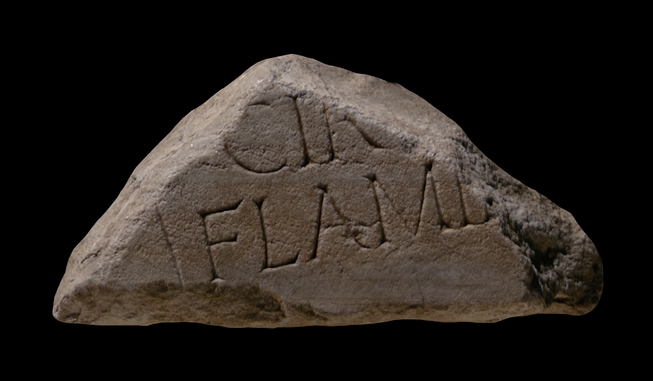
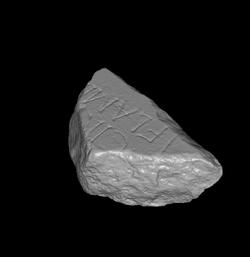
| Description A vertical line appears to the left of the inscription.
Identification: Circus Flaminius The fragment depicts the identifying label and a section of the Circus Flaminius, a structure that was created by C. Flaminius in 221 BCE at the S end of the Campus Martius, west of the Capitoline Hill and north of the Tiber Island. Its exact extent and boundaries are not known, but it ran lengthwise roughly east-southeast/west-northwest, just south of and parallel to the joint facade of the porticus Octaviae and Philippi. No permanent structures belonging to a circus--arena seating, starting gates, a central divider--have ever been excavated there; if these existed, they may have been made of wood. The ludi Plebeii (plebeian games) were held here, as were the ludi Taurei and probably some part of the ludi Saeculares; celebrations of various ludi continued into the Late Antique period. Popular assemblies and markets are also attested. Most famously, triumphal processions gathered and departed from the Circus Flaminius, which explains the density of victory temples constructed around it from the 3rd c. BCE on. In chronological order, these are the Temples of Hercules Custos, Vulcan, Neptune, Hercules Musarum (see fragments 31bb and 31hh), Pietas, Iuno Regina (see fragments 31bb and 31vaa), Diana, Iuppiter Stator (see frs. 31u and 31vaa), Mars, Castor and Pollux. Some of these temples were later enclosed within the two monumental quadriporticus: the porticus Octaviae (see frs. 31bb, 31cc, 31dd, 31u, 31vaa), and the porticus Philippi (see frs. 31bb, 31cc, 31dd, 31hh, 31u). The theater of Marcellus eventually encroached upon part of the Circus Flaminius. In 2 BCE, as part of the celebrations of the dedication of the Forum of Augustus, this was the site of an aquatic spectacle. Under Tiberius an arch commemorating Germanicus was built here; this may be the arch visible in fragment 31u.
The ancient sources are unusually quiet about the design of the Circus itself. This, and the fact that no visible remains have ever been unearthed, has brought scholars to suspect that the Circus Flaminius was simply an open space, kept free of clutter, with removable, wooden partitions like early theaters in Rome (LTUR I, p. 271). The depiction of the Circus in this fragment and in fr. 31cc seems to support the thesis that the Circus Flaminius was unlike other circuses in that it did not have banks of seats for spectators. It simply shows an open space delineated with a single straight line. In 1961 Gatti argued, based on the discovery and identification of buildings around its perimeter, that the curved end of the Circus was in the northwest, underneath the Monte dei Cenci. He also suggested that it was reduced to a square and paved in imperial times (LTUR I, pp. 270-271). The line in this fragment probably represents the edge of this paved area rather than a wall.
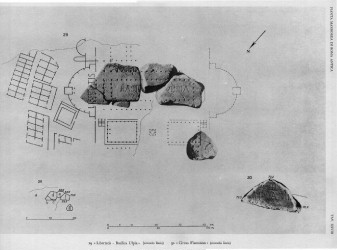
Significance The Circus was for years associated with remains excavated north of the porticus Philippi, and this fragment was positioned accordingly on the Marble Plan (see PM 1960, pl. 28). In a series of articles in the 1960's and 70's, however, G. Gatti located the Circus Flaminius between the Tiber and the porticus Octaviae and Philippi, and he discovered that this fragment made a perfect match between fr. 31u and frs. 31cc and 31z, thus reinforcing his location of the Circus south of these porticoes (see Gatti 1960). The remains under the Palazzo Paganica he identified as belonging to the Theater of Balbus. Gatti's relocation of the Circus Flaminius was key to understanding why ancient authors referred to buildings like the Porticus of Octavia, the Porticus of Philippus, the temples to Iuno Regina, to Iuppiter Stator, and to Hercules of the Muses as in circo: they faced the Circus and were aligned with it in an architectural expression of the relationship between the ritual of the triumph on one hand and victory temples and their successive embellishments on the other (LTUR I, p. 270). |
 Prev
Prev