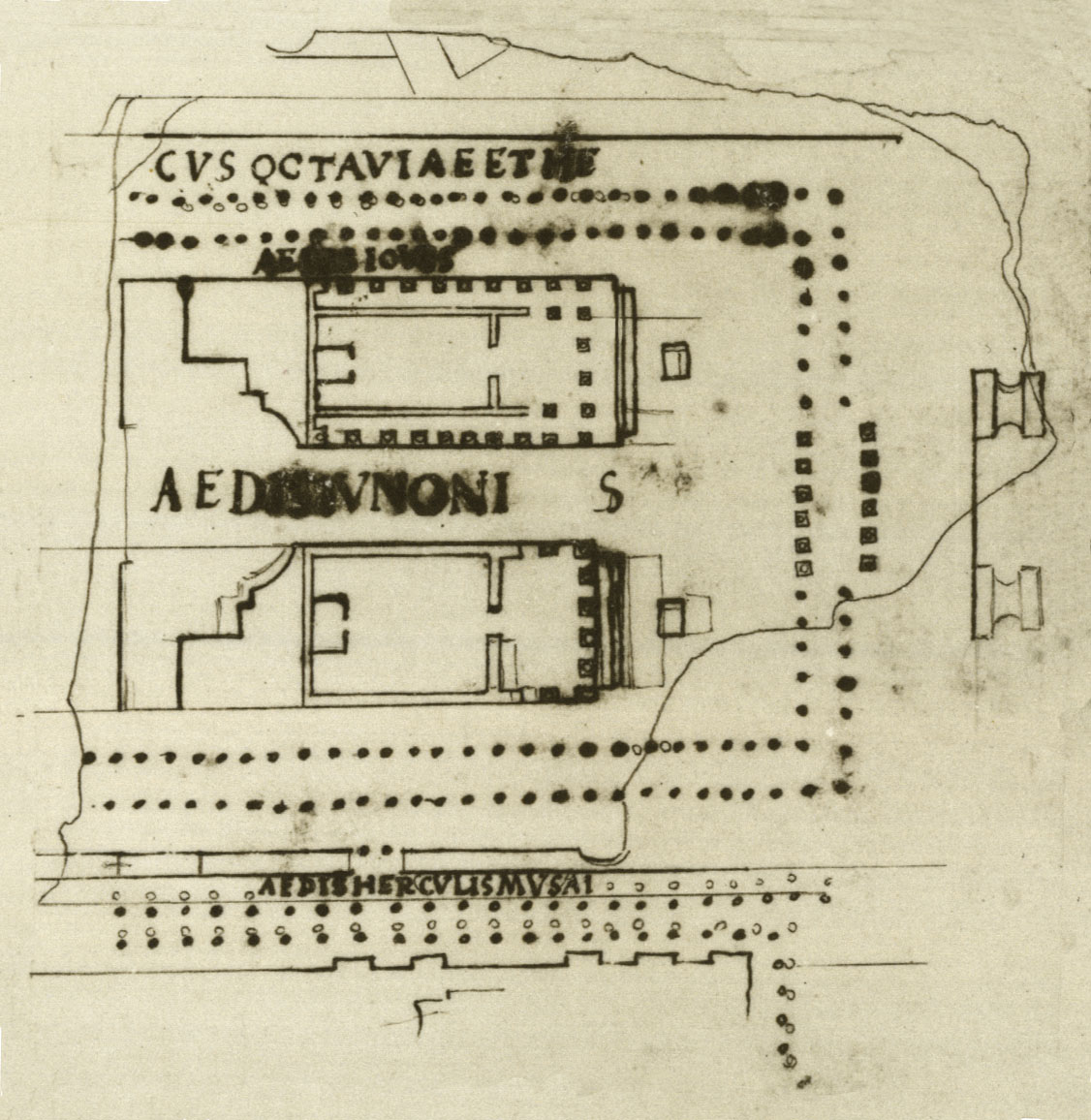
| Description The Renaissance drawing Cod. Lat. Vat. 3439 - Fo 23r (see detail above or PM 1960, pl. 14, no. 4) shows that the two lost fragments, z and gg, once belonged to a large piece that also included the still surviving frs. 31u, 31vaa, 31bb, and 31cc. The missing section z depicted part of the double colonnade of a large porticoed structure with a temple in the center of its open courtyard. Nine of the visible columns of the double colonnade were rendered as dotted squares, while three were plain dots. In front of and parallel to this double colonnade was a straight line. The temple in the center of the courtyard was a podium temple, peripteral sine postico, with a deep pronaos and a wide frontal staircase. Only two of the steps were shown on the Renaissance drawing. The walls of the cella were rendered with double lines and the surrounding columns were drawn as dotted squares. Below the temple, the letters V*NONIS were visible.
The missing section gg also depicted part of a colonnaded courtyard, situated side by side with the one in fr. 31z. Along the side, the colonnade was double; in front it consisted of a single row of columns. The engraver had problems with the double colonnade and two versions are included in his drawing. In one of them, the line of a wall or a step separated the columns of the double colonnade. All columns were rendered as single dots. Part of a crenellated platform inside the open courtyard was also visible. In the narrow space above the double colonnade, the partial inscription I*SMUSAI* was visible.
Identification: Porticus Octaviae The open courtyard surrounded by a double colonnade, partially visible in the missing section 31z, is identified by the inscription at top of the drawing as the porticus Octaviae. Augustus or his sister Octavia constructed the building, which replaced an earlier structure, the porticus Metelli (see LTUR IV, pp. 130-132; Richardson 1992 pp. 315, 317. For the identification of the S wing of the building as the porticus Octavia, built by Cn. Octavius in 168 BCE, see Richardson 1976 pp. 60-61). The porticus was rebuilt in the Severan period and may be the structure referred to twice in the Historia Augusta as the porticus Severi (LTUR IV, p. 142). FUR fragments 31u, vaa, bb, cc, and the missing z show a building that consisted of an open courtyard surrounded by a covered, double row of colonnades in front and double colonnades and walls along the sides, also covered. The rear of the building is missing on the Plan but it presumably consisted of a covered, double colonnade with a wall behind it. The Plan does not show what is demonstrated by excavations, namely that the three porticoes were raised 1.70 m above the central courtyard (Ciancio Rossetto 1996, p. 267). The entrance (visible in this and in fr. 31u) was centered in the S portico. On the Plan, it is depicted as a double row of six columns on pedestals, the front row projecting slightly out from the outer colonnade. Recent excavations have shown, however, that in the Severan period, the S portico was closed off with a wall (Ciancio Rossetto 1996, pp. 270, 273). At that time, the entrance was also changed into a monumental propylaeum (still visible today) whose front and back faces projected far out from the front and the rear of the S portico. Each face consisted of two antae that flanked four columns on plinths (Ciancio Rossetto 1996, pp. 267-270; LTUR IV, p. 144). This demonstrates that the Marble Plan depicted the porticus Octaviae in its Augustan, not Severan, phase (Ciancio Rossetto 1996, pp. 267).
Identification: Aedis Iovis Statoris The temple visible in this missing fragment is identified by an inscription in fr. 31u as the Temple to Iuppiter Stator, constructed by Q. Caecilius Metellus Macedonius after his triumph in 146 BCE, probably in 131 BCE, when he was censor. The building was also referred to as the aedes Metelli and the aedes Iovis Metellina (LTUR III, p. 157). Nothing remains of the temple today. According to Vitruvius (3.2.5), it was peripteral, hexastyle and had eleven columns on each side including the corner columns (LTUR III, 157; Richardson 1992, pp. 225-226); FUR frs. 31z and u, however, depicts it as peripteral sine postico, hexastyle, with nine or ten columns on the flanks. The difference has been attributed to possible later reconstructions, especially the one that must have taken place in the Augustan period when the curia or schola Octaviae was constructed behind the temple (LTUR III, p. 158; Richardson 1992, p. 226). As is common on the Plan, the walls of the cella were rendered with a double line (see reconstruction in PM 1960, pl. 29). The columns that surrounded the cella were depicted as dotted squares, suggesting that they stood on plinths. The temple was approaced from the front by a wide staircase, in front of which stood an altar, and a small enclosure for the cult statue abutted the back wall of the cella. As emphasized by ancient authors, the temple to Iuppiter Stator stood next to the temple of Iuno Regina (see below) within the porticus Metelli, a structure that was rebuilt and renamed the porticus Octaviae (see below) in the Augustan period (LTUR III, p. 157).
Identification: Aedis Iunonis Reginae Next to the Temple of Iupiter within the courtyard of the porticus Octaviae stood the Temple to Iuno Regina, the aedis Iunonis (PM 1960, pp. 91-92, pl. 29). On the Marble Plan, the temple itself is only visible in fr. 31bb. The identifying label, however, is partially visible in fr. 31vaa and in this missing fragment. Dedicated by M. Aemilius Lepidus in 179 BCE, the temple was constructed next to the temple of Juppiter Stator in the Campus Martius (LTUR III, pp. 126-127). Both temples were incorporated into the porticus Metelli and remained there after the latter was rebuilt and renamed porticus Octaviae (LTUR III, p. 126-127; Richardson 1992, pp. 216-217, 315). Remains of the temple podium, cella, pronaos, and columns have been unearthed--almost all belong to a Severan rebuilding of the entire structure after a fire in 203 CE. The excavations have demonstrated that the temple was hexastyle, not tetrastyle as depicted in fr. 31bb (LTUR III, p. 127; Richardson 1992, p. 217).
Identification: Porticus Philippi
The partial colonnade visible in the lost fr. 31gg has been identified as the porticus Philippi (PM 1960, pp. 91-92, pl. 29; AG 1980, p. 114, pl. 23). The identification is based on the assumption that the inscription [PORTI]CVS OCTAVIAE ET FIL[IPPI] in fr. 31u is a joint label for the two separate colonnaded courtyard structures visible in fr. 31bb (for a different interpretation, see Richardson 1976, p. 63), and that L. Marcius Philippus, probably Augustus' stepbrother, built this quadriporticus (and named it after himself) when he reconstructed the aedis Herculis Musarum, the temple enclosed in its center (LTUR IV, p. 146).
The porticus Philippi consisted of an open courtyard that was surrounded on all four sides by double porticoes. On the Plan, a line separates the outer from the inner colonnade (tentatively rendered in the drawing of this lost fragment but clearly visible on fr. 31bb). Recent excavations have demonstrated that the outer portico was raised high (at least 3 m) above the inner courtyard (LTUR IV, p. 147), and the line may denote the inner wall of this raised portico. The columns of the inner colonnade have been interpreted as trees because they do not line up with those of the outer colonnade (the Renaissance engraving shows the columns as lining up, but again fr. 31bb shows that they do not)(LTUR IV, p. 146). This thesis, however, does not concur with the observation that the Marble Plan in general only depicts man-made, architectural features. The inner colonnade is probably a covered portico that was built against the tall inner wall of the outer portico. The back wall of the E portico was parallel to the back wall of the W portico of the porticus Octaviae. The function of the narrow, elongated space between these walls is uncertain; it was accessed from both buildings through openings in the back walls, visible in fr. 31cc, and through the portico that ran along the front of both structures.
Identification: Aedis Hercules Musarum The crenulated outline inside the courtyard of the porticus Philippi is the E edge of the podium wall of the Temple to Hercules of the Muses, handily identified by the inscription in this drawing and in fr. 31bb (PM 1960, p. 91, pl. 29). This temple was built by M. Fulvius Nobilior after his victory over the Aetolians in 189 BCE. In it he dedicated sculptures taken as spoils of war, including a Hercules Musagetes (leader of the Muses) and a group of Muses taken from Ambracia (LTUR III, p. 18). The temple was restored in the Augustan period by L. Marcius Philippus, probably Augustus' stepbrother (LTUR III, p. 19). The temple proper is visible in the now missing fragment 31eeff (see reconstruction in PM 1960, pl. 29). It seems to have consisted of a tholos with a tetrastyle pronaos, part of which has been exposed through excavation (LTUR III, p. 19). The round temple faced a sacred enclosure inside which a small, circular feature may represent the bronze aedicula of Numa which Nobilior moved there from the sanctuary of the Camenae (LTUR III, p. 19). A semicircular niche was built into the N short end of the crenulated podium (LTUR III, p. 19; Richardson 1992, p. 187).
Identification: Circus Flaminius The straight line in front of the entrance to the porticus Octaviae in the missing fr. 31z is the NW edge of the Circus Flaminius. The Circus was created by C. Flaminius in 221 BCE at the S end of the Campus Martius, west of the Capitoline Hill and north of the Tiber Island. Its exact extent and boundaries are not known, but it ran lengthwise roughly E-SE/W-NW, just south of and parallel to the fronts of the porticus Octaviae and Philippi. No permanent structures belonging to a circus--arena seating, starting gates, a central divider-- have ever been excavated there; if these existed, they may have been made of wood. The ludi Plebeii (plebeian games) were held here, as were the ludi Taurei and probably some part of the ludi Saeculares; celebrations of various ludi continued into the Late Antique period. Popular assemblies and markets are also attested. Most famously, triumphal processions gathered and departed from the Circus Flaminius, and this explains the density of victory temples constructed around it from the 3rd c. BCE on. Some of these were later enclosed within the two monumental quadriporticus near by, the porticus Octaviae and the porticus Philippi. Part of the Circus Flaminius was eventually encroached on by the Theater of Marcellus. Under Tiberius an arch commemorating Germanicus was built here; this may be the arch visible in fragment 31u.
Significance Together with fragments 31u, vaa, bb, cc, dd, hh, and the missing 31eeff, the Renaissance drawing of these two missing pieces is key to identifying the Porticus Octaviae, the Porticus Philippi, the temples to Iuno Regina, to Iuppiter Stator, and to Hercules of the Muses, and to understanding the architecture of the temples to Iupiter and to Hercules, of which nothing remains today. It also helps us understand how the ancients viewed the layout of their city, as some of these monuments were referred to as in circo or ad Circum Flaminium. In a series of articles in the 1960's, G. Gatti identified the correct location of the Circus Flaminius and demonstrated that these buildings all faced and were aligned with the N side of the Circus, hence the common use of the identifying in circo (Gatti 1961). For an explanation of the ancient locators in circo and in campo, see Rodríguez-Almeida 1991-92.
|
 Prev
Prev