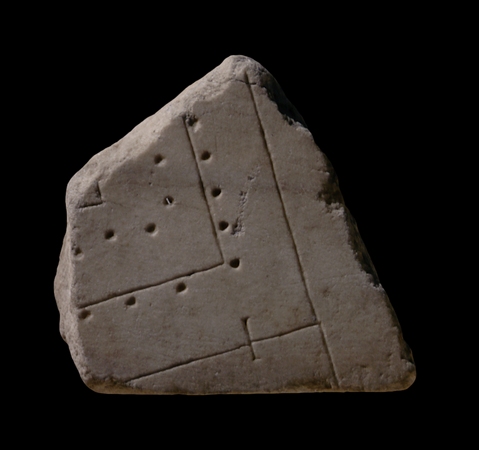
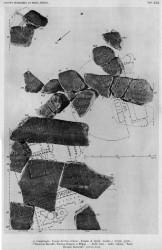
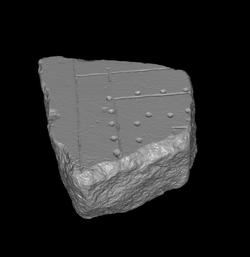
| Description This fragment was part of the lower edge of the slab. It depicts the corner of a double portico. A line separates the inner from the outer colonnade. The corner of a linear feature within the porticoes is just visible at the upper left corner. The vertical outer wall of the double portico continues down past the corner of the building. A short line across the horizontal outer wall perhaps marks an opening from the outer portico into a neighboring building.
Identification: Porticus Philippi The identification of this building is based on the inscription [PORTI]CVS OCTAVIAE ET FIL[IPPI] in fr. 31u which labels two separate structures, the one visible in this fragment as well as the large quadriporticus east of it, the Porticus Octaviae (PM 1960, pp. 91-92, pl. 29; AG 1980, p. 114, pl. 23; for a different reading of the inscription, see Richardson 1976, p. 63). The identification of the building is also based on the assumption that L. Marcius Philippus, Augustus' stepbrother, built it and named it after himself when he reconstructed the temple enclosed in its center, the aedis Herculis Musarum (Suet., Aug. 29; LTUR IV, p. 146).
The porticus Philippi consisted of an open courtyard surrounded on all four sides by double porticoes. On the Marble Plan, a line separates the outer from the inner colonnade. Recent excavations have demonstrated that the outer portico was raised at least three meters above the inner courtyard (LTUR IV, p. 147), and the line probably denotes the inner wall of this raised portico. The columns of the inner colonnade have been interpreted as trees because they do not line up with those of the outer colonnade (LTUR IV, p. 146). This, however, does not concur with the observation that the Marble Plan generally depicts man-made, architectural features. The inner row of dots probably represents a covered colonnade that was built against the tall inner wall of the outer portico. The outer, frontal portico of the porticus Philippi was aligned with the front of the porticus Octaviae. The vertical line to the far right in this fragment suggests, however, that the Porticus of Philippus in the Severan period was closed in front by a wall and had no major entrance, whereas the front of the porticus Octaviae consisted of an open, double colonnade with a propylaeum in the center (LTUR IV, p. 146). The area to the right of this wall is a street that ran between the two buildings and the Circus Flaminius (see AG 1980, pl. 23).
Identification: Aedis Hercules Musarum The structure whose SE corner appears in the center of the porticus Philippi in this fragment is identified as the Temple to Hercules of the Muses by the inscription in frs. 31bb and the missing 31ggz (PM 1960, p. 91). This temple was built by M. Fulvius Nobilior after his victory over the Aetolians in 189 BCE. In it he dedicated sculpture taken as spoils of war, including a Hercules Musagetes (leader of the Muses) and a group of Muses taken from Ambracia (LTUR III, p. 18). The temple proper is visible in the now missing fragments 31ee, 31ff and 31gg (see reconstruction in PM 1960 pl. 29). It seems to have consisted of a tholos with a tetrastyle pronaos, part of which has been exposed through excavation. The round temple faced a sacred enclosure inside which a small, circular feature may represent the bronze aedicula of Numa which Nobilior moved there from the sanctuary of the Camenae (LTUR III, p. 19). A semicircular niche was built into the N short end of the crenulated podium (LTUR III, p. 19; Richardson 1992, p. 187).
Significance With the other fragments that depict the porticus Philippi and its temple, this fragment is key to understanding the architecture of these buildings of which little remains. Their depiction on the Marble Plan also sheds light on how Rome's inhabitants understood the layout of this area of the city: Together with fragments 31u, 31vaa, 31z (missing), 31bb, 31cc, and 31ii, this piece is key to understanding why ancient authors referred to the Porticus Octaviae, the Porticus Philippi, the temples to Iuno Regina, to Iuppiter Stator, and to Hercules of the Muses as in circo or ad Circum Flaminium. In 1961, G. Gatti identified the correct location of the Circus Flaminius and demonstrated that these buildings all faced and were aligned with the N side of the Circus, hence the common use of the identifying in circo (Gatti 1961). For a more detailed explanation of the ancient locators in circo and in campo, see Rodríguez-Almeida 1991-92.
|
 Prev
Prev