ID AND LOCATION
| Stanford #
| 31eeff |
| AG1980 #
| 31ee,ff |
| PM1960 #
| 31 ee ff |
| Slab #
| V-12 |
| Adjoins
| 31bb 31dd 31ggz |
CONDITION
| Located
| true |
| Incised
| true |
| Surviving
| false |
| Slab Edges
| 1 |
| Clamp Holes
| 0 |
| Tassello
| no | |
|
|
|
|
|
BIBLIOGRAPHY
- AG 1980, p. 114, pl. 23
- LTUR III: Hercules Musarum, Aedes (A. Viscogliosi), pp. 17-19
- LTUR IV: Porticus Philippi (A. Viscogliosi), pp. 146-148
- PM 1960, pp. 91-93, pls. 13, 29
- Richardson 1992, p. 187 (Hercules Musarum, Aedes), p. 318 (Porticus Philippi)
- Richardson 1976
- Rodríguez-Almeida 1991-92
|
|
|
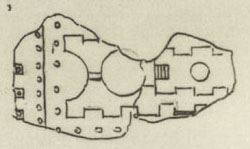
Detail from Cod. Vat. Lat. 3439 - Fo 22r,
reproduced from PM 1960, pl. 13 | |
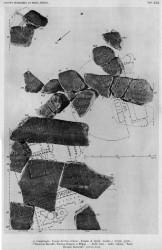
PM 1960 Plates: 13 29
AG 1980 Plates: 23
|
|
| IDENTIFICATION |
| Renaissance drawing: Porticus of Philippus (porticus Philippi) with the Temple to Hercules of the Muses (aedis Hercules Musarum)
|
|
| INSCRIPTION |
| None |
|
|
|
|
|
| ANALYSIS
|
| Description Renaissance drawing Cod. Vat. Lat. 3439 - Fo 22r (see detail above or PM 1960, pl. 13.2) shows the two joining fragments 31ee and ff, now missing. On the same plate is a smaller, faint sketch of fr. 31ee alone; this was perhaps drawn first, before the engraver realized that the fragment joined with fr. 31ff. The larger drawing shows that the lost fragments depicted part of a colonnaded courtyard with a temple in its center. The colonnade was double; each column was rendered with a single dot. A straight line separated the rows of the colonnade; it may have represented a wall or a step. Outside the double colonnade, three columns from yet another colonnade was visible. These were drawn as dotted squares. Inside the courtyard lay a platform with crenellated edges. The visible short end of this platform was curved and it was connected to a circular feature on top of the platform via a double line. A narrow set of stairs led from the circular feature to a rectangular structure with crenellated edges. In its center was another, smaller circular feature.
Identification: Porticus Philippi
The double portico visible in these lost fragments was part of the porticus Philippi (PM 1960, pp. 91-92, pl. 29; AG 1980, p. 114, pl. 23). The identification is based on the assumption that the inscription [PORTI]CUS OCTAVIAE ET FIL[IPPI] in fr. 31u is a joint label for the two separate quadriporticoes visible in that particular fragment (for a different interpretation, see Richardson 1976, p. 63), and that L. Marcius Philippus, probably Augustus' stepbrother, built the quadriporticus (and named it after himself) when he reconstructed the aedis Herculis Musarum, the temple enclosed in its center (see below)(LTUR IV, p. 146).
The porticus Philippi consisted of an open courtyard surrounded on all four sides by double porticoes. On the Marble Plan, a line separates the outer from the inner colonnade (visible in these fragments and in frs. 31bb and 31hh). Recent excavations have demonstrated that the outer portico was raised high (at least 3 meters) above the inner courtyard (LTUR IV, p. 147), and the line may therefore denote the inner wall of this raised portico. The columns of the inner colonnade have been interpreted as trees because they do not line up with those of the outer colonnade (LTUR IV, p. 146). This, however, does not concur with the observation that the Marble Plan in general only depicts man-made, architectural features. The inner colonnade is probably a covered portico that was built against the tall inner wall of the outer portico. The three columns behind the double colonnade belonged to the back wall of the portico itself, visible in fr. 31dd.
Identification: Aedis Hercules Musarum The outer crenellated platform in these fragments is the podium of the Temple to Hercules of the Muses, handily identified by the inscription in the lost fragments 31gg and in fr. 31bb (PM 1960, p. 91, pl. 29). This temple was built by M. Fulvius Nobilior after his victory over the Aetolians in 189 BCE. In it he dedicated sculptures taken as spoils of war, including a Hercules Musagetes (leader of the Muses) and a group of Muses taken from Ambracia (LTUR III, p. 18). The temple was restored in the Augustan period by L. Marcius Philippus, probably Augustus' stepbrother (LTUR III, p. 19). As these fragments demonstrate, it seems to have consisted of a tholos with a tetrastyle pronaos, part of which has been exposed through excavation (LTUR III, p. 19). The round temple faced a sacred enclosure inside which a small, circular feature may represent the bronze aedicula of Numa which Nobilior moved there from the sanctuary of the Camenae (LTUR III, p. 19). A semicircular niche was built into the N short end of the crenellated podium (LTUR III, p. 19; Richardson 1992, p. 187).
Significance The Renaissance drawing of these two lost fragments is key to reconstructing the architecture of the Temple to Hercules of the Muses.
|
|
| HISTORY OF FRAGMENT |
| Like the majority of FUR fragments, these pieces were discovered in 1562 in a garden behind the Church of Saints Cosmas and Damian. From here, they were transferred to the Palazzo Farnese and stored there. Renaissance engravers reproduced the fragments in 16th-c. drawings that are now kept in the Vatican (for more information about the creation and accuracy of these drawings, see Cod. Vat. Lat. 3439), and Giovanni Pietro Bellori included them in his 1673 publication. The whereabouts of the fragments after this date are unknown. (The history of these fragments corresponds to Iter D as summarized in PM 1960, p. 56.)
Text by Tina Najbjerg
|
|
| KEYWORDS
|
| portico, colonnade, temple, platform, steps, |
|
 Prev
Prev
