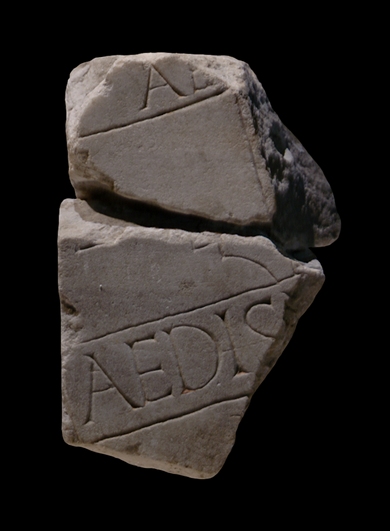
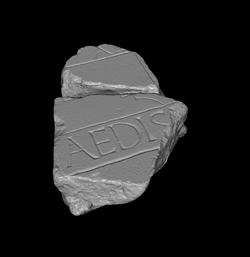
| Description The fragment consists of two pieces. The larger fr. aa formed part of a slab edge; part of a clamphole survives at its lower left corner. At the top, the fragment shows a horizontal line above which the letters A[.] are visible. At the bottom, two parallel, horizontal lines frame the letters AEDIS. At right, a straight vertical line connects the horizontal lines. Just to its left, a line articulated with a curve and two right angles extends upward from the horizontal line above the AEDIS inscription.
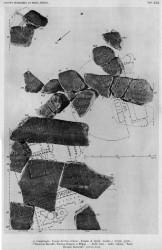
Identification: Aedis Iovis Statoris The letter A at top of the fragment is the first letter of an inscription that identifies the structure below it as the Temple to Iuppiter. The rest of the inscription and of the temple is visible in frs. 31u and the missing 31ggz (PM 1960, p. 91, pl. 29; AG 1980, p. 114, pl. 23). The temple to Iuppiter Stator was constructed by Q. Caecilius Metellus Macedonius after his triumph in 146 BCE, probably in 131 BCE, when he was censor. The building was also referred to as the aedes Metelli and the aedes Iovis Metellina (LTUR III, p. 157). Nothing remains of the temple today. According to Vitruvius (3.2.5), it was peripteral, hexastyle and had eleven columns on each side including the corner columns (LTUR III, 157; Richardson 1992, pp. 225-226); the Marble Plan, however, depicts it as peripteral sine postico, hexastyle, with nine or ten columns on the flanks. The difference has been attributed to possible later reconstructions, especially the one that must have taken place in the Augustan period when the curia or schola Octaviae was constructed behind the temple (see below; LTUR III, p. 158; Richardson 1992, p. 226). As is common on the Plan, the walls of the cella are rendered with double lines (see reconstruction in PM 1960, pl. 29). The vertical line visible to the right in this fragment constitutes the back wall of the temple. The columns that surround the cella are depicted as dotted squares, suggesting that they stood on plinths. The temple was approaced from the front by a wide staircase, in front of which stood an altar, and a small enclosure for the cult statue abutted the back wall of the cella. As emphasized by ancient authors, the temple to Iuppiter Stator stood next to the temple of Iuno Regina (see below) within the porticus Metelli, a structure that was rebuilt and renamed the porticus Octaviae (see below) in the Augustan period (LTUR III, p. 157).
Identification: Aedis Iunonis In conjunction with frs. 31bb and 31ggz (missing), the inscription at the bottom of this fragment labels the aedes Iunonis, a temple that was positioned next to the Temple of Iuppiter Stator within the porticus Metelli (later the porticus Octaviae)(PM 1960, pp. 91-92, pl. 29). The Temple to Iuno was dedicated by M. Aemilius Lepidus in 179 BCE. Excavations have revealed the remains of the temple podium, cella, pronaos, and columns--almost all belong to the Severan rebuilding of the entire structure in 203 CE. The excavations also demonstrated that the temple was hexastyle, not tetrastyle as depicted in fr. 31bb (LTUR III, p. 127; Richardson 1992, p. 217).
Identification: Porticus Octaviae The two temples to Iuppiter Stator and Iuno Regina stood side by side in the center of the porticus Octaviae. The majority of this building is visible in frs. (frs. 31u,
31z (missing),
31bb, and
31cc. It was constructed by Augustus or his sister Octavia to replace an earlier quadriporticus, the Porticus Metelli (LTUR IV, p. 141; Richardson 1992, p. 317). The Porticus of Octavia was rebuilt in the Severan period and may be the structure referred to twice in the Historia Augusta as the porticus Severi (LTUR IV, p. 142). The Marble Plan shows a building that consisted of an open courtyard surrounded by a covered, double row of colonnades in front and double colonnades and walls along the sides, also covered. The rear of the building is missing on the Plan but it presumably consisted of a covered, double colonnade with a wall behind it. Excavations have demonstrated that the porticoes were raised 1.70 m above the central courtyard (Ciancio Rossetto 1996, p. 267). The entrance (visible in frs. 31u and the missing 31ggz) was centered in the S portico. On the Plan, it is depicted as a double row of six columns on pedestals, the front row projecting slightly out from the outer colonnade. Recent excavations have shown, however, that in the Severan period, the S portico was closed off with a wall (Ciancio Rossetto 1996, pp. 270, 273). At that time, the entrance was also changed into a monumental propylaeum (still visible today) whose front and back faces projected far out from the front and the rear of the S portico. Each face consisted of two antae that flanked four columns on piers (Ciancio Rossetto 1996, pp. 267-270; LTUR IV, p. 144). This demonstrates that the Marble Plan depicted the Porticus of Octavia
in its Augustan, not Severan, phase (Ciancio Rossetto 1996, pp. 267).
Identification: Curia or schola Octaviae The strangely shaped feature behind the Temple to Iuppiter in this fragment is mirrored by a structure behind the Temple of Iuno, visible in fr. 31bb. These features might depict a large exedra that was built against the back of the two temples and was split down the middle. The structure has been associated with the curia Octaviae or the schola Octaviae, two features that are known to have been included in the porticus Octaviae in the Augustan period (LTUR IV, p. 142).
Significance Together with frs. 31u, 31z, 31bb and 31cc, this fragment confirms the location of the temples to Iuno and Iuppiter within the Porticus of Octavia, as attested by ancient sources. In conjunction with frs. 31u, 31cc, 31ii, and 31hh, this piece is also key to understanding why ancient authors referred to the Porticus of Octavia, the Porticus of Philippus, the temples to Iuno Regina, to Iuppiter Stator, and to Hercules of the Muses as in circo or ad Circum Flaminium. In 1961, G. Gatti identified the correct location of the Circus Flaminius and demonstrated that these buildings all faced and were aligned with the N side of the Circus, hence the common use of the identifying in circo (Gatti 1961). For an explanation of the ancient locators in circo and in campo, see Rodríguez-Almeida 1991-92.
|
 Prev
Prev