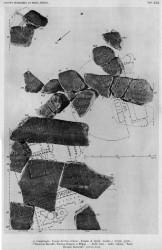
| Description The fragment was part of a slab edge. The long top and bottom edges demonstrate that it broke along the line of the vein in the marble (AG 1980, p. 114: note the similar direction of the break lines along the top edges of 31vaa, 31bb, 31cc, 31dd, 31qrs, and along the bottoms of 31ii, 31d, 31e, and 31qrs). The fragment depicts the intersection of two covered porticoes, both consisting of double colonnades. The columns of the porticoes are rendered with dots except for three at the bottom right, which are shown as dotted squares. Of these three, the two to the right protrude from the line of the outer colonnade. The vertical portico to the right is open, while the horizontal portico on top is closed by a wall behind the colonnades. In the space between the wall and the inner colonnade, the letters [...]CVSOCTAVIAEET[...] appear. Two lines appear on the other side of the horizontal wall; one lies in an oblique angle to the wall, the other is parallel to it. The corner of a small feature is visible in the triangular space created by the oblique line and the horizontal wall of the portico. Inside the space delineated by the two porticoes lies a podium temple, of which only the corner is visible. It shows that the temple was surrounded by columns (the depiction of squares around the column dots may mean the columns stood on plinths), that its cella walls were rendered by recessed and highlighted double lines, and that it was approached by a wide set of stairs (the individual steps are not marked). An altar stands in front of the temple. In the bottom right section of the fragment one sees a feature that consists of two rectangles joined by two concave lines; this is the standard symbol on the Marble Plan for an arch. A straight line, parallel to the vertical portico, extends downward from the lower left corner of the arch.
Identification: Porticus Octaviae The double porticoes visible in this fragment belonged to a large quadriporticus, the porticus Octaviae, which lay next to and shared facade with a similar structure, the porticus Philippi (for the latter, see frs. 31bb, 31cc, 31hh, and 31dd). Although the two quadriporticus were separate buildings, they were labeled jointly by the inscription [PORTI]CUS OCTAVIAE ET FIL[IPPI] in this fragment. L. Richardson has argued that it is highly unlikely that the Romans would label two separate buildings under one name. He suggests that the inscription in this fragment referred to the easternmost quadriporticus only, and that the person mentioned besides Octavia was not a FIL[IPPI} but a FIL[I], namely Octavia's son and Augustus' nephew Marcellus, to whom the theater across the street and the library within the porticus Octaviae were dedicated (Richardson 1976, p. 63). E. Rodríguez-Almeida has counterargued that the FIL of the inscription must be FIL[IPPI] because that is the only reconstruction that will fill up the available space (AG 1980, p. 27, fig. 4).
The Porticus Octaviae was constructed by Augustus or his sister Octavia to replace an earlier structure, the Porticus Metelli (LTUR IV, p. 141; Richardson 1992, p. 317). The porticus was rebuilt in the Severan period and may be the edifice referred to twice in the Historia Augusta as the porticus Severi (LTUR IV, p. 142). According to the Marble Plan (see also frs. 31ggz (missing),
31vaa,
31bb, and
31cc) the porticus Octaviae consisted of an open courtyard surrounded by a covered, double row of colonnades in front and double colonnades and walls along the sides, also covered. The rear of the building is missing on the Plan but it presumably consisted of a covered, double colonnade with a wall behind it. Excavations have demonstrated that the porticoes were raised 1.70 m above the central courtyard (Ciancio Rossetto 1996, p. 267). The entrance (visible in this fragment and in the missing fr. 31z) was centered in the open S portico. On the Plan, it is depicted as a double row of six columns on plinths, the front row projecting slightly out from the outer colonnade. Excavations have shown, however, that in the Severan period, the S portico was closed off with a wall (Ciancio Rossetto 1996, pp. 270, 273), and the entrance was changed into a monumental propylaeum (still visible today) whose front and back faces projected far out from the front and the rear of the S portico. Each face consisted of two antae that flanked four columns on plinths (Ciancio Rossetto 1996, pp. 267-270; LTUR IV, p. 144). This demonstrates that the Marble Plan depicted the Porticus Octaviae
in its Augustan, not Severan, phase (Ciancio Rossetto 1996, pp. 267).
According to ancient sources, the Temple to Apollo and the Temple of Bellona were surrounded by a porticus, which must have been cut off by the construction of the porticus Metelli and subsequently, the porticus Octaviae (LTUR I, p. 52 [Apollo, Aedes in Circo]). The line that extends at an oblique angle from the E wall of the porticus Octaviae in this fragment is possibly part of this porticus.
Identification: Aedis Iovis Statoris
In the courtyard of the porticus Octaviae two temples stood side by side, one dedicated to Iuppiter Stator and one to Iuno Regina. The temple that is partially visible in this fragment is identified by the inscription above it as the aedis Iovis (PM 1960, p. 91, pl. 29; AG 1980, p. 114, pl. 23). The rest of the inscription and of the temple is visible in fr. 31vaa and the missing 31ggz. The temple to Iuppiter Stator was constructed by Q. Caecilius Metellus Macedonius after his triumph in 146 BCE, probably in 131 BCE, when he was censor. The building was also referred to as the aedes Metelli and the aedes Iovis Metellina (LTUR III, p. 157). Nothing remains of the temple today. According to Vitruvius (3.2.5), it was peripteral, hexastyle and had eleven columns on each side including the corner columns (LTUR III, 157; Richardson 1992, pp. 225-226); the Marble Plan, however, depicts it as peripteral sine postico, hexastyle, with nine or ten columns on the flanks. The difference has been attributed to possible later reconstructions, especially the one that must have taken place in the Augustan period when the curia or schola Octaviae was constructed behind the two temples (see frs. 31vaa and 31bb; LTUR III, p. 158; Richardson 1992, p. 226). As is common on the Plan, the walls of the cella are rendered with a double line (see reconstruction in PM 1960, pl. 29). The columns that surround the cella are depicted as dotted squares, suggesting they stood on plinths. The temple was approaced from the southwest by a wide, frontal staircase, whose individual steps are not shown on the Plan. In front stood an altar, and a small enclosure for the cult statue abutted the back wall of the cella.
Identification: Arcus Germanici in the circus Flaminius The arch in the bottom right side of this fragment is probably the Arch of Germanicus, erected in the circus Flaminius during the reign of Tiberius (LTUR I, pp. 270-272; Richardson 1992, p. 83). The arch marks the E corner of the circus Flaminius (AG 1980, p. 114, pl. 23). The Circus Flaminius, built in 221 BCE by C. Flaminius, was for years associated with remains excavated north of the porticus Philippi, and fr. 31ii, which names the building, was positioned accordingly on the Marble Plan (see PM 1960, pl. 28). In a series of articles in the 1960's and 70's, G. Gatti, however, identified the correct location of the Circus Flaminius between the Tiber and the porticus Octaviae and Philippi, and he discovered that fr. 31ii made a perfect match between this fragment and frs. 31cc and 31z, thus reinforcing his location of the Circus south of the Porticus of Octavia and Philippus (see AG 1980, pl. 23). The remains under the Palazzo Paganica he identified as those of the Theater of Balbus.
Gatti's relocation of the Circus Flaminius was key to understanding why ancient authors referred to buildings like the Porticus of Octavia, the Porticus of Philippus, the temples to Iuno Regina, to Iuppiter Stator, and to Hercules of the Muses as in circo: they faced the Circus and were aligned with it (LTUR I, p. 270). This is demonstrated by this fragment in conjunction with frs. 31ii and 31cc: the line extending from the arch, representing the N wall or edge of the Circus Flaminius, runs along the front of the Porticus of Octavia and Philippus and the temples in their centers, and is more or less parallel to them (see AG 1980, pl. 23).
The Circus Flaminius had many functions not neccessarily associated with a circus, including that of a space for public assemblies and a market. It was also the main staging ground for triumphs, which explains the dense presence of victory temples. This use is also reflected in the erection of the triumphal arch to Germanicus.
The ancient sources are unusually quiet about the design of the Circus Flaminius. This, and the fact that no visible remains have ever been unearthed, has brought scholars to suspect that the Circus was simply an open space, kept free of clutter, with removable, wooden partitions like early theaters in Rome (LTUR I, p. 271). In 1961 Gatti argued, based on the discovery and identification of buildings around its perimeter, that the curved end of the circus was in the northwest, underneath the Monte dei Cenci. He also suggested that it was reduced to a square and paved in imperial times (LTUR I, pp. 270-271).
Significance Not all buildings on the Marble Plan were shown in their latest (Severan) state--comparison of the porticus Octaviae as shown on this fragment, fr. 31z (missing), and fr. 31cc with the excavated remains of the building demonstrates that it is here depicted in an earlier, probaby Augustan phase. The fragment also sheds light on monumental developments and ancient understandings of the city. The inscription on this fragment labels the porticus Octaviae and Philippi, two important structures in the Augustan building program in the Campus Martius. Together with frs. 31z (missing) and 31ii, it was key to G. Gatti's identification of the Circus Flaminius' correct location and to the realization that ancient authors referred to certain buildings in the Campus Martius as in circo because of their proximity and similar orientation to the Circus (see above). For a more detailed summary of the problem concerning the use of the ancient locators in circo and in campo, see Rodríguez-Almeida 1991-92.
|
 Prev
Prev