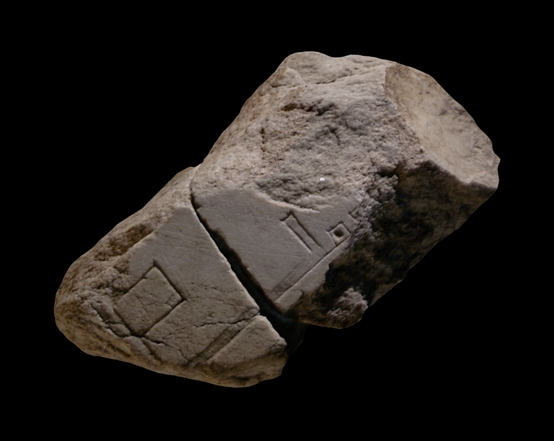
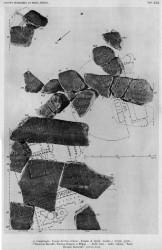
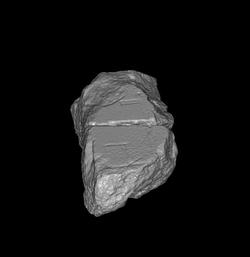
| Description These two joining fragments depict part of a rectangular temple cella. As is usual on the Marble Plan, the cella walls are rendered with recessed double lines. At least two dotted squares, denoting columns on plinths, originally extended from the corner of the cella into the pronaos; a line marking the edge of the temple podium follows the right side of the columns. A small, rectangular feature at the back of the cella probably represents a space for the cult statue.
Identification: Aedes Apollinis The authors of PM 1960 identified the temple in this fragment as that of Apollo Sosianus, located between the Theater of Marcellus and the Porticus Octaviae (PM 1960, p. 92), even though its orientation does not quite match the location of the surviving remains of the temple. Dedicated to Apollo the Healer (Medicus) in 431 BCE by the concul Cn. Iulius after a plague, this structure was the only temple to Apollo in Rome until Augustus built the one on the Palatine Hill (LTUR I, p. 49; Richardson 1992, p. 12). The temple underwent several reconstructions, the most important of which was the major refacing by C. Sosius, consul in 32 BCE. Sosius, who sided with Marc Antony in the Battle of Actium, probably completed the temple after he was officially forgiven by Octavian (see LTUR I, pp. 50-51). The extant remains of the temple are believed to belong to this Augustan reconstruction (LTUR I, p. 53, with reference to M. Wegner who has suggested a Flavian date). The remains include Corinthian columns and sections of the entablature and of the cella, partially of Luna marble, partially of travertine blocks, all of exquisite workmanship. Excavations have confirmed that this was a podium temple, pseudo-peripteral, and hexastyle. Whether the columns stood on plinths, as suggested by this fragment, has not been determined (LTUR I, pp. 52-53). According to ancient sources, the Temple to Apollo and the adjacent Temple of Bellona were surrounded by a porticus; this porticus must have been cut off by the construction of the Porticus Metelli and then the Porticus Octaviae (LTUR I, p. 52). The line that runs parallel to the back of the Temple to Apollo but extends at an oblique angle from the E wall of the Porticus Octaviae in fr. 31u is possibly part of this porticus.
Significance This fragment helps confirm the shape and location of the Temple to Apollo, now known through excavations. Adjacent to the Temple of Bellona and the Theater of Marcellus, and part of a complex of monumental buildings at the S end of the Campus Martius and the N end of the Forum Boarium, the depiction of the Temple of Apollo provides insight into the monumental development of the city and the changing meanings of buildings and space, in particular during the Augustan era.
|
 Prev
Prev