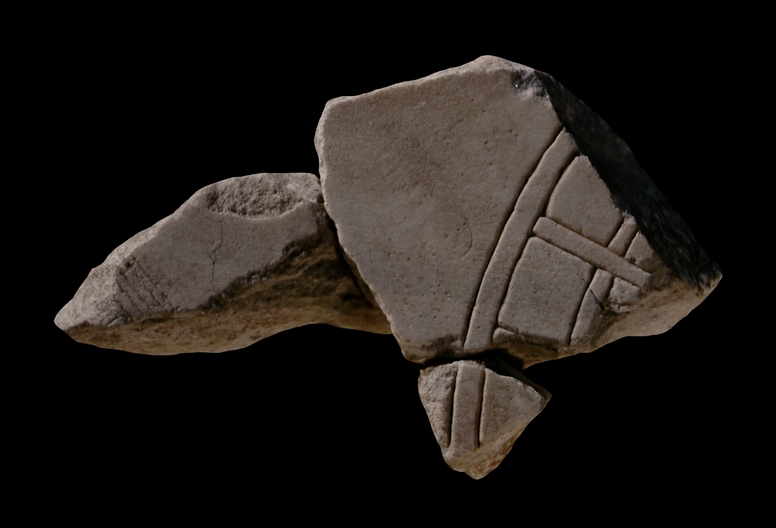
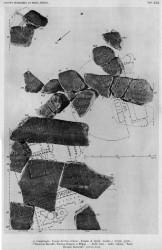
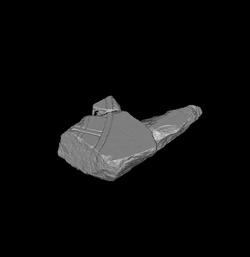
| Description To the right are two double-lined arcs; they are traversed by two double-lined radials. This arrangement immediately recalls the seating areas of entertainment buildings depicted on the Plan. A dotted circle, incompletely erased, is barely visible at the edge of the curved line. Two straight guide lines traverse the fragment through the circle and beyond it. At the far left are at least five parallel lines depicting part of a wide staircase.
Identification: Theatrum Marcelli The arc depicted in this fragment is a section of the cavea of the Theater of Marcellus (PM 1960, pp. 91-92; AG 1980, p. 114). This stone theater, Rome's second, was begun by Julius Caesar and finished by Augustus, who named it in honor of his sister Octavia's son, Marcellus; it was inaugurated in 13 or 11 BCE. (LTUR V, p. 32). Part of the cavea of the theater is still standing, thanks to its conversion at an early stage into a fortress, then a castle, and finally a private residence for the Orsini family in the 17th century. In the 1930's it was expropriated; shops were removed from its bottom arcade and abutting houses were torn down (LTUR V, p. 32). Renaissance drawings, excavations within the theater, and the standing remains themselves demonstrate that the cavea consisted of three storeys; within each, a complex system of radial corridors and staircases intersecting with annular walkways took the spectators to and from their seats. Each storey was distinguished architecturally on the exterior of the theater: the bottom arcade was open and had pilasters of the Doric order interspersed between the arches; the middle arcade was also open and it was decorated in the Ionic order; the top section probably consisted of blind arches, embellished with pilasters of the Corinthian order (LTUR V, p. 33; Richardson 1992, p. 383).
The Marble Plan generally depicts the ground plan of buildings. In the case of the entertainment buildings, however, the engravers of the Plan diverged from the rule and showed entire or parts of buildings as seen from above (see for example the fragments of the Colosseum, the Circus Maximus, and the Theater of Pompey). The cavea of the Theater of Marcellus is rendered partially in bird's eye view; the rows of seats are depicted rather than the rooms, staircases and passageways at ground level. On other entertainment buildings on the Plan, the concentric lines designate the praecinctiones that divided the seating area according to rank. In the case of the Theater of Marcellus, however, there are too many lines to denote such divisions. There is also a clear distinction between the rendering of the concentric lines in the outer and the inner half. Perhaps the engravers here used double lines to show the three praecinctiones in the outer half, and the single lines to convey the idea of rows of benches in the inner half (Reynolds 1996, p. 87). The radials in this fragment do not represent the walls of the substructure but the stairs that divided the cavea into cunei (PM 1960, p. 91). Other parts of the cavea of the Theater of Marcellus are visible in frs. 31p, 31qrs, and 31il.
Identification: Aedes Bellonae The stairs visible at the far left of this group of fragments belong to a temple, the rest of which is depicted in fr. 31d. For decades referred to as the "unknown temple," it was finally identified by F. Coarelli in 1968 as the Temple of Bellona (Coarelli 1968; LTUR I, p. 192). Coarelli's interpretation of ancient sources led him to locate the Temple of Bellona near the pomerium and the walls of the city, close to the Temple of Apollo, to the Theater of Marcellus, to the Forum Holitorium, and to the Villa Publica, and convinced him that the SE end of the Circus Flaminius was visible from it. The combination of these clues pointed to the "unknown temple" next to the Temple of Apollo as being the Temple of Bellona (Coarelli 1968, pp. 49-72). Vowed in 296 BCE by Appius Claudius Ciecus, the temple was dedicated to the goddess of frenzy in war, Bellona, and it was a frequent site for senate meetings that needed to be held outside the pomerium. The columna Bellica, demarking a plot of enemy soil, stood in front of the temple (Coarelli 1968, p. 54; Richardson 1992, p. 94). Excavations together with the evidence presented in this fragment and in fr. 31d have demonstrated that the temple was a typical Roman podium temple, peripteral, hexastyle, with nine columns along the sides. It had a deep pronaos and a frontal staircase (LTUR I, p. 192). During the Republican period an arcaded portico framed this temple as well as the Temple of Apollo Sosianus next to it (Richardson 1992, p. 58).
Significance These fragments are key to understanding the architecture of the Temple of Bellona and the Theater of Marcellus, structures that are only partially preserved. In the case of the Theater of Marcellus, this fragment also provides insight into the way in which the Plan's engravers departed from the rule of depicting ground-floor walls and spaces in representing the seating area of enertainment buildings (see above). Also significant is the fact that the
Theater of Marcellus is located 30 meters too far to the west and has been turned 13° clockwise from its correct orientation on the Plan -- this represents one of the deformations in the topography on the Marble Plan which happened when the engravers mosaicked together the surveys of different sections of the city. The concentric circle is the compass mark left behind from the process of triangulation by which the buildings were located on the map (Rodríguez-Almeida 1993). Both the Theater of Marcellus and the Temple of Bellona were part of the monumental complex of buildings at the S end of the Campus Martius and the N end of the Forum Boarium, under the Capitoline and adjacent to the city's oldest crossing of the Tiber. They tell a great deal about the development, changing meanings, and complex interactions of monuments in the city, in particular during the Augustan era. |
 Prev
Prev