ID AND LOCATION
| Stanford #
| 31d |
| AG1980 #
| 31d |
| PM1960 #
| 31 d |
| Slab #
| V-12 |
| Adjoins
| 31eno |
CONDITION
| Located
| true |
| Incised
| true |
| Surviving
| true |
| Subfragments
| 1 |
| Plaster Parts
| 0 |
| Back Surface
| smooth |
| Slab Edges
| 0 |
| Clamp Holes
| 0 |
| Tassello
| no |
TECHNICAL INFO
|
|
|
|
|
|
|
|
|
|
|
| ANALYSIS
|
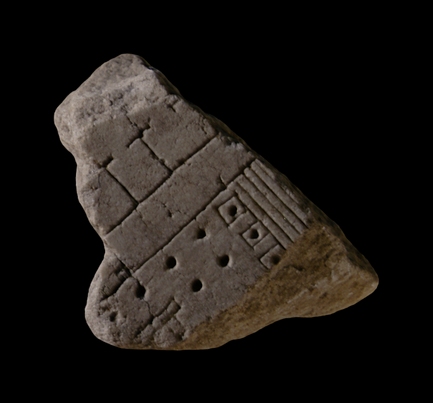
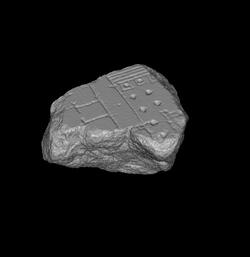
| Description The bottom half of the fragment depicts a corner of a podium temple. The cella is rendered with recessed double lines, as is common on the Plan. It is surrounded by one row of columns and has two columns in antis, all rendered with single dots. A row of dotted squares in front suggests that the temple was faced with a row of six(?) columns on plinths. The frontal staircase had at least five steps. A row of rooms or tabernae backs on to the temple and is separated from it by a narrow passageway.
Identification: Temple of Bellona The joining of this fragment to fr. 31eno, which shows the remainder of the temple staircase and part of the outer curve of the Theater of Marcellus, and indirectly to fr. 31fg which depicts the Temple of Apollo, identifies the temple in this fragment as being the one whose core is still visible today next to the Temple of Apollo and the Theater of Marcellus. For decades referred to as the "Unknown Temple", it was identified as the Temple of Bellona by F. Coarelli in 1968 (Coarelli 1968). Coarelli's interpretation of ancient sources led him to locate the Temple of Bellona near the pomerium and the walls of the city, close to the Temple of Apollo, to the Theater of Marcellus, to the Forum Holitorium, and to the Villa Publica, and convinced him that the SE end of the Circus Flaminius was visible from it. The combination of these clues pointed to the "Unknown Temple" next to the Temple of Apollo as being the Temple of Bellona (Coarelli 1968, pp. 49-72). Vowed in 296 BCE by Appius Claudius Ciecus, the temple was dedicated to the goddess of frenzy in war, Bellona, and it was a frequent site for senate meetings that had to be held outside the pomerium (LTUR I, pp. 190-91). The columna Bellica, marking a plot of enemy soil, stood in front of the temple (Coarelli 1968, p. 54; Richardson 1992, p. 94). Excavations and the evidence presented by this fragment have demonstrated that the temple was a typical Roman podium temple, peripteral, hexastyle, with nine columns along the sides. It had a deep pronaos and a frontal staircase (LTUR I, p. 192, fig. 108).
Significance The fragment helps recreate the architecture of the Temple of Bellona of which little remains. The presence of the row of rooms east of the temple, as seen in this fragment, supports the thesis that the senaculum, the large gathering space which must have been situated south and east of the temple (Fest. 347), had gone out of use and been built over by the time of the early Empire (see Coarelli 1968, pp. 55-56; Richardson 1992, p. 348 [Senaculum]). |
|
| HISTORY OF FRAGMENT |
| Like the majority of FUR fragments, this piece was discovered in 1562 in a garden behind the Church of Saints Cosmas and Damian. From here, it was transferred to the Palazzo Farnese and stored there. The fragment was later used as building material in the 17th-c. construction of the Farnese family's Giardino Segreto (Secret Garden) near the Via Giulia, and was rediscovered in 1888 or 1898 when the walls of the garden were demolished. Since then, it has been stored with the other known FUR fragments in various places: the storerooms of the Commissione Archeologica (1888/1898-1903), the Antiquarium Comunale (1924-1939), the Capitoline Museums (1939-1955), the Palazzo Braschi (1955-1998), and since 1998 in the Museo della Civiltà Romana in EUR under the auspices of the Sovraintendenza ai Beni Culturali del Comune di Roma. (This fragment's history corresponds to Iter E'' as summarized in PM 1960, p. 56.) N.B. PM 1960 does not reveal the whereabouts of the fragment between 1903 and 1924.
Text by Tina Najbjerg |
|
| KEYWORDS
|
| temple, Bellona, portico |
|
 Prev
Prev