ID AND LOCATION
| Stanford #
| 31p |
| AG1980 #
| 31p |
| PM1960 #
| 31 p |
| Slab #
| V-12 |
| Adjoins
| 31eno 31qrs |
CONDITION
| Located
| true |
| Incised
| true |
| Surviving
| true |
| Subfragments
| 1 |
| Plaster Parts
| 0 |
| Back Surface
| smooth |
| Slab Edges
| 0 |
| Clamp Holes
| 0 |
| Tassello
| no |
TECHNICAL INFO
|
|
|
|
|
|
|
|
|
|
|
| ANALYSIS
|
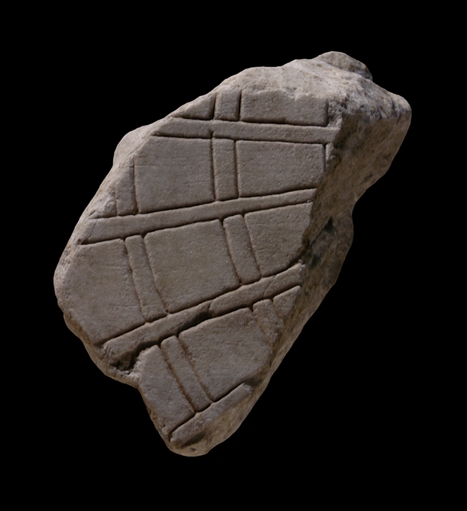
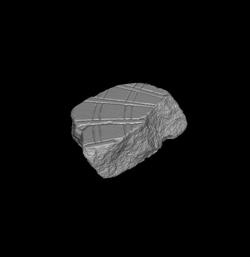
| Description This fragment shows a section of a curved seating area. It is rendered as two double-lined arcs traversed by four double-lined radials.
Identification: Theatrum Marcelli The curved seating area depicted in this fragment is from the cavea of the Theater of Marcellus (PM 1960, pp. 91-92; AG 1980, p. 114). This stone theater, Rome's second, was begun by Julius Caesar who razed several sacred structures to make room for it. The building was finished by Augustus who named it in honor of his sister Octavia's son, Marcellus, and it was inaugurated in 13 or 11 BCE. (LTUR V, pp. 31-32). Part of the cavea of the theater is still standing, thanks to its conversion at an early stage into a fortress, then a castle, and finally a private residence for the Orsini family in 17th century. In the 1930's it was expropriated; shops were removed from its bottom arcade and abutting houses were torn down (LTUR V, p. 32). Excavations within the theater, Renaissance drawings, and the standing remains themselves demonstrate that the cavea consisted of three layers; within each layer a complex system of radial corridors and staircases intersecting with annular walkways brought the spectators to and from their seats. Each layer was distinguished architecturally on the exterior of the cavea: the bottom arcade was open and had pilasters of the Doric order interspersed between the arches; the middle arcade was also open and it was decorated in the Ionic order; the top section probably consisted of blind arches, embellished with pilasters of the Corinthian order (LTUR V, p. 33; Richardson 1992, p. 383). The Marble Plan generally depicts the ground plan of buildings; in the case of the entertainment buildings, however, the engravers of the Plan diverged from the rule and showed entire or parts of buildings as seen from above (see for example the fragments of the Colosseum, the Circus Maximus, and the Theater of Pompey). Also the cavea of the Theater of Marcellus seems to be rendered partially from above. In other entertainment buildings, the concentric lines designate the praecinctiones that divide the seating area according to rank. In the case of the Theater of Marcellus, however, there are too many lines to denote praecinctiones. There is also a clear distinction between the rendering of the concentric lines in the outer and the inner half. Perhaps the engravers here used double lines to show the three praecinctiones in the outer half, and the single lines to convey the idea of rows of benches in the inner half (Reynolds 1996, p. 87). The radials in this fragment do not represent the walls of the substructure but the stairs that divided the cavea into cunei (PM 1960, p. 91). Other parts of the cavea of the Theater of Marcellus are visible in frs. 31eno, 31qrs, and 31il.
Significance This fragment and the others that depict the Theater of Marcellus are key to understanding the architecture of this only partially preserved structure. Also significant is the fact that the Theater is located 30 meters too far to the west and has been turned 13° clockwise from its correct orientation on the Plan -- this represents one of the deformations in the topography on the Marble Plan which happened when the engravers mosaicked together the surveys of different sections of the city (Rodríguez-Almeida 1993). |
|
| HISTORY OF FRAGMENT |
| Like the majority of FUR fragments, this piece was discovered in 1562 in a garden behind the Church of Saints Cosmas and Damian. From here, it was transferred to the Palazzo Farnese and stored there. It was not among the fragments that were reproduced in the Renaissance drawings that are now kept in the Vatican, but Giovanni Pietro Bellori included it in his 1673 publication. In 1742, it was moved to the Capitoline Museums and exhibited with some of the other known fragments in wooden frames along the main staircase. In 1903, museum curators included the fragment in a reconstruction of the FUR mounted on a wall behind the Palazzo dei Conservatori (1903-1924). Since then, the fragment has been stored with the other known FUR fragments in various places: the storerooms of the Antiquarium Comunale (1924-1939), the Capitoline Museums again (1939-1955), the Palazzo Braschi (1955-1998), and since 1998 in the Museo della Civiltà Romana in EUR under the auspices of the Sovraintendenza ai Beni Culturali del Comune di Roma. (This fragment's history corresponds to Iter E as summarized in PM 1960, p. 56.)
Text by Tina Najbjerg |
|
| KEYWORDS
|
| theater, seating |
|
 Prev
Prev