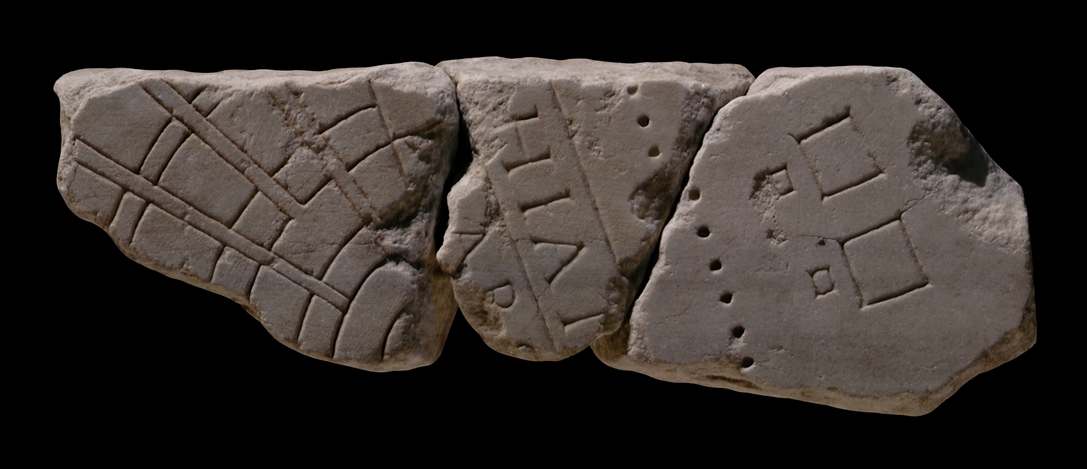
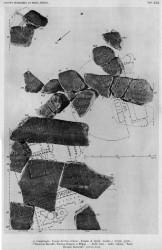
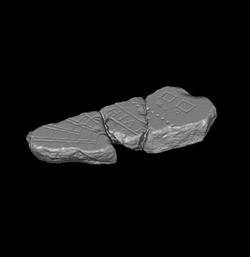
| Description Fr. 31qrs consists of three subfragments, fr. s being part of a slab edge. To the left, the group depicts a section of a semicircular seating area, represented by seven concentric lines crossed by double-lined radials. The two outermost arcs are placed closely together; the remaining five fall in regular intervals towards the center. The two outer double-lined radials stop at the second concentric line from center; the central radial ends even sooner, at the fourth concentric line. A passageway separates the straight side of the semicircular seating area from another structure. The letters [T]HEAT[RVM] and M[AR]CELLI are inscribed in the passageway along the straight end of the semicircular building. Beyond these spaces and the inscription, and parallel to the straight edge of the semicircular structure, lies a colonnade of which nine columns are visible. The six central columns are set back slightly in relation to the others. Behind the colonnade two square structures are placed side by side, each fronted by an even smaller square feature.
Identification: Theatrum Marcelli The inscription on this fragment and on the lost fr. 31mt identifies the semicircular structure as the cavea of the Theater of Marcellus (PM 1960, pp. 91-92; AG 1980, p. 114). This stone theater, Rome's second, was begun by Julius Caesar and finished by Augustus, who named it in honor of his sister Octavia's son, Marcellus; it was inaugurated in 13 or 11 BCE. (LTUR V, pp. 31-32). Part of the cavea of the theater is still standing, thanks to its conversion at an early stage into a fortress, then a castle, and finally a private residence for the Orsini family in 17th century. In the 1930's it was expropriated; shops were removed from its bottom arcade, and abutting houses were torn down (LTUR V, p. 32). Excavations within the theater, Renaissance drawings, and the standing remains themselves demonstrate that the cavea consisted of three storeys; within each storey a complex system of radial corridors and staircases intersecting with annular walkways took the spectators to and from their seats. Each storey was distinguished architecturally on the exterior of the cavea: the bottom arcade was open and had pilasters of the Doric order interspersed between the arches; the middle arcade was also open and was decorated in the Ionic order; the top section probably consisted of blind arches, embellished with pilasters of the Corinthian order (LTUR V, p. 34; Richardson 1992, p. 383).
The Marble Plan in general depicts the ground plan of buildings; in the case of the entertainment buildings, however, the engravers of the Plan diverged from the rule and showed entire or parts of buildings as seen from above (see for example the fragments of the Colosseum, the Circus Maximus, and the Theater of Pompey). Similarly, the cavea of the Theater of Marcellus seems to be rendered partially from above. In other entertainment buildings on the Plan, the concentric lines designate the praecinctiones that divided the seating area according to rank. In the case of the Theater of Marcellus, however, there are too many lines to denote praecinctiones. As seen in this fragment and in frs. 31eno, 31il, and 31p, there is also a clear distinction between the rendering of the concentric lines in the outer and the inner half of the cavea. Perhaps the engravers used double lines to show the three praecinctiones in the outer half, and the single lines to convey the idea of rows of benches in the inner half (Reynolds 1996, p. 87). The radials in this fragment do not represent the walls of the substructure but the stairs that divided the cavea into cunei, accessible from varying depths of the substructure of the cavea. The trapezoidal shapes that flank the orchestra are the tribunals (PM 1960, pp. 91-92).
The architecture of the unusual stage building of the Theater of Marcellus is mainly known from this fragment and from the lost fr. 31mt. It consisted of a shallow, rectilinear scaenae frons with only a single colonnade as backdrop. It has been suggested that the four enormous columns that Augustus removed from the house of Scaurus were among the six central columns seen in this fragment; as is visible here, they were highlighted by being set back slightly from the rest of the colonnade (Richardson 1992, p. 382). The stage was flanked on each side by apsidal and probably crossvaulted aulae. These opened up to the passageway that divided the stage from the cavea. The sides of the aulae were open and consisted of double rows of pilasters and columns (LTUR V, pp. 34-35). Recent excavations have revealed the pavement and a few of the pilasters and corresponding columns from the E aula (LTUR V, fig. 19). The excavations also unearthed traces of the Temple of Pietas, which Caesar destroyed to make room for the theater; this suggests that the aulae were constructed at the same time as the rest of the theater (LTUR V, p. 35). Reconstructions based on the Marble Plan show a wall connecting the back of the two aulae: on the sides it runs parallel to the scaenae frons, then it extends towards the Tiber in a great semicircle (see reconstruction in PM 1960, p. 92). Excavations in 1999 revealed traces of this wall, which probably served as protection against flooding, and of the pavement within, thus confirming the unusual shape of the building as depicted on the Marble Plan (LTUR V, p. 35). F. Coarelli has identified the two square features, centrally located behind the colonnade, as small temples with altars in front, one dedicated to Pietas and the other to Diana (Coarelli 1997, pp. 451, 486).
Significance Together with frs. 31il and the missing 31mt, this fragment is key to our knowledge of the architecture of the stage building of the Theater of Marcellus. Also significant is the fact that the Theater of Marcellus is located 30 meters too far to the west and has been turned 13° clockwise from its correct orientation on the Plan -- this represents one of the deformations in the topography on the Marble Plan that happened when the engravers mosaicked together the surveys of different sections of the city (Rodríguez-Almeida 1993). |
 Prev
Prev