ID AND LOCATION
| Stanford #
| 32b |
| AG1980 #
| 32b |
| PM1960 #
| 32 b |
| Slab #
| V-13 |
| Adjoins
| 32cde 32f |
CONDITION
| Located
| true |
| Incised
| true |
| Surviving
| false |
| Slab Edges
| 0 |
| Clamp Holes
| 0 |
| Tassello
| no | |
|
|
|
|
|
BIBLIOGRAPHY
- AG 1980, pp. 115-18, pl. 24
- LTUR III: Aesculapius, Aedes, Templum (Insula Tiberina)(D. Degrassi), pp. 21-22
- LTUR III: Insula Tiberina (D. Degrassi), pp. 99-101
- LTUR V: Vicus Censori (D. Degrassi), p. 157
- PM 1960, pp. 93-4, 149, pls. 13, 30, 54
- Richardson 1992, pp. 3-4 (Aesculapius, Aedes); pp. 209-210 (Insula Tiberina); p. 422 (Vicus Censori)
|
|
|

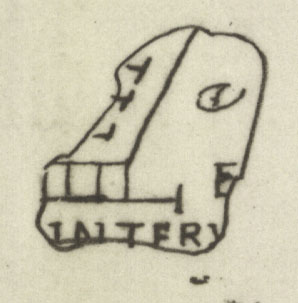
Detail from Cod. Vat. Lat. 3439 - Fo 22r,
reproduced from PM 1960, pl. 13 | |
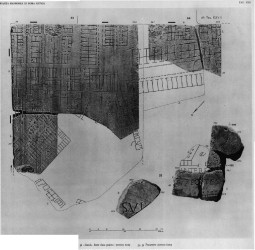
PM 1960 Plates: 13 30
AG 1980 Plates: 24
|
|
| IDENTIFICATION |
| Renaissance drawing: Tiber Island (insula Tiberina) with a section of Censorius Street (vicus Censori)
|
|
| INSCRIPTION
Epigraphic conventions used |
| Transcription |
| None; the fragment itself is lost
|
| Renaissance Transcription |
| INTER*V
|
| Reconstruction |
| [INTER D]UOS PONTES (with fr. 32cde: AG 1980; PM 1960) |
|
|
|
|
|
| ANALYSIS
|
| Description This fragment is missing, but fortunately it was reproduced in Renaissance drawing Cod. Vat. Lat. 3439 - Fo 22r (see photographic detail above or PM 1960, pl. 13). The drawing shows that the fragment depicted, on the left, a triangular structure with a horizontal row of rooms or tabernae at the bottom, and additional rooms extending from this row in an oblique angle to the upper right. A line in front of this skewed row of shops may have denoted the edge of a sidewalk or a wall. On the right there was an open, triangular space, framed at the bottom by a wall that extended from the horizontal row of shops and by a rectangular room to the right of it. In the center of this piazza lay a small, strange feature, in the shape of a lower case e.
Identification: Insula Tiberina L. Cozza was able to match this lost fragment to frs. 32c and, during the printing of PM 1960, to frs. 560 and 549, which were renamed 32e and 32f (hence the dual appearance of these in PM 1960, pls. 30 and 54). The matches allowed Cozza to identify these pieces as belonging to the area of Tiber Island where the two bridges, the Cestius and the Fabricius, met (PM 1960, p. 93). The island was referred to in antiquity as the insula Tiberina, insula Tiberis, isula Tiberini, insula Aesculapi, or simply insula (LTUR III, p. 99). Part of one of these labels is visible in fr. 32a. Despite its importance in Rome's earliest history, when it was the only point at which the treacherous Tiber could be crossed by a ferry, the tiny island is not mentioned in ancient sources until the 3rd c. BCE, when it became the site of the imported cult of Aesculapius. According to legend, the serpent of Aesculapius and the statue of that god were being brought to Rome in 292 BCE. The serpent left the ship and swam ashore on the island, an act that prompted the creation of a sanctuary to the god there. The island's use as a center of healing continued through the Middle Ages to this day. Even before the 1st c. BCE the island was surrounded by stone foundations to give it the shape of a ship, perhaps to honor the ship on which the cult of Aesculapius was brought to Rome. Remains of the travertine "stern", with a serpent coiled around a staff carved in relief, are still visible on the SE tip. Systematic construction on the island, which was located in the 14th Augustan region, seems to have begun in the 1st c. BCE with the rebuilding of the Temple of Aesculapius and the construction of the two stone bridges, the Fabricius (62 BCE) and the Cestius (mid-1st c. BCE), on either side (LTUR III, p. 100). The evidence provided by this lost fragment and by 32e suggests that the structure above the inscription in these fragments consisted of a triangular courtyard, surrounded by rows of rooms. These rooms were perhaps connected to the sanctuary of Aesculapius, which is believed to have been located on the SE end of the island (LTUR III, p. 100, fig. 62). If this interpretation is correct, then the strangely shaped feature in the center of the triangular courtyard perhaps represents a circular shrine to Aesculapius or, more likely, a snake pit, known from sanctuaries to the god elsewhere in the Mediterranean world.
Identification: Vicus Censori
The open space at the bottom of this fragment, occupied by the letters INTER, seems to have been the main street crossing the island between the two bridges, and it may therefore represent the vicus Censori, the only vicus known to have existed on the island (LTUR III, p. 100). The colonnade that frames the NW edge of this wide street in fr. 32cde heightens the impression of an important thoroughfare.
Significance The partial inscription in this missing fragment helped identify it and frs. 32cde and 32f as belonging to the Tiber Island. |
|
| HISTORY OF FRAGMENT |
| Like the majority of FUR fragments, this piece was discovered in 1562 in a garden behind the Church of Saints Cosmas and Damian. From here, it was transferred to the Palazzo Farnese and stored there. Renaissance engravers reproduced the fragment in 16th-c. drawings that are now kept in the Vatican (for more information about the creation and accuracy of these drawings, see Cod. Vat. Lat. 3439), and Giovanni Pietro Bellori included it in his 1673 publication. The whereabouts of the piece after this date are unknown. (This fragments history corresponds to Iter D as summarized in PM 1960, p. 56.)
Text by Tina Najbjerg
|
|
| KEYWORDS
|
| Tiber, island, colonnade, vicus, courtyard, sanctuary, bridge, snake pit, river |
|
 Prev
Prev