ID AND LOCATION
| Stanford #
| 330(*) |
| AG1980 #
| 330 |
| PM1960 #
| 330 |
| Slab #
| unknown |
| Adjoins
| 284 354 |
CONDITION
| Located
| false |
| Incised
| true |
| Surviving
| true |
| Subfragments
| 1 |
| Plaster Parts
| 0 |
| Back Surface
| smooth |
| Slab Edges
| 2 |
| Clamp Holes
| 1 |
| Tassello
| yes |
TECHNICAL INFO
|
|
|
|
|
|
|
|
|
|
|
| ANALYSIS
|
| [FRAGMENT ANALYSIS IN PROGRESS]
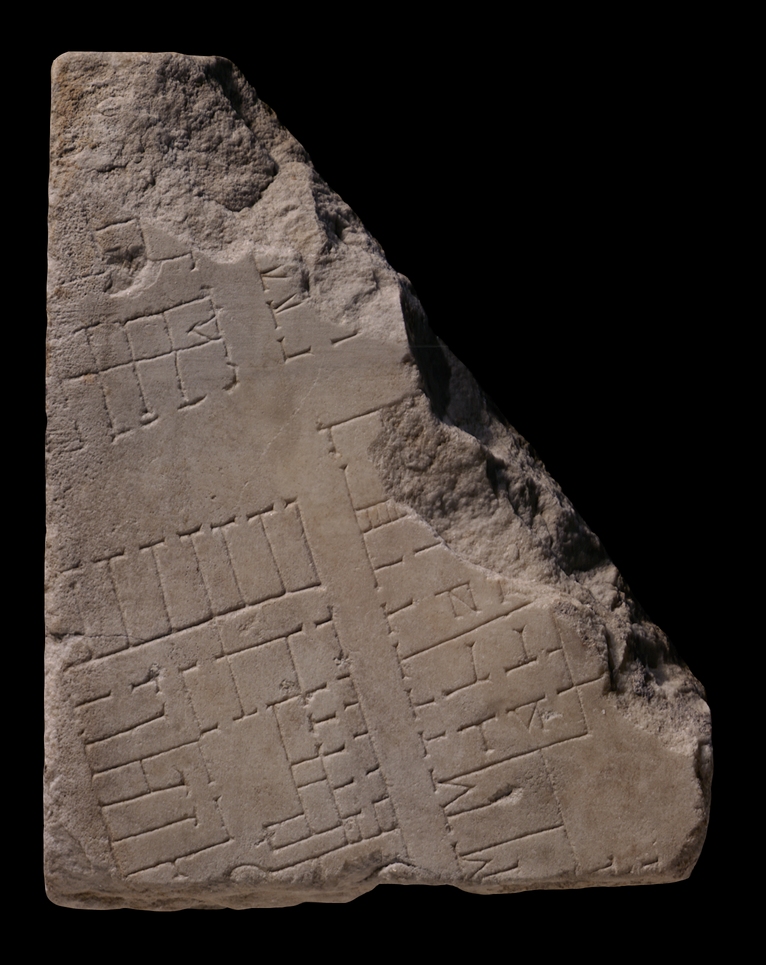
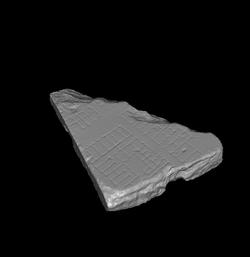
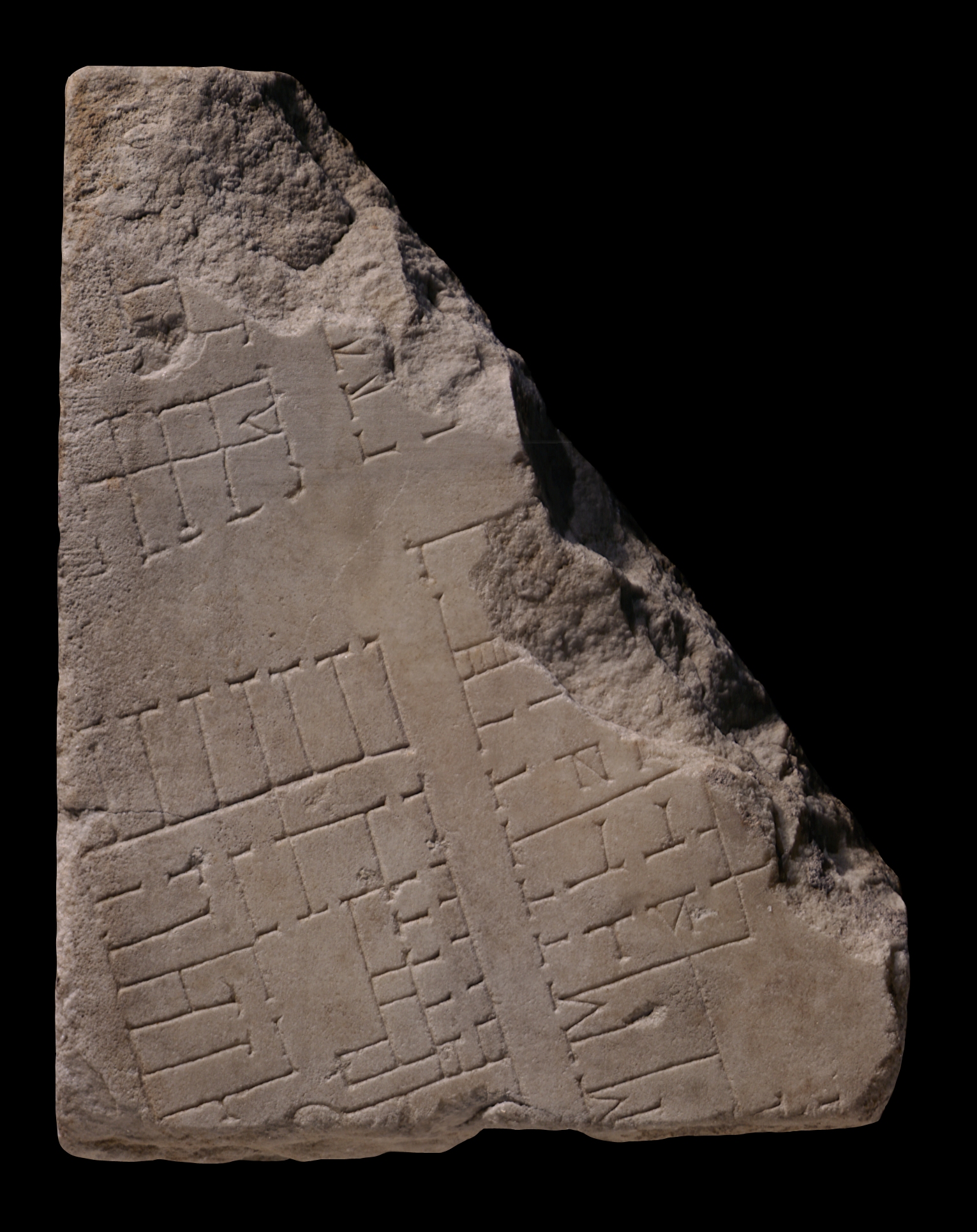
Description This large fragment formed the corner of a slab. A clamp hole is visible on the back (left side), as is a wedge hole (tassello). Five clusters of architecture are
separated by an almost vertical street that traverses the entire fragment.
The top left cluster is separated from a row of tabernae below it by a narrow street or alley. The tabernae of the second, left cluster all have back rooms (the engravers of the Plan did not indicate doorways between the front and the back rooms, but these were probably connected). They face a wide street, across which is another row of tabernae. These shops share a wall with a large, square building with many small rooms that all connect to each other and to a large room in the center, probably an apartment building, an insula. The back of an apse (belonging to a building next door?) is visible at the bottom of the fragment, possibly belonging to a small room on fragment 284. The rooms of the top, right cluster cannot be described with certainty, but they were separated from the large structure in the bottom right corner of the fragment by a street. This large structure consisted of at least four units, separated by walls, which all faced the vertical street: The top room is not preserved but it included a long staircase. Note that the stairs are incised with parallel lines, as opposed to the Z usually employed by the carvers of the Plan. Below it, and perhaps connected to it, a group of rooms opens onto a long, central corridor. One of the rooms
has a small staircase. The structure below it is of same configuration: rooms of different sizes, one with a small staircase, opens onto a central corridor. This structure continues on fragment 354. Both of these structures are of a type known as corridor apartments (see Reynolds 1996, pp. 166-167, cf. fig. 3.24). Finally, two large detached rooms with staircases open up to the vertical street.
Identification E. Rodríguez-Almeida joined this fragment to fr. 284 (Rodríguez-Almeida 1992). The architecture depicted here is both residential and commercial in nature. A good example of this mixed use is offered by
the row of tabernae with back rooms. Such back rooms probably served as domestic or storage space for the persons or family who ran the shop in the front room. In addition, the large apartment structure was faced with shops and was situated right next to a large structure with interconnecting rooms around a central space, which probably was a small, public bath complex, a balneum (Staccioli 1961, p. 99, pl. 44).
Significance With its mixed residential and commercial architecture, the fragment represents one of the non-monumental, and therefore lesser known sections of the ancient city.
|
|
| HISTORY OF FRAGMENT |
| This fragment was found sometime between 1931 and 1938 in the Via dei
Fori Imperiali (PM 1960, p. 134; AG 1980, p. 23). Since then, the fragment h as been stored with the other known FUR fragments in various places: Until 1939 in the storerooms of the Antiquarium Comunale, between 1939 and 1955 in the Capitoline Museums, in the Palazzo Braschi (1955-1998), and since 1998 in the Museo della Civiltà Romana in EUR under the auspices of the Sovraintendenza ai Beni Culturali del Comune di Roma.
Text by Tina Najbjerg and Jennifer Trimble |
|
| KEYWORDS
|
| corridor flats, bath, street, stairs, intersection, single-room shops, shops with back rooms |
|
 Prev
Prev