ID AND LOCATION
| Stanford #
| 354 |
| AG1980 #
| 354 |
| PM1960 #
| 354 |
| Slab #
| unknown |
| Adjoins
| 330 |
CONDITION
| Located
| false |
| Incised
| true |
| Surviving
| true |
| Subfragments
| 1 |
| Plaster Parts
| 0 |
| Back Surface
| smooth |
| Slab Edges
| 0 |
| Clamp Holes
| 0 |
| Tassello
| no |
TECHNICAL INFO
|
|
|
|
|
|
|
|
|
|
|
| ANALYSIS
|
| [FRAGMENT ANALYSIS IN PROGRESS]
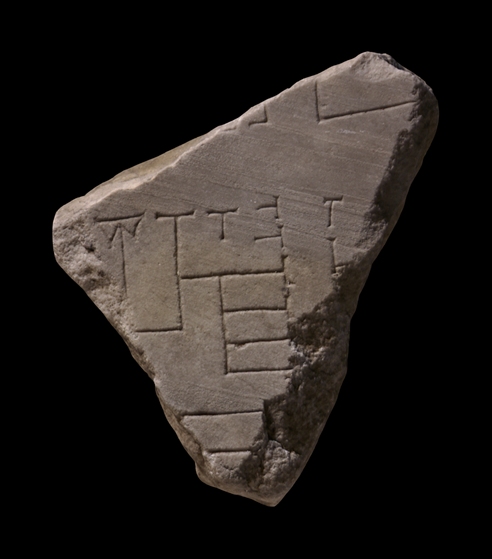
Description A horizontal and a vertical street intersect. The upper right and left corners of the resulting city blocks are barely visible. The insula at bottom right is faced with an arcade. The insula at bottom left consists of rooms of various sizes and shapes that all open up to the street. Two rooms to the far left have staircases.
Identification Some of the rooms in the bottom left insula are tabernae of a type that is commonly depicted on the FUR. Each shop consisted of a single room with a wide opening towards the street that could be screened off a night. The owners probably resided with their families on a wooden platform in the back of the shop, although the small size of these particular tabernae may indicate they were strictly for commercial use. Other rooms in this complex may have been large, single-room apartments. The rectilinear architecture in this fragment is similar to that depicted in the large fragment group 37A.
Identification: match with 330 Boundary incision and veining direction constraints were employed in the suggested match output for fragment 330
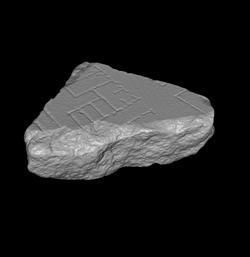
with 354 by the Stanford team (Koller-Levoy 2005, fig. 15).Although only two parallel incised features delimiting a street aligned in the computer algorithm search, the additional third constraint of the marble veining direction limited the relative orientation of these two fragments to only two possibilities and helped to produce a relatively high matching score.
Manual observation of three-dimensional computer models confirmed that the fragments should join immediately adjacent to one another. The computer models (fig. 16) showed that both fragments exhibit unusual smooth, flat areas in their fractured edge surfaces along the proposed interface between the fragments.
Rodríguez-Almeida previously joined fragments 284 and 330 together, resulting in the complete floorplan of an insula (Rodríguez-Almeida 1992 , pp. 64-66). The addition of fr. 354 to this cluster of fragments extends the depicted architecture another block, including another apparent street intersection. A number of features are present that should help to locate these fragments on the Plan, including a slab corner, a clamp hole, and a tassello (fig. 18). Rodríguez-Almeida noted the similarity between the depicted insula and one excavated underneath the Palazzo Piombino along the Via Lata, and a number of alternative locations to position the fragments are under investigation at present, such as along the Via Campana-Portuensis beneath fr. 27.
Significance This fragment is typical of non-identified fragments of the Plan. No monumental buildings are represented, and the fragment instead provides a view of the lesser known structures that made up the urban fabric of Rome: the residential and commercial buildings.
|
|
| HISTORY OF FRAGMENT |
| Like the majority of FUR fragments, this piece was discovered in 1562 in a garden behind the Church of Saints Cosmas and Damian. From here, it was transferred to the Palazzo Farnese and stored there. The fragment was later used as building material in the 17th c. construction of the Farnese familys Giardino Segreto (Secret Garden) near the Via Giulia, and was rediscovered in 1888 or 1898 when the walls of the garden were demolished. Since then, it has been stored with the other known FUR fragments in various places: the storerooms of the Commissione Archeologica (1888/1898-1903), the Antiquarium Comunale (1924-1939), the Capitoline Museums (1939-1955), the Palazzo Braschi (1955-1998), and since 1998 in the Museo della Civiltà Romana in EUR under the auspices of the Sovraintendenza ai Beni Culturali del Comune di Roma. (This fragments history corresponds to Iter E" as summarized in PM 1960, p. 56.) N.B. PM 1960 does not reveal the whereabouts of the fragment between 1903 and 1924.
Text by Tina Najbjerg and Lidewijde de Jong |
|
| KEYWORDS
|
| insula, taberna, stairs, apartments |
|
 Prev
Prev