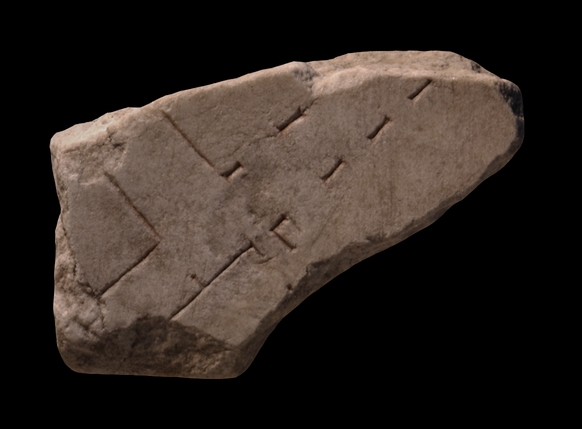
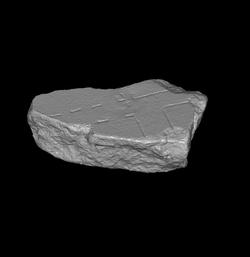
| Description The fragment is part of two slab edges near a corner. It seemingly depicts parts of three buildings. Two joining walls of a building are visible in the lower left part of the fragment. This structure is separate from another at top of the fragment, which seems to consist of a wall that joins with an arcade. A possible thoroughfare separates these two buildings from a structure in the lower right whose outer wall consists partially of a solid wall, partially of an arcade. Where the wall meets the arcade, both turn a corner. This either marks an entrance to the building, or it signifies that there are in reality two structures, separated by a narrow passageway.
Identification: Saepta Iulia In 1937, G. Gatti demonstrated that the two joining walls to the left in this fragment constitute the SW corner of the saepta Iulia (Gatti 1937; PM 1960, p. 97). Also referred to as the Saepta (Cass. Dio 53.23), or Septa (CIL 15.7195), the porticus Saeptorum (Plin., NH 16.201), the Saepta Agrippiana (Hist. Aug. Alex. 26), and the Ovile (Liv. 26.22; Lucan 2.197), the building was planned and perhaps begun by Caesar (Cic. ad Att. 4.16.14) to replace the earlier (wooden?) Saepta, the voting precinct in the campus Martius. It was partly built by M. Aemilius Lepidus (Cass. Dio 53.23), partly by Agrippa who completed and dedicated it and gave it the official designation of saepta Iulia in 26 BCE. Damaged by fire, it was restored by Domitian and later by Hadrian (LTUR IV, p. 228). With the transfer of electoral power from the people to the senate in the beginning of the 1st c. CE, the Saepta lost its original function as Rome's voting precinct and came to serve a variety of purposes including that of a market in luxury goods and a place for recreation and relaxation. According to Pliny (NH 36.29) the building was filled with works of art, including sculptural groups of Olympos and Pan and of Achilles and Chiron.
Gatti demonstrated that Agrippa's Saepta, other parts of which are visible in frs.
35bb,
35gg,
35lpqr,
35nozaa, 35uv, and in the missing
36a, consisted of a large open space, about 120 m. wide and 310 m. long, that was framed on the east and the west by covered colonnades or porticoes (Gatti 1937; Richardson 1992, p. 340; see reconstruction in PM 1960, p. 98 or LTUR I, fig. 122a). Excavations east of the Pantheon have revealed the remains of the back wall of the W portico (see Gatti 1938, fig. 2).
F. Coarelli has determined that the Caesarian and the Agrippan Saepta had similar dimensions, and he suggests that Cicero's reference to Caesar's Saepta as being one mile long (Cic., Att. 4.16.14) was not a reference to the length of the building itself but to the combined length of the covered colonnades that surrounded it on three sides (Coarelli assumes that the N end of the building consisted of a covered colonnade). The combined length of the lateral porticoes (310 m. each) and the short N portico (120 m.) was 740 m., or one half mile. If the porticoes were doublesided (porticus duplices), this would in effect bring their total length to one mile (Coarelli 1997, p. 157-9). Coarelli's thesis is an attractive solution to the mystery of the one-mile long building; his assumption that a covered colonnade framed the Saepta at its N end does not, however, match the evidence presented by the now lost FUR fr. 36. Here, the N end seems to consist of an arcade, or a wall which L. Richardson suggests must have had at least eight openings (Richardson 1992, p. 341). Richardson further points out that this wall must have separated the open, central space of the Saepta from a lobby or entrance hall at the N end, through which the thousands of voters would enter the building.
How to reconstruct the S end of the Saepta is equally uncertain. A solid line, visible in this fragment and frs. 35l, p, and q, seems to represent a party wall between the Saepta and the Diribitorium, simultaneously functioning as the S facade of the Saepta and the back wall of a covered colonnade that flanked the Diribitorium on the north (see reconstruction in PM 1960, pl. 31). Immediately within the S wall of the Saepta lies what seems to be a very wide, T-shaped pier (visible in frs. 35p and 35gg).
The pier must represent the platform (called pons) where votes were dropped when the Saepta still served as Rome's voting precinct. From here the votes would have been transferred to and counted in the Diribitorium (see L. Cozza and L. Ross Taylor's reconstruction of the entire complex in Coarelli 1997, fig. 18).
Identification: Porticus Argonautarum The inscription PORTIC[US] M[ELEA]GRI in frs. 36a, 35uv, and 35nozaa labels the E portico of the Saepta Iulia and indicates that the two porticoes in this building were thought of as individual features (Gatti 1937). Gatti suggested that the W portico, partially visible in this fragment, is identical to the structure referred to as the porticus Argonautarum in an ancient source--a conclusion that is generally accepted today. This building is known (Cass. Dio 53.27.1) to have been constructed by Agrippa in 25 BCE and adorned with painted images of the Argonauts (Gatti 1938). Gatti's proposal (1938) that the building referred to as the porticus agrippiana (schol. ad Iuv. 6.154) is the porticus Argonautarum is dismissed by L. Richardson (1982).
Identification: Diribitorium The building whose corner is visible in the upper right is the Diribitorium, the structure in which the votes cast in the Saepta were counted (PM 1960, p. 100; LTUR II, p. 17). The grandiose building was begun by Agrippa in connection with the construction of the Saepta, but it was completed by Augustus in 7 BCE. Wooden beams, 100 feet long, were used to roof the building, an astonishing feat which made the building a tourist attraction; one of the unused beams was even put on display in the Saepta as a curiosity. After the destruction of its roof in the great fire of 80 CE, the structure remained unroofed (LTUR II, pp. 17-18).
L. Cozza and G. Gatti put an end to the long debate about the location of the Diribitorium when they identified it as the great, rectangular building, 120 by 43 m., that adjoins the S end of the saepta Iulia in this fragment and in fr. 35lpqr (PM 1960, pp. 97-101). As seen in the reconstruction in PM 1960, pl. 31, two parallel lines separate the interior of the Diribitorium from the center of the Saepta. It is uncertain if the elongated space between these lines represents an open corridor or a covered colonnade between the two buildings. It was closed at its E end (see fr. 35l) and open to the street at its W end, as seen in this fragment. This fragment also depicts the principal entrance of the Diribitorium: Richardson has proposed that the two parallel, dashed lines at the W end represent the walls of a lobby with a series of opposing doors (Richardson 1992, p. 110); M. Torelli suggests that only one of these belongs to the Diribitorium proper--the other is probably connected to the area around the Hecatostylum (LTUR II, p. 18). The S wall of the Diribitorium is not visible in the FUR, but possible remains of it were excavated in 1884 under the Corso Vittorio Emanuele, stretching more than 100 m. between via dei Cesari and la Piazza del Gesù (Gatti 1938; PM 1960, p. 100). The E end of the building seems to have been set off from the main part of the structure through a series of columns, niches and exedrae of unknown purpose. A recessed triangle adjoining the N wall probably represents a staircase (LTUR II, p. 18; Richardson 1992, p. 110).
Significance During the printing of PM 1960, the authors discovered that their proposed join of this fragment to frs. 375b and c was erroneous, hence the appearance of the fragment among unidentified fragments in pl. 47, as well as in the group from slab IV-5 in pl. 31. The thickness of the fragment, its veining, and the quality of its incisions enabled the authors to locate it correctly in the corner of slab IV-5 and to identify it as depicting the corners of two known buildings, the saepta Iulia and the Diribitorium.
This fragment has not only helped to identify the Diribitorium and to illuminate the relationship between this building and the Saepta, it also vividly illustrates the cramped conditions in this section of Rome. If Richardson's interpretation of the two dashed lines in this fragment as a W lobby to the Diribitorium is correct, then there was essentially no direct throroughfare from the area between the porticus Minucia and the Largo Argentina to the front of the Saepta, and it is difficult to imagine how thousands of people would make their way from southern Rome to the main entrance of this voting precinct. It is, however, easy to understand why the open space within the Saepta, along with that of the neighboring Porticus of Pompey, later became popular places to stroll and relax and get away from the crowded areas outside. |
 Prev
Prev