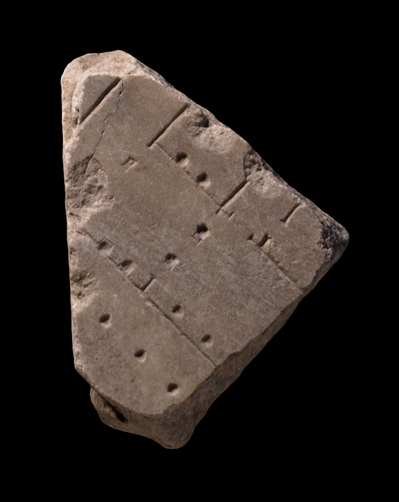
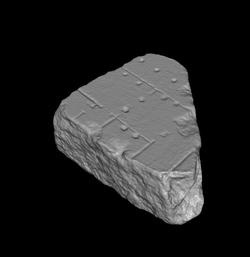
| Description The left side of the fragment was part of a slab edge; a clamp hole is still visible on the edge. The architecture depicts the end of a covered portico with a secondary colonnade running parallel to it on the left. The top section of the covered portico has been partitioned off and made into an entry hall by the addition of two sets of antae and columns. The hall leads from the portico into a perpendicular street or alley. A small exedra or room with two columns on the left abuts the entry hall on the right. Below the entry hall, a door on the right leads from the portico into interior rooms.
Identification: Hecatostylum The portico in the fragment has been identified as the E end of the Hecatostylum, a covered colonnade of 100 columns which Martial (2.14.9) testifies flanked the N side of the Porticus of Pompey but was entirely separate from it (PM 1960, p. 105; LTUR III, p. 9; Richardson 1992, p. 185; AG 1980, p. 130). It was a double-aisled colonnade whose inner colonnade was raised a step above the outer. The step is represented in this fragment as the line that separates the two rows of parallel columns. A large part of this portico as well as part of the identifying inscription are visible in fr. 39ac; fr. 39ac also shows some of the many niches that adorned the back wall of the portico. As demonstrated by this fragment, the Hecatostylum extended beyond the rear of the Porticus of Pompey to flank the N side of the Largo Argentina (see reconstruction in PM 1960, p. 103 and AG 1980, pl. 28). Excavations have revealed the remains of the Hecatostylum that correspond to the section depicted in this fragment, including the back wall of the portico, the southernmost antae and columns that formed the entry hall, and the entrance in the backwall of the portico that led into the smaller rooms on the right (see LTUR III, p. 9 and LTUR II, fig. 97). The excavations also revealed that the line that separated the entry hall from a small room to its right in this fragment was a step, not a wall. The room was thus a distyle exedra that opened up onto the entry hall of the Hecatostylum. The rooms on the right, to which there was access from the Hecatostylum through at least one door, as shown in this fragment, may also have been accessible from the porticus that surrounded the Republican temples in the Largo Argentina (see LTUR II, fig. 97 and LTUR IV, pp. 137-138 [Porticus Minucia Vetus]). F. Coarelli has suggested that the Hecatostylum is to be identified with the porticus Lentulorum, a portico known from ancient sources to have been adjacent to the Theater of Pompey. The porticus Lentulorum was probably constructed by P. Cornelius Lentulus Spinther (consul in 57 BCE) and P. Cornelius Lentulus Crus (consul in 49 BCE). Years later, when the Lentili had disappeared from the political arena, the portico with the hundred columns became known by a name that reflected its architecture rather than its patrons (LTUR III, pp. 9-10; LTUR IV, pp. 125-6).
Identification: Porticus Minucia In 1968, L. Cozza identified the porticus visible in fr. 35dd as the Porticus Minucia or Minicia (Cozza 1968). He was also able to join fr. 35ff to fr. 35ee, thus demonstrating that a podium temple was situated within the porticus Minucia. This great porticus, remains of which have been excavated underneath the Via delle Botteghe Oscure, was bordered by the Diribitorium and the Saepta Iulia to the north, by the Republican temples in the Largo Argentina to the west, and to the south, by the Theater and Cryptoporticus of Balbus. Cozza also demonstrated that the horizontal wall visible at the top of this fragment aligned perfectly with the westernmost wall of the porticus Minucia, which was discovered under the Via San Nicola de' Cesarini (Cozza 1968, p. 19, fig. 2, nos. 7a and x-y). The passageway that runs perpendicular to the Hecatostylum at the top of this fragment can then be identified as the street that separated the porticus Minucia from the Hecatostylum and from the porticus that surrounded the temples in the Largo Argentina. It is interesting to note that the modern Via San Nicola de' Cesarini follows the ancient passageway exactly (see Cozza 1968, fig. 2).
Cozza's identification of the quadriporticus under the Via delle Botteghe Oscure as the Porticus Minucia has not solved all the problems of this enigmatic building, however. While most ancient sources refer to the Porticus Minucia as a single structure, the Regionary Catalogues lists two buildings by the name of Porticus Minucia in Regio IX: The porticus Minucia Vetus and the porticus Minucia Frumentaria (LTUR IV, p. 137). The Porticus Minucia Vetus, which enclosed the Temple to the Lares Permarini and contained a statue of Hercules, was dedicated by M. Minucius Rufus, consul in 110 BCE, and completed in 100 BCE. It was repaired by Domitian, probably after the fire in 80 CE (LTUR IV, p. 137). The Porticus Minucia Frumentaria was a center for grain distribution, probably built in the Claudian period, and it is known to have had 44 ostia, or openings (LTUR IV, p. 134). Scholars are still disputing whether to identify the porticus under the Via delle Botteghe Oscure as the Porticus Minucia Vetus or the Frumentaria. Stressing that there must have been two structures situated next to each other (one perhaps being an extension of the other), scholars like F. Coarelli (1968), C. Nicolet (1976), and E. Rodríguez-Almeida (AG 1980) associate the porticus that surrounds the Republican temples in the Largo Argentina with the Porticus Minucia Vetus; they suggest that Temple D in the Largo Argentina is the Temple to the Lares Permarini; and they identify the quadriporticus underneath the Via delle Botteghe Oscure with the Porticus Minucia Frumentaria and the temple inside it with the Temple to the Nymphs (LTUR IV, p. 132; AG 1980, p. 122; Coarelli 1997). Others, such as Castagnoli (1946 and 1984), G. Rickman (1983), L. Richardson (1992, pp. 315-16), and F. Zevi (1993) follow Cozza's lead and associate the Botteghe Oscure porticus with the Porticus Minucia Vetus and the temple in its center with that of the Lares Permarini (LTUR IV, pp. 132-33). Emphasizing the utilitarian nature of the Frumentaria with its 44 ostia, they disassociate this building with the two traditional porticus-type buildings in the Largo Argentina and under the Via delle Botteghe Oscure, and situate it elsewhere in Rome.
Significance This fragment helps locate the Hecatostylum and clarify its architectural relationship to the porticus Minucia and the Porticus of Pompey. It demonstrates that the Hecatostylum was accessed directly from the street that divided the porticus Minucia from the portico around the Largo Argentina. Fr. 37e shows that the S side of the Porticus of Pompey was closed off and lined with stalls and tabernae; this fragment demonstrates that the Hecatostylum would have served as a formal, perhaps the primary, entrance into the porticus and theater complex. |
 Prev
Prev