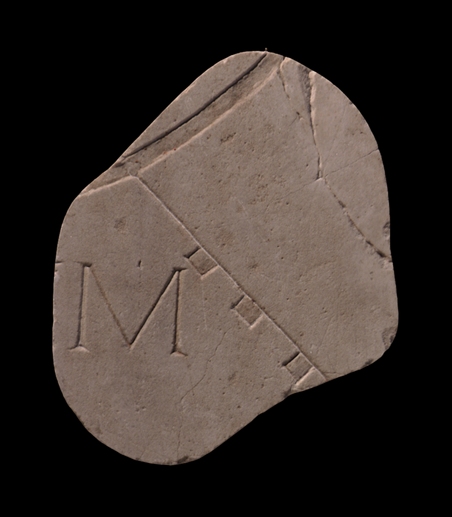
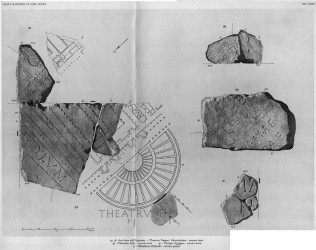
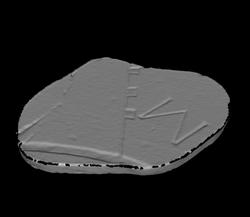
| Description The edges of the piece were rounded and the back sawn off in 1742 when it was inserted into wooden frames for exhibition, hence its overly smooth and rounded appearance. The fragment shows the outer section of a circular or semi-circular feature, rendered with a recessed double line. Three small recessed squares, probably columns, abut a straight wall or edge that extends from the curved structure. A large "M" appears to the left of this wall.
Identification: Theatrum Pompeianum The curved line in this fragment represents the outer wall of the cavea of the great theater of Pompey, variously referred to by ancient authors as the theatrum Pompeium, theatrum Pompeianum, theatrum Marmoreanum, or simply the Theatrum (PM 1960, pp. 104-106, pl. 32; AG 1980, p. 148, pl. 32; LTUR V, p. 35). Inaugurated in 55 BCE, the building was Rome's first permanent stone theater, and it remained the most important theater in the city for centuries (LTUR V, p. 35). It was part of a large complex that included a great porticus (see frs.
37a,
37b [missing],
37d,
37e,
37l,
39ac,
39b,
39d [missing],
and
39g), a curia (frs. 37a, 37b [missing], and 37d), and several temples or shrines (see below). The rest of the theater proper is depicted in the now missing fr. 39de.
On the Plan, the cavea and orchestra of the theater seem to have been depicted in aerial view, while the stage section was rendered in ground plan. The ima and media cavea (there does not seem to have been a summa cavea) were separated by a praecinctio or passageway, a division that would only have been visible from above, not in ground plan. The outer arc of the theater, as seen in this fragment, is rendered with a continuous line, also suggesting an aerial view (PM 1960, p. 104). In ground plan, the outer curve would have been shown with a dashed line as in the Circus Maximus (see fr. 7abcd). How to read the lines that divided the seating area into cunei is continuously debated. Either they represent steps, in which case the view is aerial (Reynolds 1996, pp. 86-87); or the wedges themselves were symbolic representations of the vaults that upheld the structure, i.e. they were seen in ground plan (Richardson 1987, p. 125; LTUR V, p. 37).
The stage was represented in ground plan. Behind the deep pulpitum, the scaenae frons was embellished with a central, rectilinear niche which was flanked by two semicircular niches, all faced with one to three rows of columns (note that Renaissance drawing Cod. Vat. Lat. 3439 - Fo 22r [PM 1960, pl. 13, no. 28] depicts the four central files of columns in the central niche as alternately two and three rows deep, while they are all three rows deep in Renaissance drawing Cod. Vat. Lat. 3439 - Fo. 23r [PM 1960, pl. 14, no. 3]). Five openings in the scaenae frons (one from each of the semicircular niches, three from the central niche, including the porta regia) gave access directly from the porticus Pompeianae to the rear of the stage. In addition, there was access from the Porticus to four triangular rooms behind the semicircular niches in the scaenae frons that probably functioned as storage and changing spaces. Three parallel rows of columns flanked the stage and separated the back wall of the stage from the cavea. The two colonnades closest to the cavea were shown as rows of squares, probably indicating that they were arcades and that the space between them was covered. Strangely, these arcades extend beyond and do not link with the outer wall of the cavea; at the N end, however, they seem to have connected with the W end of the double colonnade of the Hecatostylum (see frs. 39a and 37c).
The theater is today buried under tall buildings, but parts of the substructure are still visible in basements off the Campo dei Fiori. In addition, the inner and outer curves of the cavea are reflected in the layout of buildings and streets in the area (see LTUR V, fig. 25).
Identification: Aedes Veneris Victricis The feature that emerges at a slight angle from the circumference of the theater in this fragment is generally associated with the Temple of Venus Victrix (PM 1960, p. 104). The temple was one of four or five shrines that Pompey supposedly placed around the top rim of the theater, the others being dedicated to Honos, Virtus, Victoria(?), and Felicitas (Richardson 1992, p. 411; LTUR V, p. 36). The squares that line the edge of the proposed temple in this fragment are plain; note, however, that they appear as dotted squares in Renaissance drawing Cod. Vat. Lat. 3439 - fo 23r (see fr. 39de). They have been interpreted as buttresses that stabilized what must have been a very tall platform for the temple (PM 1960, p. 104). Remnants of an apsidal feature in the basement of a building that faces Campo dei Fiori have been associated with this platform (see LTUR V, fig 24). The identification of the structure shown in this fragment as the temple to Venus Victrix has been challenged by Richardson, who suggests that the lines and squares instead represent a tree-lined avenue that led from Pompey's house to his theater (Richardson 1987, p. 126). He adds that temples on the Plan are drawn in ground plan with recessed double lines for emphasis; the feature in this fragment is rendered with a single line and has no interior features, and it has more in common with the two rectangular structures inside Pompey's porticus (see frs. 39ac and 39b, which probably depicted pools or plantations, than with a temple. Richardson finally observes that the feature in this fragment probably is not a temple structure because it is skewed in relation to the axis of the theater. Richardson's theory is intriguing and his reluctance to identify the lines on the FUR as the temple is based on some valid observations but has not met with much acceptance (LTUR V, p. 120). His claim that the squares depicted trees, for example, is unlikely; comparison with the use of such symbols elsewhere on the Plan suggests that they generally represent columns (Reynolds 1996, fig. 2.27).
Significance
The theater of Pompey was the first permanent theater in Rome and highly controversial as such. In the fraught politics of the Late Republic, such a building was threatening in two ways. It provided a potentially uncontrollable place for public assemblies and oratory outside the traditional political space of the Forum, and it provided Pompey with a tremendous source of popular support and hence increased political power. Pompey himself is said to have legitimized this construction by describing the entire theater as a staircase to the Temple of Venus Victrix at the top of the cavea (Gell., 10.1.7; Pliny, NH 8.20, Tert. Spect. 10).
The fragment also offers a cautionary tale about the Renaissance drawings. It clearly shows that the squares that lay along the lines emerging from the arc of the cavea of the theater were plain. The engraver of Renaissance drawing Cod. Vat. Lat. 3439 - fo 23r, however, rendered them as dotted squares, a difference of great significance for the interpretation of the depicted feature.
|
 Prev
Prev