| Description The two now missing fragments 39d and 39e were reproduced in two separate Renaissance drawings, Cod. Vat. Lat. 3439 - Fos 22r and 23r (see photo details above or PM 1960, pls. 13, no. 28 and 14, no. 3). Fo 22r only included fr. 39d; Fo 23r incorporated both 39d and e.
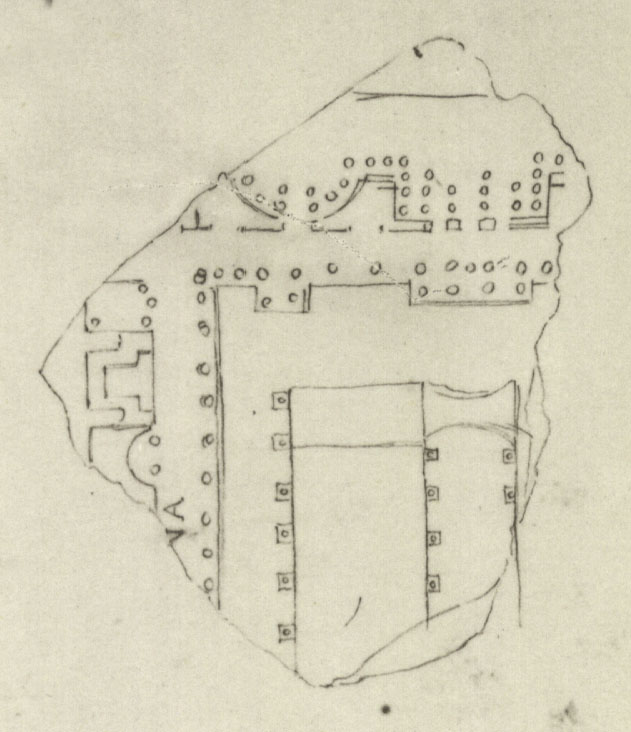
Renaissance drawing Cod. Vat. Lat. 3439 - 22r reproduces the still existing fr. 39b and the now lost fr. 39d. It depicts part of two interconnected buildings. At top, a horizontal wall is pierced by what seems to be eight openings. These lead into a wide, rectilinear exedra on the right, to a semicircular exedra on the left, and to irregular spaces between them. A row of columns follows the outline of the exedrae in front and the wall areas between them. Two additional columns are placed on either side of the opening in the semi-circular exedra; four parallel rows of one or two columns are situated in front of the rectangular niche.
The building below seems to be a porticoed structure, with a single colonnade surrounding an open courtyard. At top, a distyle and a tetrastyle addition to the colonnade align with the semi-circular and the rectilinear niches of the upper structure. Within the courtyard of the porticus lies a rectangular structure surrounded by a row of dotted squares. A similar feature is barely visible to the right. A curved structure, perhaps an arch, connects the two elongated rectangles. The back wall of the porticus on the left is perforated by a distyle, semicircular niche and a tristyle, rectangular room with additional columns in the rear. A T-shaped feature is situated between these two exedrae. Two letters, NA, are visible in the lower left stretch of the colonnaded walkway.
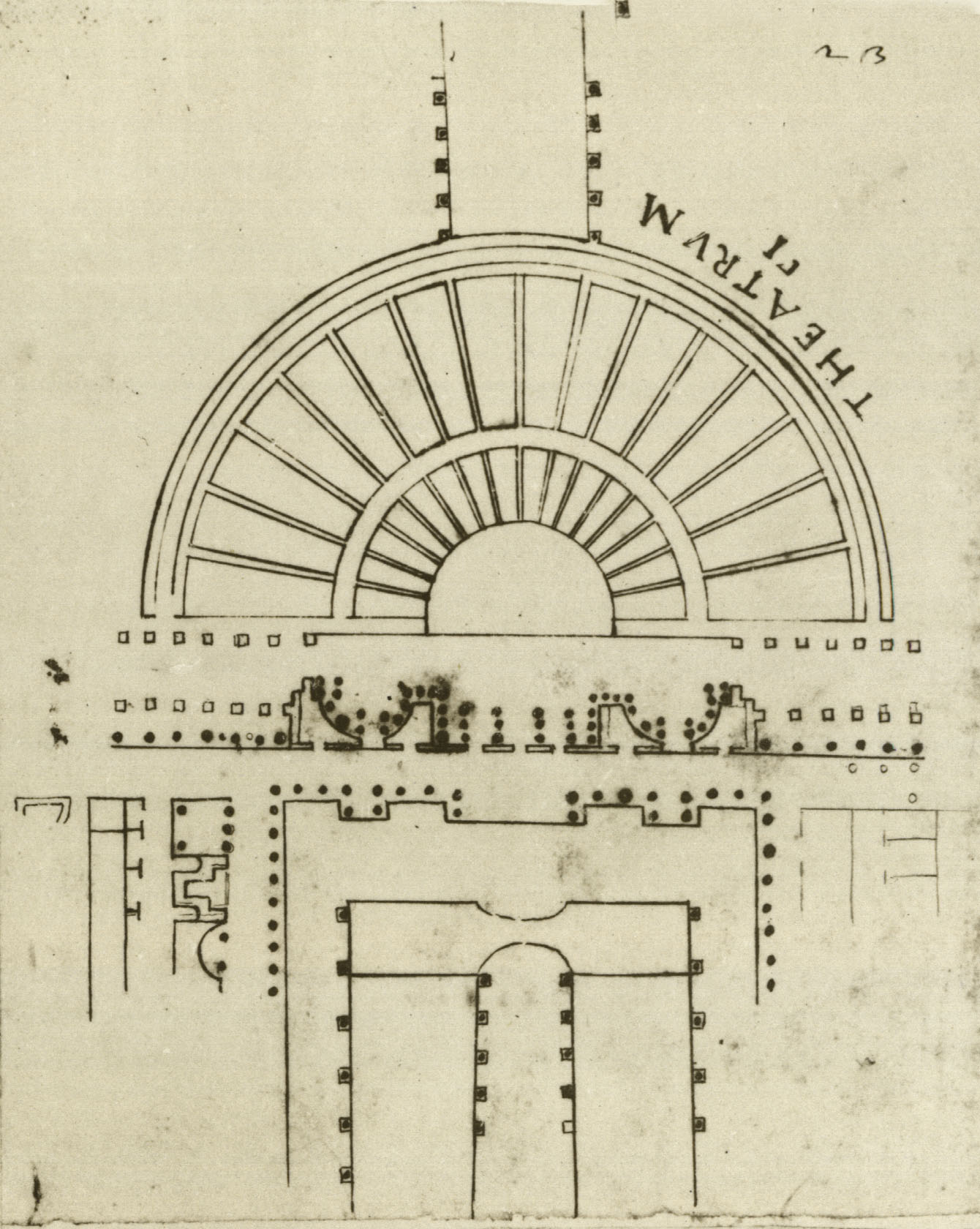
Renaissance drawing Cod. Vat. Lat. 3439 - Fo 23r also reproduces frs. 39b and the missing 39d. In addition, however, the engraver has included frs. 39c (now incorporated with fr. 39a), fr. 39f, and the missing fr. 39e. The Renaissance drawing shows that the fragments depicted the cavea and scaenae frons of a theater and a connecting porticus. The cavea and orchestra of the theater are shown in aerial view, while the stage section is rendered in ground plan. The ima and media cavea (there does not seem to have been a summa cavea) are separated by a praecinctio or passageway, a division that would only have been visible from above, not in ground plan. The outer arc of the theater is rendered with a continuous line, also suggesting an aerial view (PM 1960, p. 104). In ground plan, the outer curve would have been shown with a dashed line as in the Circus Maximus (see fr. 7abcd). How to read the lines that divided the seating area into cunei is continuously debated. Either they represent steps, in which case the view is aerial (Reynolds 1996, pp. 86-87); or the wedges themselves were symbolic representations of the vaults that upheld the structure, i.e. they were seen in ground plan (Richardson 1987, p. 125; LTUR V, p. 37).
The stage is represented in ground plan. Behind the deep pulpitum, the scaenae frons is embellished with a central, rectilinear niche and two flanking semi-circular niches. A row of columns follows the outline of these exedrae and the wall areas between them. Two additional columns are placed on either side of the opening in the semicircular exedra; four parallel rows, two columns deep, are added to the front of the rectangular niche. Five openings in the scaenae frons (one from each of the semicircular niches, three from the central niche, including the porta regia) give access to the rear of the stage. Four triangular rooms behind the semicircular niches in the scaenae frons are accessed from behind the stage; these probably functioned as storage and changing spaces. Three parallel rows of columns flank the stage and separate the postscaenium wall from the cavea. The two colonnades closest to the cavea are shown as rows of squares, probably indicating that they are arcades and that the space between them is covered. A partial inscription, THEATRUM/E*I, is placed along the outer arc of the cavea. At a slightly oblique angle, two parallel lines extend from the outer wall of the cavea. They are lined part way on the outside by dotted squares.
The lower half of Renaissance drawing 23r depicts a porticus that is connected to the back of the theater building. The open, and probably sunken(?), courtyard is surrounded by a row of columns; at top center, a wide step protrudes into the open courtyard. It is flanked by two smaller, distyle steps. Two rectangular features are situated in the center of the open courtyard. They are connected at top by a curved structure which is perhaps an arch. Dotted squares line the long sides of the two rectangular features. On the left, the back wall of the covered colonnade is pierced by a distyle, semicircular niche and a tristyle, rectangular room with two additional columns in the rear. A T-shaped feature is situated between these two exedrae. Behind the left back wall, and parallel to it, lies a row of shops(?). Behind the shops, a strangely shaped feature - triangular? - is visible. It is drawn with double lines. On the right side of the porticus, faint lines indicate a row of shops that matches those on the left side.
Identification: Theatrum Pompeianum The theater depicted in the two missing fragments, 39d and 39e, has been identified as the theater built by Pompey the Great, variously referred to by ancient authors as the theatrum Pompeium, theatrum Pompeianum, theatrum Marmoreanum, or simply the Theatrum (PM 1960, pp. 104-106, pl. 32; AG 1980, p. 148, pl. 32; LTUR V, p. 35). Inaugurated in 55 BCE, the building was Rome's first permanent stone theater, and it remained the most important theater in the city for centuries (LTUR V, p. 35). It was part of a large complex that included a great porticus, a curia, and several temples or shrines (see below). The theater is today buried under tall buildings; only a few parts of the substructure are visible in basements off the Campo dei Fiori, and the inner and outer curves of the cavea are reflected in the layout of buildings and streets in the area (see LTUR V, fig. 25). Renaissance drawings 22r and 23r therefore remain our best source of knowledge of the architecture of the theater.
According to these drawings, the cavea was only divided into two sections (as opposed to the standard three). How to read the lines that divided the seating area into cunei is continuously debated. Either they represent steps (Reynolds 1996, pp. 86-87) or the wedges themselves were symbolic representations of the vaults that upheld the structure (Richardson 1987, p. 125; LTUR V, p. 37).
The stage was deep and flanked on either side by three parallel rows of columns. These separated the postscaenium wall from the cavea. The two colonnades closest to the cavea are shown as rows of squares, probably indicating that they were arcades and that the space between them was covered. Strangely, these arcades extend beyond and do not link with the outer wall of the cavea; at the N end, however, they seem to have connected with the W end of the double colonnade of the Hecatostylum (see frs. 39ac and 37c).
The scaenae frons was embellished with a central, rectilinear niche and two flanking semicircular niches and faced with rows of columns. Five openings in the postscaenium (including the porta regia) gave direct access to the porticus Pompeianae behind the stage. In addition, there was access from the porticus to four triangular rooms behind the semicircular niches in the scaenae frons that probably functioned as storage and changing spaces.
Identification: Aedes Veneris Victricis The feature that emerges at a slight angle from the circumference of the Theater of Pompey, visible in Renaissance drawing 23r and in fr. 39f, is generally associated with the Temple of Venus Victrix (PM 1960, p. 104). The temple was one of four or five shrines that Pompey supposedly placed around the top rim of the theater, the others being dedicated to Honos, Virtus, Victoria(?), and Felicitas (Richardson 1992, p. 411; LTUR V, p. 36). The squares that line the edges of the proposed temple are dotted in Cod. Vat. Lat. 3439 - fo 23r, but the surviving fr. 39f shows that they were plain. They have been interpreted as buttresses that stabilized what must have been a very tall platform for the temple (PM 1960, p. 104). Remnants of an apsidal feature in the basement of a building that faces Campo dei Fiori have been associated with this platform (see LTUR V, fig 24). The identification of the structure as the temple to Venus Victrix has been challenged by Richardson, who suggests that the lines and squares instead represent a tree-lined avenue that led from Pompey's house to his theater (Richardson 1987, p. 126). He adds that temples on the Plan are drawn in ground plan with recessed double lines for emphasis; the feature in this fragment is rendered with a single line and has no interior features, and it has more in common with the two rectangular structures inside Pompey's porticus (see frs. 39ac and 39b, which probably depicted pools or plantations, than with a temple. Richardson finally observes that the feature in this fragment probably is not a temple structure because it is skewed in relation to the axis of the theater. Richardson's theory is intriguing and his reluctance to identify the lines on the FUR as the temple is based on some valid observations but has not met with much acceptance (LTUR V, p. 120).
Identification: Porticus Pompeianae In addition to the Theater of Pompey, the two missing fragments depicted a large section of the adjoining porticus of Pompey, the porticus Pompeia (Prop. 2.32.11), or Pompeianae (Vitr. 5.9.1)(PM 1960, pp. 103-104, pl. 32; AG 1980, pl. 28; LTUR IV, p. 148). Part of the latter name is visible in fr. 39d (see Renaissance drawing 22r and reconstruction in PM 1960, pl. 32). The porticus was one of the components of Pompey's immense theater complex in the Campus Martius, constructed as a whole and inaugurated in 55 BCE (LTUR IV, p. 148) or 52 BCE (Richardson 1992, p. 318). Other parts of the porticus Pompeianae are visible in frs. 37a, 37b (missing), 37d, 37e, 37l, 39b, and 39g (PM 1960, p. 103, pl. 32; AG 1980, p. 148, pls. 28, 32). Vitruvius (5.9.1) explains that Pompey built the porticus behind the theater as a shelter for the spectators in the case of rain, as a place for them to relax and converse, and as a storage area for stage machinery (LTUR IV, p. 148; Richardson 1992, p. 318). Fountains, trees, and expensive art works created an atmosphere of luxury and relaxation. The niches visible in the back wall of the covered portico may have held some of these pieces of art, and the large, rectangular features in the center of the open courtyard perhaps represented pools of water with fountains. According to Propertius (2.32.11-13) the porticus also contained trees that were trimmed to an equal height. Richardson (1992, p. 318) has suggested that the dotted squares surrounding the rectangular pools represent such trees. This, however, would be inconsistent with the use of dotted squares elsewhere on the Plan where they seem to denote columns on plinths (see Reynolds 1996, fig. 2.28).
Significance
The two missing fragments, 39d and e, as represented in the two Renaissance drawings Cod. Vat. Lat. 3439 - Fo 22r and 23r, are key to our knowledge of the architecture of the Theater and Porticus of Pompey and to the relationship between these two buildings. As mentioned above, only a few remnants of these structures are known today. Curiously, there are slight differences in the two Renaissance versions of the buildings. In drawing 22r, the four central files of columns in the central rectilinear niche of the scaenae frons are rendered as alternately two and three rows deep, while they are all three rows deep in 23r. In 22r, there is a clear opening in the leftmost semicircular niche in the scaenae frons; this opening is blocked in 23r. In 22r, four columns are added to the front of the wide, central step of the portico; the step in 23r is left blank except for two columns at each end. Finally, the letters NA in 22r do not appear in 23r. The authors of PM 1960 relied on 22r for their reconstruction of this particular section of Pompey's complex in pl. 32.
|
 Prev
Prev