ID AND LOCATION
| Stanford #
| 39ac |
| AG1980 #
| 39a,c |
| PM1960 #
| 38 a c |
| Slab #
| III-11 |
| Adjoins
| 37a 39b 39de |
CONDITION
| Located
| true |
| Incised
| true |
| Surviving
| true |
| Subfragments
| 2 |
| Plaster Parts
| 0 |
| Back Surface
| smooth |
| Slab Edges
| 2 |
| Clamp Holes
| 2 |
| Tassello
| no |
TECHNICAL INFO
|
|
|
|
|
|
BIBLIOGRAPHY
- AG 1980, p. 148, pls. 28, 31, 32
- LTUR III: Hecatostylum (F. Coarelli), pp. 9-10
- LTUR IV: Porticus Lentulorum (S. Orlandi), pp. 125-126; Porticus Pompei (P. Gros), pp. 148-149
- PM 1960, pp. 103-106, pls. 9, 14, 32, 62
- Reynolds 1996, pp. 86-87, figs. 2.12, 2.28, 2.33
- Richardson 1992, p. 185 (Hecatostylon), pp. 318-319 (Porticus Pompeii)
- Richardson 1987
|
|
|
|
|
| ANALYSIS
|
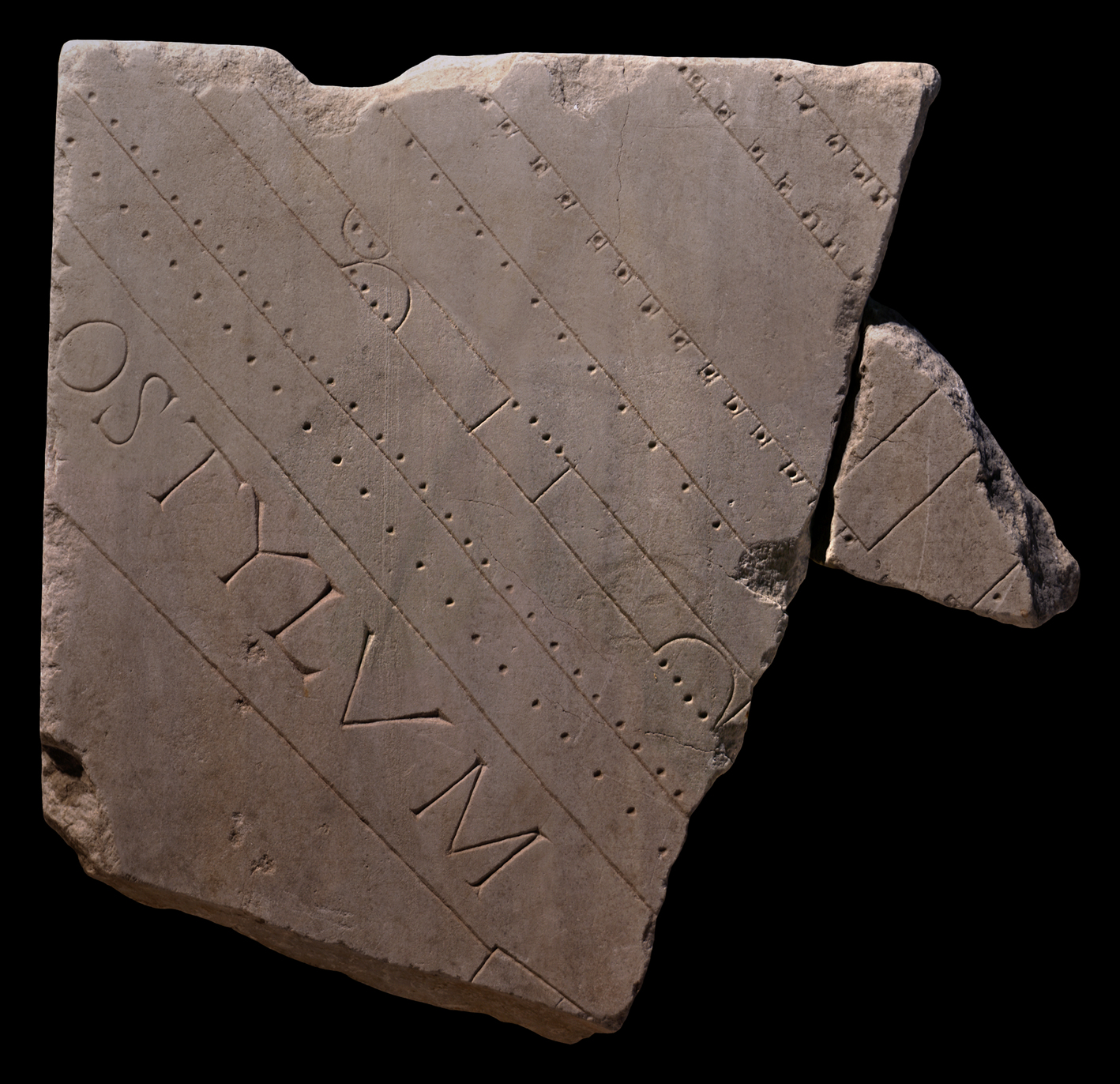
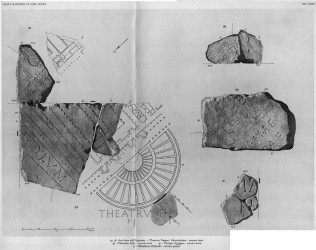
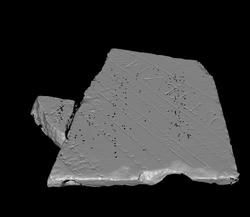
| Description The group consists of two fragments, one large (a) and one small (c). Fr. 39a constitutes the corner of a slab; two clamp holes are visible on the back, as is a veining line. Fr. 39a is traversed diagonally by nine parallel lines; three parallel lines on fr. 39c are perpendicular to these. Dotted squares along lines 1-3 (counting from upper right corner) probably represent columns on plinths that outlined the features delineated here (pools or gardens?). Two of the perpendicular lines on fr. 39c constitute the end of these features. The relationship between lines 4-8 and the columns in between is complex and much disputed but may be reconstructed as follows: Lines 4 and 5 represent, respectively, the roof line and the back wall of a covered portico that faced the rectangular pools; the back wall (line 5) is perforated by a distyle, semicircular niche and by a tetrastyle, rectangular exedra. Lines 6-8 represent another covered portico that was placed back to back to the first portico. The back wall (line 6) of this second portico is perforated by two tetrastyle, semi-circular niches. Line 8 designates the outer roof line, and line 7 represents a step up within this portico (Richardson 1992 p. 185). The area between lines 8 and 9 is probably a street. This space is filled with large letters that spell OSTYLUM and perhaps designates the second portico. In the lower right corner of fr. 39a, line 9 meets the corner of another structure.
Identification: Porticus Pompeianae These two fragments show a large section of the porticus Pompeia (Prop. 2.32.11), or Pompeianae (Vitr. 5.9.1)(PM 1960, pp. 103-104, pl. 32; AG 1980, pl. 28; LTUR IV, p. 148). Part of the latter name may be visible in the now missing fr. 39d (see PM 1960, pl. 32). The porticus was one of the components of Pompey's immense theater complex in the Campus Martius, constructed as a whole and inaugurated in 55 BCE (LTUR IV, p. 148) or 52 BCE (Richardson 1992, p. 318). Other parts of the porticus Pompeianae are visible in frs. 37a, 37b (missing), 37d, 37e, 37l, 39b, 39d (missing), and 39g (PM 1960, p. 103, pl. 32; AG 1980, p. 148, pls. 28, 32). In addition to the porticus, the complex comprised a theater and temples (see fr. 39f for more info on the temples and on the theater itself).
Vitruvius (5.9.1) explains that Pompey built the porticus behind the theater as a shelter for the spectators in the case of rain, as a place for them to relax and converse, and as a storage area for stage machinery (LTUR IV, p. 148; Richardson 1992, p. 318). Fountains, trees, and expensive art works created an atmosphere of luxury and relaxation. The niches visible in the back wall of the covered portico in fr. 39a may have held some of these pieces of art, and the large, rectangular features in the upper right corner of fr. 39a may have represented pools of water with fountains. According to Propertius (2.32.11-13) the porticus also contained trees that were trimmed to an equal height. Richardson (1992, p. 318) has suggested that the dotted squares surrounding the rectangular pools represent such trees. This, however, would be inconsistent with the use of dotted squares elsewhere on the Plan where they seem to denote columns on plinths (see Reynolds 1996 fig. 2.28).
Identification: Hecatostylum The second of the two covered porticoes depicted in fr. 39a is identified by the letters OSTYLUM as the Hecatostylum, a covered portico of 100 columns that is recorded by Martial (2.14.9) as being next to but separate from the porticus Pompeianae (PM 1960, p. 105; LTUR III, p. 9; Richardson 1992, p. 185). It consisted of a two-aisled covered portico, with the outer colonnade separated from the inner with a step (line 7). The E end of the Hecatostylum is visible in fr. 37c (AG 1980, pl. 28). Martial (3.19.1) associated the portico with plantations of trees which Richardson (1992, p. 185) suggests must have been a park north of the porticus Pompeianae. Does line 9 perhaps delineate the S end of such a park? F. Coarelli has suggested that the Hecatostylum is to be identified with the porticus Lentulorum, a portico known from ancient sources to have been adjacent to the Theater of Pompey. The porticus Lentulorum was probably constructed by P. Cornelius Lentulus Spinther (consul in 57 BCE) and P. Cornelius Lentulus Crus (consul in 49 BCE). Years later, when the Lentili had disappeared from the political arena, the portico with the hundred columns became known by a name that reflected its architecture rather than its donors (LTUR III, pp. 9-10; LTUR IV, pp. 125-6).
Significance Fragment 39ac depicts part of one of the most famous buildings of ancient Rome, the theater and portico of Pompey the Great. As only few remains have been revealed by excavations, these fragments are our only visual clue to the nature of this important complex. Excavations reveal, however, that the width of the porticus as represented on the Plan corresponds to its actual width, while the length does not (PM 1960, p. 105). This fragment is also crucial for the identification of the large rectangular fields within the porticus proper: Are they pools of water, garden plots, or built structures? Precursor for solving the problem is determining the symbolic meaning of dotted squares on the Marble Plan: Do they always denote columns on plinths, or can they in some instances represent something non-architectural like trees or plants? This fragment also helps locate the Hecatostylum and clarify its architectural relationship with the porticus Pompeianae. Fr. 37e shows that the S side of the porticus Pompeianae was closed off and lined with stalls and tabernae; this fragment demonstrates that the Hecatostylum would have served as a formal, perhaps the primary, entrance into the porticus and theater complex.
|
|
| HISTORY OF FRAGMENT |
| Together with the majority of the fragments, these were discovered in 1562 behind the Church of Saints Cosmas and Damian. From here, they were transferred to the Palazzo Farnese and stored there. Renaissance engravers reproduced the fragment in 16th-c. drawings that are now kept in the Vatican (Cod. Vat. Lat. 3439). The engraver(s) of Cod. Vat. Lat. 3439, however, failed to recognize the connection between fr. 39a and those he included in his drawing of Pompey's theater (PM 1960, pl. 14.3). The connection between 39a and this group was discovered by Baltard in 1837. In 1742, they were moved to the Capitoline Museums. In 1903, museum curators included the pieces in a reconstruction of the FUR mounted on a wall behind the Palazzo dei Conservatori (1903-1924). Fr. 39c was added in recent times (PM 1960, p. 106). Since 1924, the fragments have been stored with the other known FUR fragments in various places: the storerooms of the Antiquarium Comunale (1924-1939), the Capitoline Museums again (1939-1955), the Palazzo Braschi (1955-1998), and since 1998 in the Museo della Civiltà Romana in EUR under the auspices of the Sovraintendenza ai Beni Culturali del Comune di Roma.
Text by Tina Najbjerg |
|
| KEYWORDS
|
| portico, porticus, pools, garden, trees, niches, exedrae, colonnades, street, step |
|
 Prev
Prev