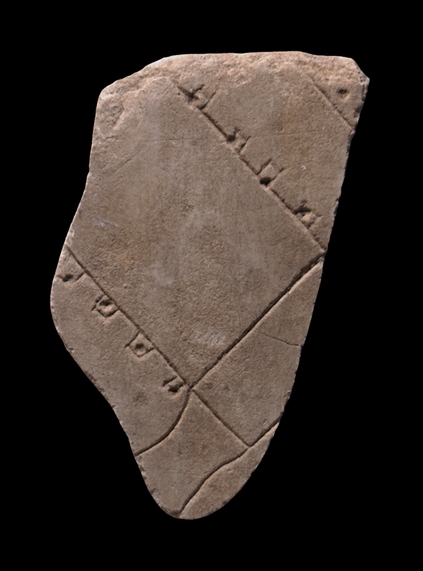
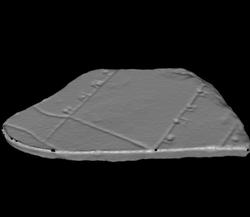
| Description The fragment was part of the edge of a slab. Its edges have been smoothed out and the back sawn off (PM 1960, p. 106). It depicts a large rectangle whose long sides are flanked by dotted squares. A perpendicular line at the bottom separates a section of this rectangle from the rest. Two curved lines extending from the left side of this smaller section of the rectangle probably represent an arch. In the top right corner of the fragment, a small section of a covered portico, parallel to the large rectangle, is visible.
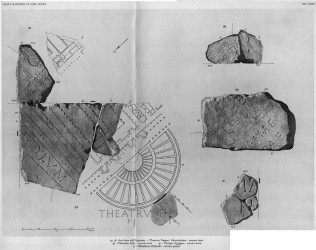
Identification: Porticus Pompeianae The architecture shown in this fragment is part of the porticus Pompeia (Prop. 2.32.11), or Pompeianae (Vitr. 5.9.1)(PM 1960, pp. 104-106, pl. 32; AG 1980, pl. 32; LTUR IV, p. 148). Part of the latter name may be visible in the now missing fr. 39de (see PM 1960, pl. 32). The porticus was one of the components of Pompey's immense theater complex in the Campus Martius, constructed as a whole and inaugurated in 55 BCE (LTUR IV, p. 148) or 52 BCE (Richardson 1992, p. 318). Other parts of the porticus Pompeianae are visible in frs. 37a,
37b (missing),
37d, 37e, 37l,
39ac,
39de (missing), and 39g (PM 1960, p. 103, pl. 32; AG 1980, pls. 28 and 32). In addition to the porticus, the complex comprised a theater and temples (see fr. 39f for information about the temples and about the theater itself).
Vitruvius (5.9.1) explains that Pompey built a porticus behind the theater as a shelter for the spectators in the case of rain, as a place for them to relax and converse, and as a storage area for stage machinery (LTUR IV, p. 148; Richardson 1992, p. 318). Fountains, trees, and expensive art works created an atmosphere of luxury and relaxation. According to Propertius (2.32.11-13) the trees were trimmed to an equal height. Richardson (1992, p. 318) has suggested that the dotted squares surrounding the rectangular features represent such trees. This, however, would be inconsistent with the use of dotted squares elsewhere on the Plan, where they seem to denote columns on plinths (see Reynolds 1996, fig. 2.28). It is more likely that the large, rectangular feature shown in this fragment and in fr. 39ac represented pools of water with fountains, or were planted with trees, and surrounded by columns (LTUR IV, p. 148; Richardson 1992, pp. 318-319). The small rectangle at the end of the large pool or planted space is matched by a similar feature in fr. 39c; they frame what must be an arch, indicating that the features themselves represented the piers of the arch. The arch denoted the central axis of the porticus (PM 1960, p. 105).
Significance Excavations have revealed that the width of the porticus Pompeianae, as demonstrated by this fragment and by fr. 39ac, is rendered correctly on the Plan; the length, however, does not correspond to reality (PM 1960, p. 105). This is, then, yet another instance in which the Marble Plan shows itself to be both highly accurate and inaccurate. This fragment is also crucial to the identification of the large rectangular fields within the porticus proper: Are they pools of water, garden plots, or built structures? Precursor for solving the problem is determining the symbolic meaning of dotted squares on the Marble Plan: Do they always denote columns on plinths, or can they in some instances represent something non-architectural like trees or plants? |
 Prev
Prev