ID AND LOCATION
| Stanford #
| 39g |
| AG1980 #
| 39g |
| PM1960 #
| 639 |
| Slab #
| III-11 |
| Adjoins
| 39de |
CONDITION
| Located
| true |
| Incised
| true |
| Surviving
| true |
| Subfragments
| 1 |
| Plaster Parts
| 0 |
| Back Surface
| not preserved |
| Slab Edges
| 1 |
| Clamp Holes
| 0 |
| Tassello
| no |
TECHNICAL INFO
|
|
|
|
|
|
BIBLIOGRAPHY
- AG 1980, p. 148, pls. 32, 33
- LTUR IV: Porticus Pompei (P. Gros), pp. 148-149
- PM 1960, pp. 104-106, 154, pls. 13, 14, 32, 57
- Richardson 1992, pp. 318-319 (Porticus Pompeii)
|
|
|
|
|
| ANALYSIS
|
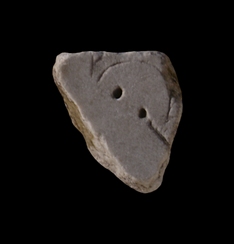
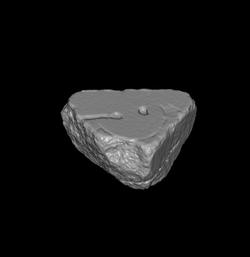
| Description The tiny fragment, which was part of a slab edge, depicts a distyle semi-circular niche or exedra.
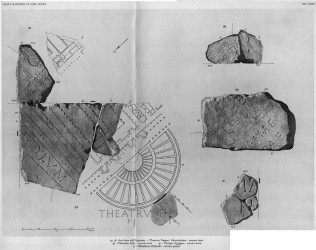
Identification: Porticus Pompeianae E. Rodríguez-Almeida identified the semicircular niche depicted in this fragment as the westernmost exedra in the S portico of the great porticus Pompeianae, visible in the Renaissance drawings of the now missing fr. 39de (AG 1980, p. 148, pls. 32-33; for the Renaissance drawings, see PM 1960, pls. 13 and 14). Similar niches in the N and E walls of the building are visible in frs. 37a, 37b (missing), and 39ac.
The great porticus was one of the components of Pompey's immense theater complex in the Campus Martius, constructed as a whole and inaugurated in 55 BCE (LTUR IV, p. 148) or 52 BCE (Richardson 1992, p. 318). In antiquity, the building was referred to as the porticus Pompeia (Prop. 2.32.110 or, according to Vitruvius (5.9.1), Pompeianae (LTUR IV, p. 148). Two letters, NA, perhaps of the latter name, are visible in one of the two Renaissance drawings of the now missing fr. 39de (PM 1960, pl. 13 and reconstruction in pl. 32). In addition to the porticus, the complex comprised a theater and temples (see fr. 39f for more info on the temples and on the theater itself).
Vitruvius (5.9.1) explains that Pompey built the porticus behind the theater as a shelter for the spectators in the case of rain, as a place for them to relax and converse, and as a storage area for stage machinery (LTUR IV, p. 148; Richardson 1992, p. 318). Fountains, trees, and expensive pieces of art created an atmosphere of luxury and relaxation; niches in the back walls of the covered porticos, like the one visible in this fragment, may have held some of these art works.
Significance Albeit small, the fragment depicts part of one of the most famous buildings of ancient Rome, the theater and portico of Pompey the Great. As only few remains have been revealed by excavations, these fragments are important visual clues to the nature of this enormous structure, and they serve to illustrate and confirm descriptions of the building by ancient authors. |
|
| HISTORY OF FRAGMENT |
| The provenance of this fragment is unknown (PM 1960, p. 154). However, if E. Rodríguez-Almeida is correct in locating the tiny piece in slab III-11, then it must have broken off the larger, now missing fragment 39de which was discovered, along with the majority of pieces, in 1562 behind the Church of Saints Cosmas and Damian. Renaissance engravers reproduced frs. d and e in 16th-c. drawings that are now kept in the Vatican (Vat. Lat. 3439). Their whereabouts thereafter are unknown, but this piece probably broke off from the larger fragment before all known FUR fragments were transferred to the Capitoline museums in 1742. Since then, the fragment has probably been stored with the other known FUR fragments in various places: the storerooms of the Antiquarium Comunale (1924-1939), the Capitoline Museums again (1939-1955), the Palazzo Braschi (1955-1998), and since 1998 in the Museo della Civiltà Romana in EUR under the auspices of the Sovraintendenza ai Beni Culturali del Comune di Roma.
Text by Tina Najbjerg |
|
| KEYWORDS
|
| niche, portico, theater, porticus, column, exedra |
|
 Prev
Prev