ID AND LOCATION
| Stanford #
| 3ab |
| AG1980 #
| 3a-b |
| PM1960 #
| 3 a b |
| Slab #
| X-4 |
| Adjoins
| 3a |
CONDITION
| Located
| true |
| Incised
| true |
| Surviving
| true |
| Subfragments
| 1 |
| Plaster Parts
| 1 |
| Back Surface
| rough |
| Slab Edges
| 0 |
| Clamp Holes
| 0 |
| Tassello
| no |
TECHNICAL INFO
|
|
|
|
|
|
|
|
|
|
|
| ANALYSIS
|
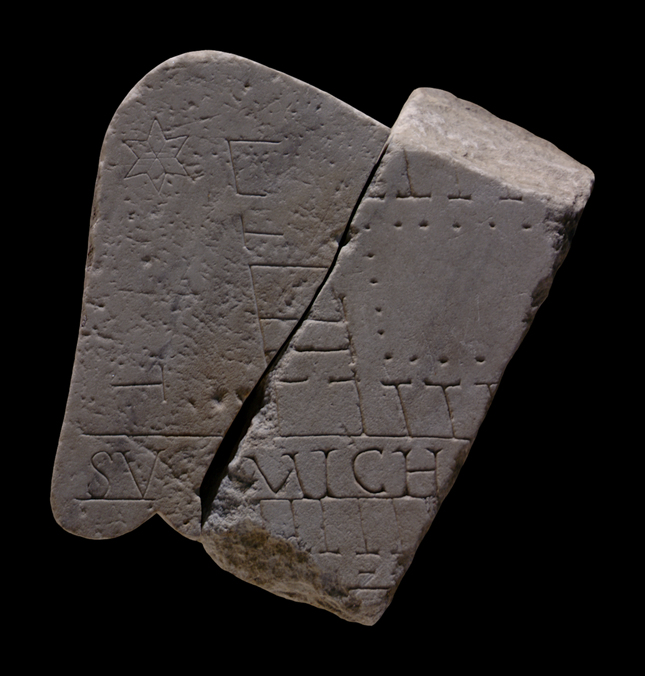
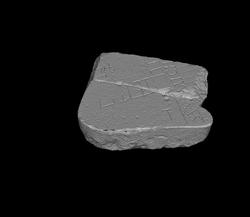
| Description The fragment consists of two parts of which only the one on the right is original. The piece on the left is a plaster copy of the missing fr. 3a, based on Renaissance drawing Cod. Vat. Lat. 3439 - Fo 20r, which reproduced the entire piece before it broke in two. The incised star signifies the plaster cast. Together, the two fragments at the bottom depicted a narrow, horizontal street. An inscription labeled it [VICUS]SVMMICH[ORAGI]. The street separated two features: the one on top consisted of a rectangular courtyard surrounded on at least three sides by columns and by inward-facing rooms. In the open space to the left of this building, a section of a wall (or a sidewalk?) is visible, parallel to the street. Only a tiny part of the lower feature can be seen in this fragment: it consisted of a row of rooms (tabernae?) that backed onto the street and which was faced with an arcade (not a colonnade as incorrectly rendered in the Renaissance drawing [see fr. 3a]). A line in front of the arcade may represent a wall or the edge of a sidewalk.
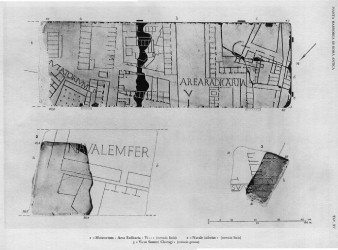
Identification: Vicus Summi Choragi The street in this fragment received its name from the Summum Choragium, one of the annex buildings to the Colosseum. The structure functioned as a storage space for the stage machinery used in the amphitheater (PM 1960, p. 61). The origin of the name is uncertain; it has been suggested that the word summum implies a) that the building had imperial status, or b) that it was the largest of the city's choragia (LTUR IV, p. 386). The Regionary Catalogues, and inscriptions discovered south of the Via Labicana between the Baths of Titus and San Clemente, locate the Summum Choragium in Regio III, somewhere east of the castra Misenatium and west of the ludus Magnus (LTUR IV, p. 386). The precise location of the street in this fragment, to which the Summum Choragium gave its name, is uncertain, but it was presumably close to the building itself. The authors of PM 1960 place this fragment in the lower right corner of slab X-4 (pl. 62a) and E. Rodríguez-Almeida agrees to this positioning (AG 1980, p. 57; Rodríguez-Almeida 1977, fig. 14). K. Welch, however, argues that this location is too far east from the presumed location of the Summum Choragium (LTUR IV, p. 386). L. Richardson suggests that the vicus was a side street that led from the Via Labicana towards the Oppian Hill (Richardson 1992, p. 374). Whether the structures depicted in this fragment represent the actual storage building(s) is uncertain, but not unlikely (Rickman 1971, pp. 112-113).
Significance This fragment and the missing fr. 3a are the only known source for the existence of a street named after the Summum Choragium. Locating this fragment securely on the map would help locate the street in the urban landscape and thus illuminate some of the traffic patterns around the Flavian amphitheater.
|
|
| HISTORY OF FRAGMENT |
| Like the majority of FUR fragments, this piece was discovered in 1562 in a garden behind the Church of Saints Cosmas and Damian. From here, it was transferred to the Palazzo Farnese and stored there. Renaissance engravers reproduced the fragment in 16th-c. drawings that are now kept in the Vatican (for more information about the creation and accuracy of these drawings, see Cod. Vat. Lat. 3439), and Giovanni Pietro Bellori included it in his 1673 publication. Comparison with the present state of conservation shows that the fragment sustained additional damage at some point after that: it broke in two and section 3a was lost. In 1742, the surviving fragment b was moved to the Capitoline Museums and exhibited with some of the other known fragments in wooden frames along the main staircase. At this time, a plaster cast was made of the missing fr. a and this cast was attached to the surviving section b. A star was incised in the plaster part to distinguish it as a replica. In 1903, museum curators included the piece in a reconstruction of the FUR on a wall behind the Palazzo dei Conservatori (1903-1924). Since then, the fragment has been stored with the others in various places: the storerooms of the Antiquarium Comunale (1924-1939), the Capitoline Museums again (1939-1955), the Palazzo Braschi (1955-1998), and since 1998 in the Museo della Civiltà Romana in EUR under the auspices of the Sovraintendenza ai Beni Culturali del Comune di Roma. (This fragments history corresponds to Iter B as summarized in PM 1960, p. 56.)
Text by Tina Najbjerg
|
|
| KEYWORDS
|
| street, arcade, courtyard, rooms, tabernae?, colonnade, horrea?, warehouses? |
|
 Prev
Prev