ID AND LOCATION
CONDITION
| Located
| true |
| Incised
| true |
| Surviving
| true |
| Subfragments
| 1 |
| Plaster Parts
| 0 |
| Back Surface
| smooth |
| Slab Edges
| 1 |
| Clamp Holes
| 1 |
| Tassello
| no |
TECHNICAL INFO
|
|
|
|
|
|
|
|
|
|
|
| ANALYSIS
|
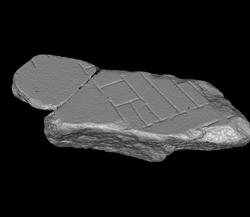
| Description The two joining fragments were part of a slab edge; a partial clamp hole is visible. On the right, a vertical street traverses the fragments. A series of horizontal tabernae opens onto this street from the left. Below these shops is a large room with two smaller rooms or exedra at top. The small room on the left may have an opening in the back.
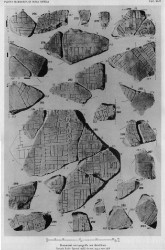
Identification: A section of the Campus Martius From an early stage it was known that fr. 40a and the missing fr. 40b joined with the larger group 40cdefgh, but only during the printing of PM 1960 did its authors realize that fr. 40i also join (see PM 1960, fig. on p. 131). The authors of PM 1960 also recognized that the architecture depicted in the large group consisting of this fragment and of frs. 40cdefgh and 40b belonged to a flat section of Rome (PM 1960, p. 132). Later, E. Rodríguez-Almeida located the entire group to the upper right corner of slab III-12, based on primarily on his identification of the central, vertical street in fr. 40cdefgh as the vicus Stab[u]larius (or vicus Bublarius [PM 1960, pp. 313-132; AG 1980, pp. 149-150]) and his positioning of other fragments in the slabs just above this one (slabs IV-6 and IV-7), one of which contained, he suggested, the beginning of the inscription VICUS STABLARIUS (Rodríguez-Almeida 1970-71, pp. 113-115, fig. 114). This location identified the architecture in the entire group as a section of the flat area of the Campus Martius, right between the Theater of Pompey and the Tiber (see Rodríguez-Almeida 1983a, fig. 3, for an image of this fragment group superimposed on the modern topography of Rome).
Identification: Tabernae and a possible schola
As in fr. 40cdefgh, the architecture of these two fragments consists mainly of single rooms, probably tabernae or shops. Rows of tabernae like those depicted here are one of the most common features on the Marble Plan. Most often, the shops consisted of a single room with a wide opening towards the street that could be screened off a night, while the owners perhaps resided with their families on a wooden platform in the back of the shop. In the larger tabernae, the back of the room might be closed off with a screen to create a separate living space for the family (Reynolds 1996, p. 161).
The large room at bottom may be the meeting hall, schola, for one of Rome's many collegia of artisans, craftsmen, or priesthoods. A collegium of any sort would have required a large room for meetings and communal dining, perhaps a sacellum or altar for the worship of the patron god, and the ability to restrict access to members only. The hall in this fragment seems to fulfill these requirements: The right exedra at top may have been the sacellum, the large room provided ample space for meetings, and access to the hall seems to be restricted to the narrow opening in the room next to the sacellum (not included in the Renaissance drawing but clearly visible in the digital photo of these fragments).
Significance Rodríguez-Almeida's identification and location of the large fragment group to which these fragments belong is a great gain for our knowledge of non-monumental Rome. The group provides excellent evidence for the type of mixed residential and commercial architecture that probably was common in most of Rome's neighborhoods and for the organization and movement through this little known section of the Campus Martius. |
|
| HISTORY OF FRAGMENT |
| Like the majority of FUR fragments, these pieces were discovered in 1562 in a garden behind the Church of Saints Cosmas and Damian. From here, they were transferred to the Palazzo Farnese and stored there. Renaissance engravers reproduced the fragments in 16th-c. drawings that are now kept in the Vatican (Vat. Lat. 3439), and Giovanni Pietro Bellori included them in his 1673 publication. Comparison with the present state of conservation shows that these fragments broke off from the larger piece, 40c, at some point after that. In 1742, they were moved to the Capitoline Museums and exhibited with some of the other fragments in wooden frames along the main staircase. Since then, the fragments have been stored with the other known FUR fragments in various places: the storerooms of the Capitoline Museums (1903-1924), the Antiquarium Comunale (1924-1939), the Capitoline Museums again (1939-1955), the Palazzo Braschi (1955-1998), and since 1998 in the Museo della Civiltà Romana in EUR under the auspices of the Sovraintendenza ai Beni Culturali del Comune di Roma. (The history of these fragments corresponds to Iter B as summarized in PM 1960, p. 56.)
Text by Tina Najbjerg
|
|
| KEYWORDS
|
| street, exedra, tabernae, shops, courtyard |
|
 Prev
Prev