ID AND LOCATION
| Stanford #
| 40cdefgh |
| AG1980 #
| 40c-h |
| PM1960 #
| 285 c-h |
| Slab #
| III-12 |
| Adjoins
| 40ai 40b |
CONDITION
| Located
| true |
| Incised
| true |
| Surviving
| true |
| Subfragments
| 6 |
| Plaster Parts
| 0 |
| Back Surface
| smooth |
| Slab Edges
| 2 |
| Clamp Holes
| 0 |
| Tassello
| no |
TECHNICAL INFO
|
|
|
|
|
|
|
|
|
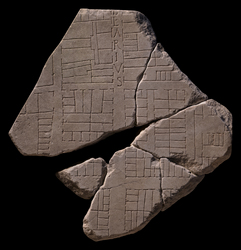
Photograph (Mosaic) (1 MB)
Note about photographs | |
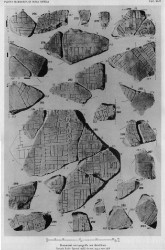
PM 1960 Plates: 8 44
AG 1980 Plates: 33 45
|
|
| IDENTIFICATION |
| Section of city blocks (insulae) in the SW area of the Field of Mars (campus Martius), including the Vicus Stabularius (vicus Stabularius)?
|
|
| INSCRIPTION
Epigraphic conventions used |
| Transcription |
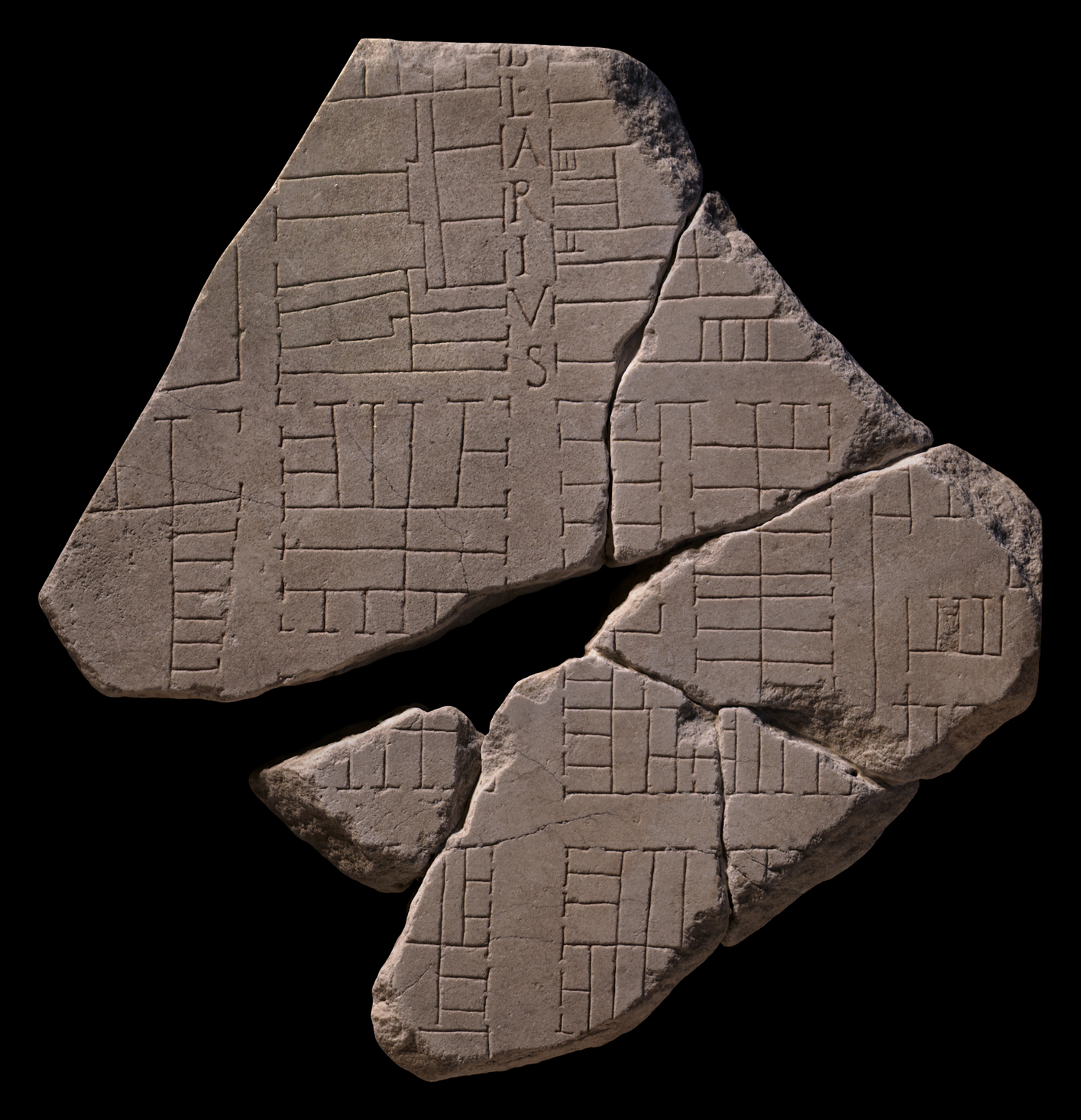
| [---]BLARIVS (vertical)
|
| Renaissance Transcription |
DLARIVS (vertical)
(Cod. Vat. Lat. 3439 -- Fo 18 r, reproduced at PM 1960, pl. 8, no. 1)
|
| Reconstruction |
[VICVS STA]BLARIVS
Vicus StaBLARIVS?, sive BuBLARIVS (AG 1980) |
|
|
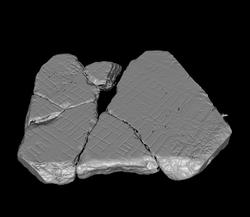
3D Model Full model | Top surface
Download the viewer | Note about 3D models |
|
|
| ANALYSIS
|
| Description The six fragments, now joined, were part of the upper right corner of a slab, with parts of the upper and the right edge still preserved. A vertical street, partially labeled [...]BLARIUS, traverses the group in the center and divides the depicted architecture into two halves. It is paralleled by two narrower, equidistant streets on either side and crossed by two perpendicular streets. The architecture is thus laid on a perfect grid. Most of the nine depicted city blocks (some are only partially visible) consist of single rooms of varying sizes that each have one entrance facing one of the streets mentioned. The blocks or insulae in the upper right corner and the far right fragment stand out by being multi-storeyed. The large block on the center right is unusual in that a vertical corridor onto which several of the rooms open is situated in the center of this particular . Apart from being a multi-storeyed building, the block on the far right also differs from the others in that a wall seems to surround the individual rooms, thus restricting access to them. Was this a hotel? Finally, the block on the far left has, unlike the others, a large central courtyard which is framed by the outward-facing rooms or shops.
Identification: A section of the Campus Martius with the vicus Stabularius? The authors of PM 1960 recognized that the architecture depicted in this large group belonged to a flat section of Rome (PM 1960, p. 132). Later, E. Rodríguez-Almeida located the group to the upper right corner of slab III-12, based on primarily on his identification of the central, vertical street as the vicus Stab[u]larius (or vicus Bublarius [PM 1960, pp. 313-132; AG 1980, pp. 149-150]) and his positioning of other fragments in the slabs just above this one (slabs IV-6 and IV-7), one of which contained, he suggested, the beginning of the inscription VICUS STABLARIUS (Rodríguez-Almeida 1970-71, pp. 113-115, fig. 114). This location identified the architecture in this group as a section of the flat area of the Campus Martius, right between the Theater of Pompey and the Tiber (see Rodríguez-Almeida 1983a, fig. 3, for an image of this fragment group superimposed on the modern topography of Rome).
The architecture of the individual insulae seems to consist of single rooms, most of which are probably tabernae or shops. Rows of tabernae like those depicted here are one of the most common features on the Marble Plan. Most often, the shops consisted of a single room with a wide opening towards the street that could be screened off a night, while the owners perhaps resided with their families on a wooden platform in the back of the shop. In the larger tabernae, the back of the room might be closed off with a screen to create a separate living space for the family (Reynolds 1996, p. 161).
Significance Rodríguez-Almeida's identification and location of this large fragment group is a great gain for our knowledge of non-monumental Rome. The group provides excellent evidence for the type of mixed residential and commercial architecture that probably was common in most of Rome's neighborhoods and for the organization and movement through this little known section of the Campus Martius. |
|
| HISTORY OF FRAGMENT |
| Like the majority of FUR fragments, all six pieces were discovered in 1562 in a garden behind the Church of Saints Cosmas and Damian. From here, they were transferred to the Palazzo Farnese and stored there. Only fr. c was reproduced in Renaissance drawings that are now kept in the Vatican (Vat. Lat. 3439), but Giovanni Pietro Bellori included all but fr. h in his 1673 publication. Comparison with the present state of conservation shows that fr. c sustained damage at some point after that and broke into four pieces (now 40c, 40ai, and the missing 40b). All fragments but fr. h were moved to the Capitoline Museums in 1742 and exhibited with some of the other fragments in wooden frames along the main staircase. Fr. h had been used as building material in the 17th-c. construction of the Farnese familys "Giardino Segreto" (Secret Garden) near the Via Giulia, and it was only rediscovered in 1888 or 1898 when the walls of the garden were demolished. It was then kept in the storerooms of the Commissione Archeologica until 1903. Since 1903, all six fragments have been stored together with the other known FUR fragments in various places: the storerooms of the Capitoline Museums (1903-1924), in the Antiquarium Comunale (1924-1939), the Capitoline Museums again (1939-1955), the Palazzo Braschi (1955-1998), and since 1998 in the Museo della Civiltà Romana in EUR under the auspices of the Sovraintendenza ai Beni Culturali del Comune di Roma. (The histories of frs. c, defg, and h correspond to Iter B, E', and E'' as summarized in PM 1960, p. 56.)
Text by Tina Najbjerg |
|
| KEYWORDS
|
| tabernae, shops, streets, grid plan, stairs |
|
 Prev
Prev