ID AND LOCATION
| Stanford #
| 5Aab |
| AG1980 #
| 5Aa-b |
| PM1960 #
| 42 a b |
| Slab #
| IX-5 |
| Adjoins
| 5Aa |
CONDITION
| Located
| true |
| Incised
| true |
| Surviving
| false |
| Slab Edges
| 0 |
| Clamp Holes
| 0 |
| Tassello
| no | |
|
|
|
|
|
|
|
|
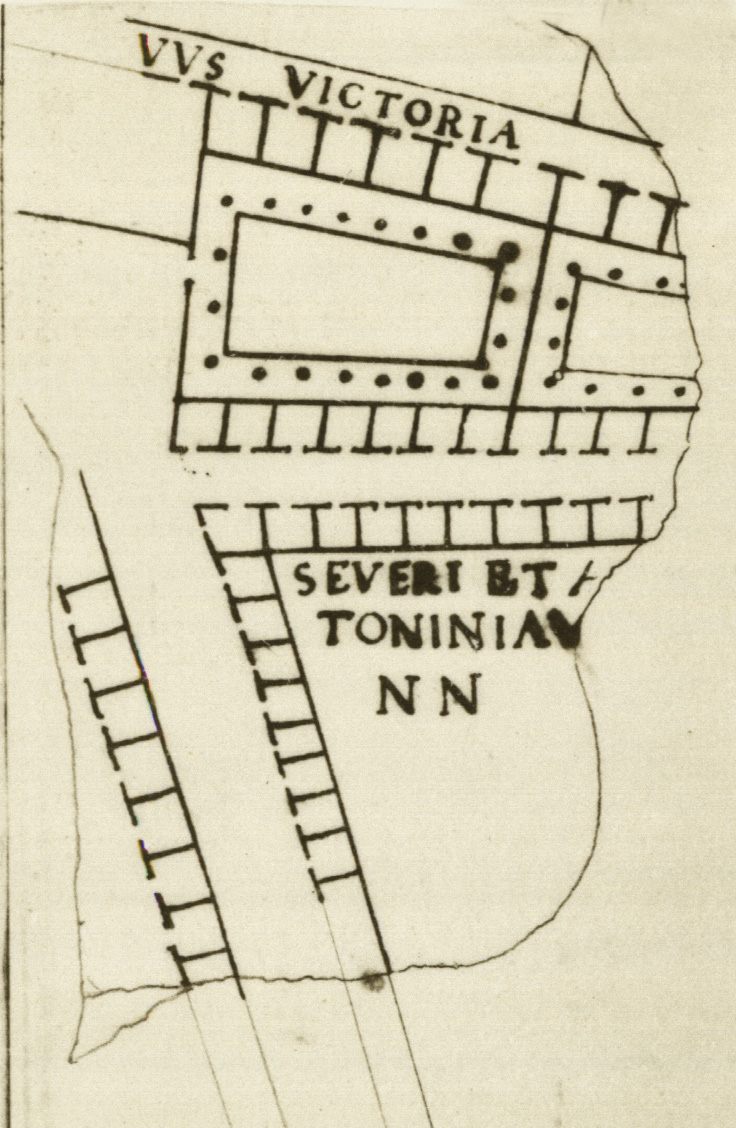
Detail from Cod. Vat. Lat. 3439 - Fo 23r,
reproduced from PM 1960, pl. 14 | |
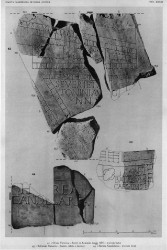
PM 1960 Plates: 14 33
AG 1980 Plates: 3
|
|
| IDENTIFICATION |
Renaissance drawing: Porticoed courtyards and shops (tabernae) north of Victory Street (clivus Victoriae)
Scaurus Street (clivus Scauri)
|
|
| INSCRIPTION |
| None |
|
|
|
|
|
| ANALYSIS
|
| Description The small fragment 5Aab is missing, but Renaissance drawing Cod. Vat. Lat. 3439 - Fo 23r shows it as it looked when still in one piece with frs. 5Aa and 5Ab (see photo detail above or PM 1960, pl. 14, no. 1). The entire left side of the fragment was blank while on the right was the corner of a colonnaded courtyard, faced with shops.
Location: Slab IX-5 The tentative placement of the surviving frs. 5Aa and 5Ab, both of which joined this missing fragment, in slab IX-5 by the authors of PM 1960 (p. 110) has since been solidified by E. Rodríguez-Almeida (AG 1980, pp. 65-69). The location in slab IX-5 seems confirmed by a) the fragments are of same thickness as the securely placed fragment group 5 in the left end of the same slab, b) the marble veining in this group is similar to those in the left side, c) clamp holes along the top of frs. 5Abcd and Aa match two clamp holes in the aula wall exactly, d) the street that runs obliquely from top left to bottom right in this and in frs. 5Abcd and 5Af, coincides exactly with the clivus Scauri, e) the angle of the intersection between this oblique street and the one that traverses the fragments horizontally just above the bottom inscription in fr. 5Abcd coincides exactly with the intersection between the clivus Scauri and an ancient street shown among other places in Colini 1944, pl. 11 (PM 1960, pp. 110-111).
Identification: Clivus Scauri The course of the street that runs obliquely from top left to bottom right in this and in frs. 5Abcd and 5Af corresponds exactly with the clivus Scauri that ran along the NW slope of the Caelian Hill (PM 1960, p. 111; AG 1980, p. 66). The name of the street is known from an inscription (CIL 6.9940) which was discovered in the nearby via Appia (LTUR I, p. 286). The angle of the intersection between the clivus Scauri and the smaller, horizontal street in fr. 5Abcd, just above the bottom inscription, also corresponds with remains of an ancient street depicted in Colini 1944, pl. 11 (PM 1960, p. 111, n.9).
Identification: Colonnaded courtyards north of clivus Victoriae The Renaissance drawing shows that the colonnaded courtyard, of which a corner is visible in this missing fragment, was one of three trapezoidal courtyard on a line, located just north of the street labeled clivus Victoriae. The identity and function of these courtyards are uncertain. They fit well into the ceremonial and monumental nature of this area of Rome, however.
Significance This missing fragment completes the corner of the unidentified colonnaded courtyards north of the clivus Victoriae and corfirms the course of the clivus Scauri. |
|
| HISTORY OF FRAGMENT |
| When discovered in 1562 in a garden behind the Church of Saints Cosmas and Damian, this fragment was part of a much larger piece that included frs. 5Aa and 5Ab. This large piece was transferred to the Palazzo Farnese and stored there. Renaissance engravers reproduced it in 16th-c. drawings that are now kept in the Vatican (for more information about the creation and accuracy of these drawings, see Cod. Vat. Lat. 3439), and Giovanni Pietro Bellori included it in his 1673 publication. Comparison with the present state of conservation shows that the fragment broke into three pieces at some point after that. Of these, only sections a and b survive. A small section between the two, fr. ab, is still missing.
Text by Tina Najbjerg
|
|
| KEYWORDS
|
| street, porticus, peristyle, shops, tabernae, colonnades, courtyards |
|
 Prev
Prev