ID AND LOCATION
| Stanford #
| 5Aa |
| AG1980 #
| 5Aa |
| PM1960 #
| 42 a |
| Slab #
| IX-5 |
| Adjoins
| 5Aab 5Abcd |
CONDITION
| Located
| true |
| Incised
| true |
| Surviving
| true |
| Subfragments
| 1 |
| Plaster Parts
| 0 |
| Back Surface
| smooth |
| Slab Edges
| 1 |
| Clamp Holes
| 1 |
| Tassello
| no |
TECHNICAL INFO
|
|
|
|
|
|
|
|
|
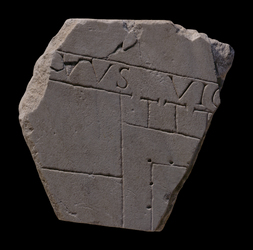
Photograph (Mosaic) (278 KB)
Note about photographs | |
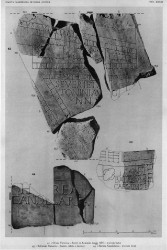
PM 1960 Plates: 14 33
AG 1980 Plates: 3
|
|
| IDENTIFICATION |
| Porticoed courtyard and shops (tabernae) north of Victory Street (clivus Victoriae)
|
|
| INSCRIPTION
Epigraphic conventions used |
| Transcription |
| [---]VVS VIC*[---]
|
| Renaissance Transcription |
[---]VVS VICTORIA
(Cod. Vat. Lat. 3439 - Fo 23 r, reproduced at PM 1960, pl. 14, no. 1)
|
| Reconstruction |
[CLI]VVS VICTORIAE (with frs. 5Abcd: PM 1960)
[CLI]VUS VICTORIAE/SEVERI ET A[N]/TONINI AU[G]G/NN (with fr. 5Abcd: AG 1980)
|
|
|
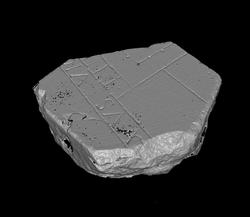
3D Model Full model
Download the viewer | Note about 3D models |
|
|
| ANALYSIS
|
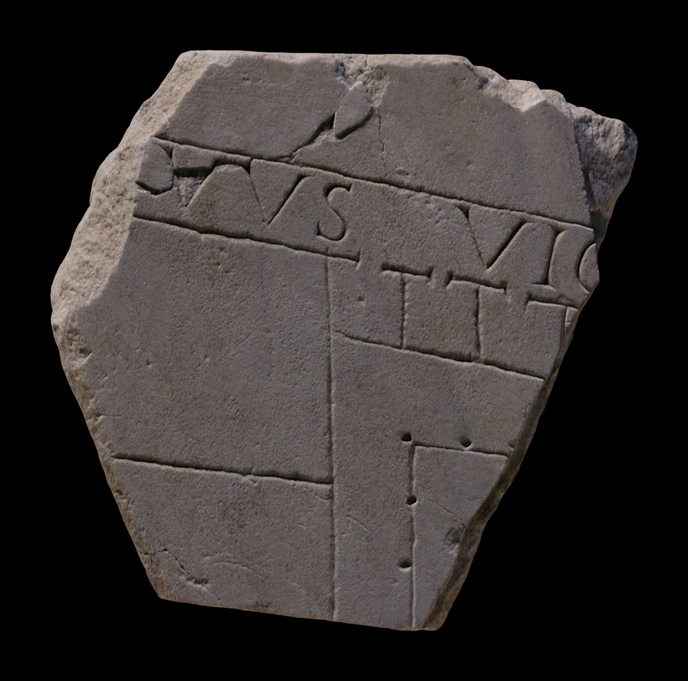
| Description The fragment was part of a slab edge; a clamp hole is visible on the edge. A street traverses the fragment at an almost horizontal angle; part of an inscription, [---]VVS VIC[---] appears in it. Below the street, on the left, are two large enclosures; on the right, the street is flanked by a row of tabernae. These shops back onto a peristyle courtyard of trapezoidal shape. The space above the street appears to be open.
Identification: Clivus Victoriae The street and the inscription continues in fr. 5Abcd, thus identifying the street in this fragment as the clivus Victoriae on the NW slope of the Caelian Hill, not the clivus Victoriae on the Palatine (PM 1960, p. 110, with reservations). E. Rodríguez-Almeida has proposed that this inscription joined with the one at the bottom of fr. 5Abcd to form a single phrase: [CLI]VUS VICTORIAE/SEVERI ET A[N]/TONINI AU[G]G/NN. Perhaps referring to Septimius Severus' Parthian victory in 198 CE, the street was in this way distinguished from the clivus Victoriae on the Palatine (AG 1980, p. 68).
The Caelian clivus Victoriae ran from the S edge of the Temple of the Deified Claudius (visible in fr. 4b) to what looks like a huge piazza in front of the Septizodium (PM 1960, pp. 109-111; AG 1980, pp. 65-67; LTUR I p. 287).
The identification and location of this fragment and the joining fr. 5Abcd and f in slab IX-5 seem confirmed by a) they are of same thickness as the securely placed frs. 5 in the left end of the same slab; b) the direction of the marble veining in this group is similar to those in the left side; c) the clamp hole at top of this fragment matches a clamp hole in the aula wall exactly; d) the street that runs obliquely from top left to bottom right in frs. 5Ab and 5Af coincides more or less with the known clivus Scauri; e) the angle of the intersection between this oblique street and the horizontal one that traverses the center of fr. 5Abde coincides with the intersection between the clivus Scauri and an ancient street shown among other places in Colini 1944, pl. 11; and f) the oblique street would be parallel to the Aqua Claudia than ran from the Caelian Hill to the Palatine (PM 1960, pp. 110-111). In addition, Rodríguez-Almeida has pointed out that the increase in thickness from bottom to top in frs. 5Af, 5Abcd, and 5Aa is similar to the increase seen in the fragments in the left side of the slab (AG 1980, p. 67, fig. 18). Comparison with frs. 5Abcd shows that tabernae lined the N side of the street from the center of this fragment to the open piazza in front of the Septizodium. Behind these shops were three consecutive porticus buildings of trapezoidal shape, seemingly with no access to the street, surrounded by outward-facing shops. They have in the past been identified as ware houses, but it has recently been suggested that since the shops do not open onto the internal courtyards, they are probably not horrea but grandiose market buildings (Insalaco 2003, p. 109).
Significance In combination with frs. 5Abcd and 5Af, this fragment provides the vertical dimensions of the entire slab IX-5. The clamp hole in its top edge proves its precise placement in this slab. It has recently been proposed that certain inconsistensies between the architecture depicted in this fragment and the actual remains on the ground are caused by the same 21-degree skewing that characterizes the Templum Divi Claudi on the same slab (Insalaco 2003, p. 108). Together, these fragments also document some of the important thoroughfares in this monumental section of Rome.
|
|
| HISTORY OF FRAGMENT |
| When discovered in 1562 in a garden behind the Church of Saints Cosmas and Damian, this fragment was part of a larger piece that included frs. 5Abcd and the missing section 5Ae. The large fragment was transferred to the Palazzo Farnese and stored there. Renaissance engravers reproduced the fragment in 16th-c. drawings that are now kept in the Vatican (for more information about the creation and accuracy of these drawings, see Cod. Vat. Lat. 3439), and Giovanni Pietro Bellori included it in his 1673 publication. Comparison with the present state of conservation shows that the large fragment sustained additional damage at some point after that and broke into several pieces, of which this is one. In 1742, it was moved to the Capitoline Museums and exhibited with some of the other known fragments in wooden frames along the main staircase. In 1903, museum curators included the piece in a reconstruction of the FUR on a wall behind the Palazzo dei Conservatori (1903-1924). Since then, the fragment has been stored with the others in various places: the storerooms of the Antiquarium Comunale (1924-1939), the Capitoline Museums again (1939-1955), the Palazzo Braschi (1955-1998), and since 1998 in the Museo della Civiltà Romana in EUR under the auspices of the Sovraintendenza ai Beni Culturali del Comune di Roma. (This fragments history corresponds to Iter B as summarized in PM 1960, p. 56.)
Text by Tina Najbjerg
|
|
| KEYWORDS
|
| street, Caelian, tabernae, peristyle, courtyard, porticus, shops, market, colonnade, columns, |
|
 Prev
Prev