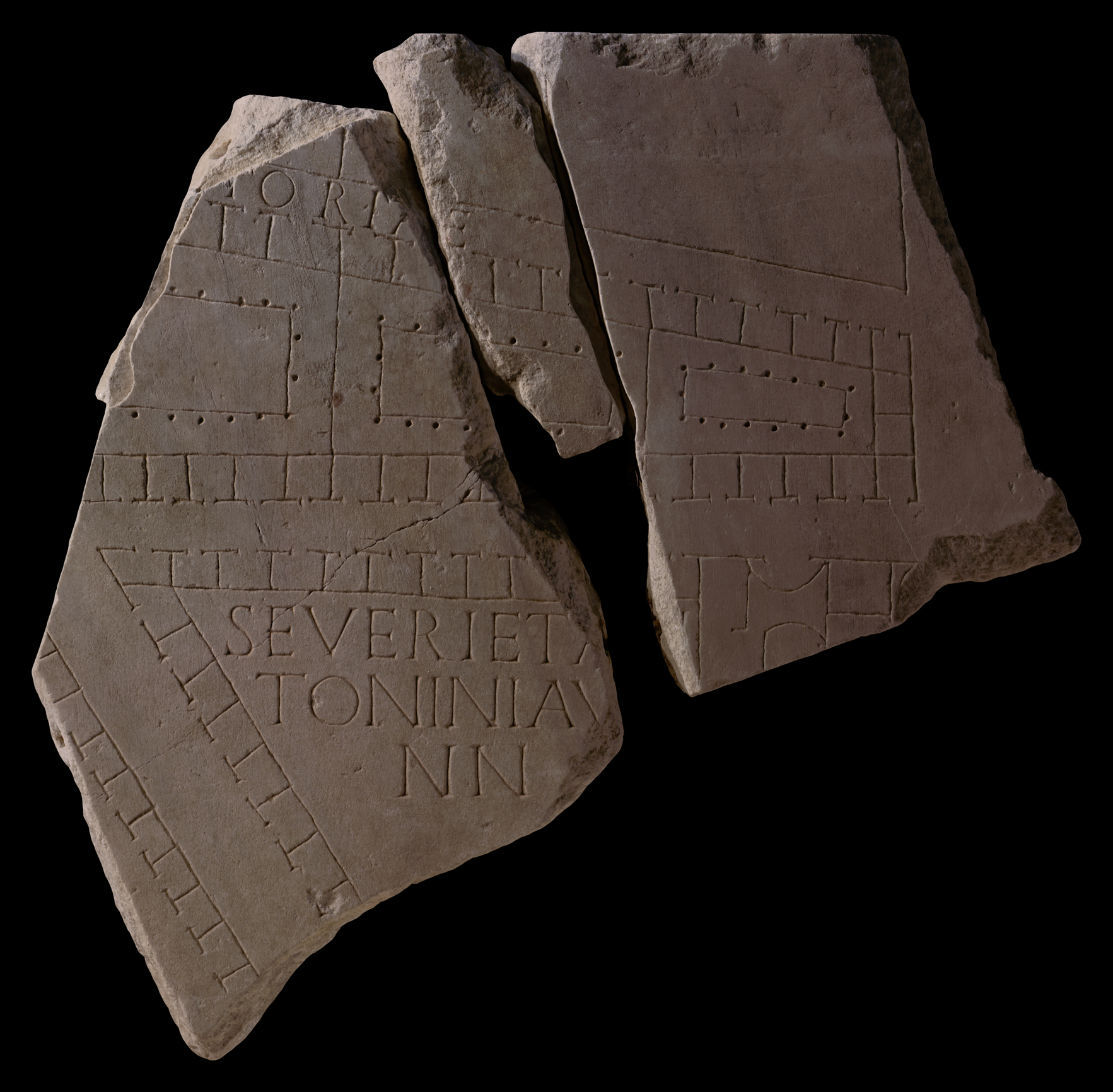
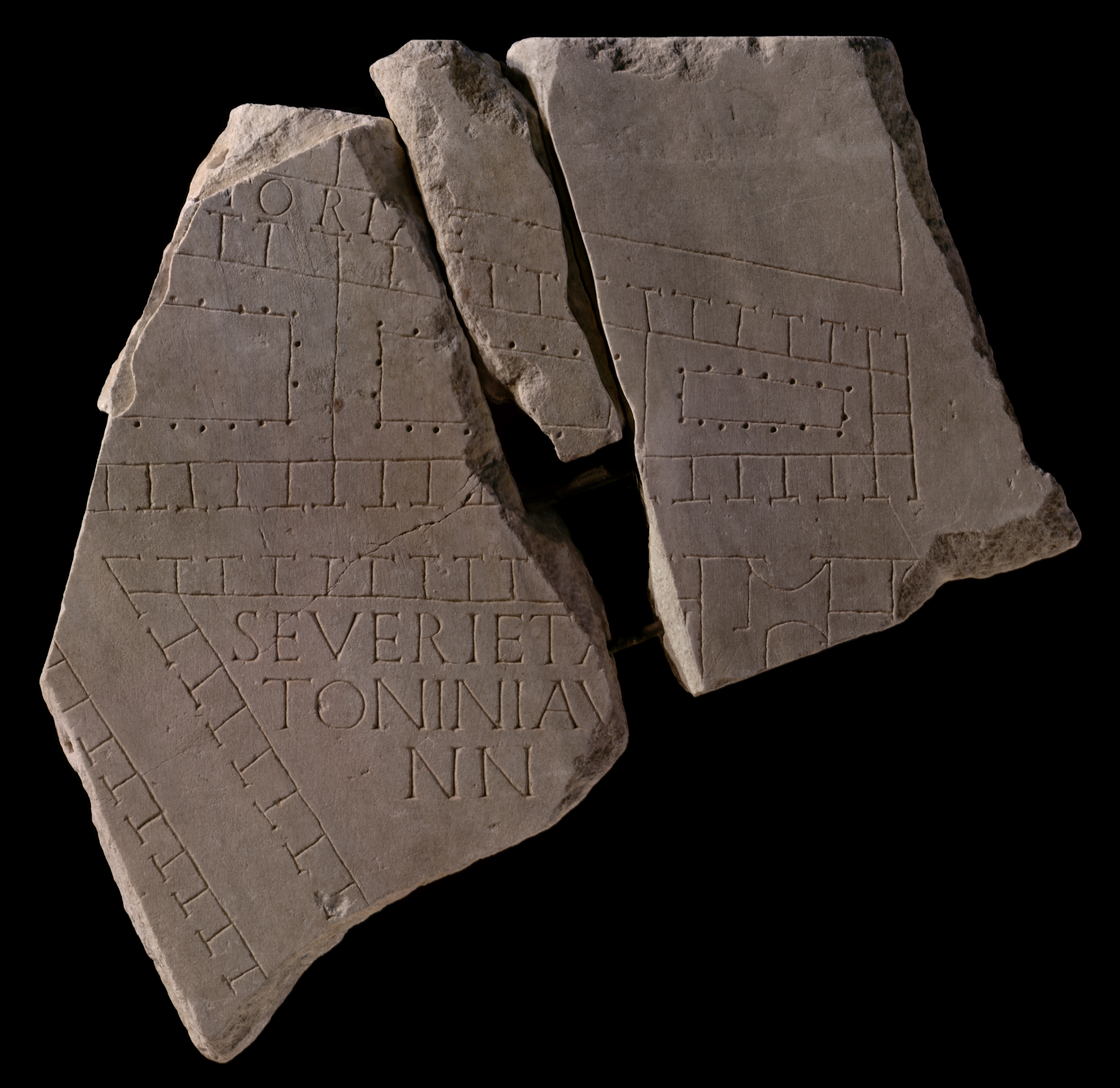
| Description This group was part of the top edge of a slab; there is a clamp hole along the edge. Two streets run left to right across the fragments and flow into a large open space visible at right. The upper street is labeled CLIVVS VICTORIAE, or "Victory Street". It is lined by tabernae below and a wall above. Above this street, three lines probably represent walls around two very large, open spaces. Below, the area between the two streets is occupied by three adjoining courtyards of trapezoidal shapes. These are peristyle courtyards: the open centers are surrounded on all sides by columns. The central area of each one is set off by a line that probably represents not a wall but a step down from a covered, colonnaded walkway into an open area. Curiously, no entrance into any of these courtyards is visible; yet, they must have been accessible from the tabernae that surround them. Below the three courtyards, across the street, is a large, triangular, open space into which is carved the inscription SEVERI ET ANTONINI AVGG NN (meaning either "in the names of the emperors Severus and Antoninus" or "of our emperors Severus and Antoninus"). Rows of tabernae back onto the top and left side of this open space. In the top right corner of the triangular space is a curious feature that might represent an arch or a barrel-vaulted entrance to the area. A third street runs down the fragment's left edge at an oblique angle. It is framed on the right side by a line of tabernae and on the left side by a wall.
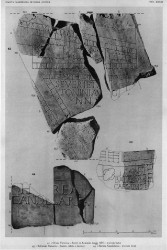
Location: Slab IX-5 The tentative placement of these fragments in slab IX-5 by the authors of PM 1960 (p. 110) has since been solidified by E. Rodríguez-Almeida (AG 1980, pp. 65-69). The location in slab IX-5 seem confirmed by a) the fragments are of same thickness as the securely placed frs. 5 in the left end of the same slab, b) the marble veining in this group is similar to those in the left side, c) the two clamp holes at top of these fragments and the joining fr. 5Aa match two clamp holes in the aula wall exactly, d) the street that runs obliquely from top left to bottom right in this fragment and in fr. 5Af coincides more or less with the clivus Scauri, e) the angle of the intersection between this oblique street and the one that traverses the fragments horizontally just above the bottom inscription coincides with the intersection between the clivus Scauri and an ancient street shown among other places in Colini 1944, pl. 11 (PM 1960, pp. 110-111). It has recently been proposed that certain inconsistensies between the architecture depicted in this fragment and the actual remains on the ground are caused by the same 21 degree-skewing that characterizes the Templum Divi Claudi on the same slab (Insalaco 2003, p. 108).
Identification: Clivus Victoriae
The placement of these fragments in slab IX-5 identifies the horizontal street at top as the clivus Victoriae on the NW slope of the Caelian Hill, not the clivus Victoriae on the Palatine. The inscription that labeled the street is partially visible in this fragment and partially in fr. 5Aa. E. Rodríguez-Almeida has proposed that the complete label included the inscription at the bottom of this fragment, reconstructing the full inscription as [CLI]VVS VICTORIAE SEVERI ET AN/TONINI AV[GG]/NN ("the street of victory of Severus and Antoninus, our emperors"). This was done, he argued, to distinguish this clivus Victoriae from the one on the Palatine (AG 1980, p. 68). This street ran from the S edge of the Temple of the Deified Claudius (visible in fr. 4b) to what looks like a huge square (visible at the right edge of this fragment group) in front of the Septizodium (PM 1960, pp. 109-111, with reservations; AG 1980, pp. 65-67; LTUR I, p. 287).
Identification: Clivus Scauri The course of the street that runs obliquely from top left to bottom right in this and in fr. 5Af corresponds with the clivus Scauri that ran along the NW slope of the Caelian Hill (PM 1960, p. 111; AG 1980, p. 66). The name of the street is known from an inscription (CIL 6.9940) which was discovered in the nearby via Appia (LTUR I, p. 286). The angle of the intersection between the clivus Scauri and the smaller, horizontal street in this fragment, just above the bottom inscription, corresponds with the remains of an ancient street depicted in Colini 1944, pl. 11 (PM 1960, p. 111, n.9).
Identification: SEVERI ET ANTONINI AUGG NN To which building or place the second inscription, SEVERI ET ANTONINI AUGG NN, refers is disputed. Because the emperors are named in the genitive case, the inscription should refer to something they owned or built or were directly responsible for. The authors of PM 1960 suggested that the inscription referred to a building on the Plan that lies beyond the edges of the surviving fragments (PM 1960, p. 109). E. Rodríguez-Almeida has proposed that this inscription was part of the name of the horizontal street at top, reconstructing the full inscription as [CLI]VVS VICTORIAE SEVERI ET AN/TONINI AV[GG]/NN. This was done, he argued, to distinguish this clivus Victoriae from the one on the Palatine (AG 1980, p. 68). Why the two inscribed parts would be placed so far apart when there was plenty of space above the clivus Victoriae section to complete a larger inscription, is not considered.
It seems most likely that the inscription refers to the triangular courtyard itself and/or to the arched or vaulted feature in the lower right corner of fr. d (T. Najbjerg, May 2003). Since inscribed labels on the Plan generally are placed inside or immediately next to the feature they describe, this would be the more logical solution. The arched/vaulted feature in the upper right corner of the courtyard perhaps represented a large triumphal arch or a monumental entrance to the triangular area, or it introduced a structure, built by Septimius Severus and his son, that backed onto the right side of the courtyard and presented a splendid facade towards the open space in front of the neighboring Septizodium. This grand structure was possibly one of the means by which Septimius Severus monumentalized this area of Rome.
Identification: Trapezoidal porticos The identification of the three adjoining, porticoed buildings of trapezoidal shape that occupy the upper half of this fragment group is still elusive. They have in the past been identified as horrea, but it has recently been suggested that since the surrounding shops do not open onto the internal courtyards, they are probably not warehouses but grandiose market buildings (Insalaco 2003, p. 109).
Identification: Piazza ad Septem Vias? The open space on the far right of this fragment group must be part of the large piazza in front of the Septizodium. This piazza is probably to be identified with the toponym septem vias, known from Medieval sources to have been located by the Septizodium (LTUR IV, p. 271). This fragment shows two of the seven streets that converged on this piazza.
Significance This fragment includes key evidence for the date of the Plan. The inscription refers to Septimius Severus and his son Aurelius Antoninus (nicknamed Caracalla) as co-emperors. This was true between 198 CE, when Caracalla was created Augustus to rule alongside his father, and Feb. 4, 211 CE, when Septimius died. The inscription does not mention Septimius' younger son Geta, who was made Augustus in 209 and assassinated by his brother in 212. This additional detail may mean that the Plan was made before 209; however, the commonly accepted upper limit is 211 CE. Other fragments (7abcd, 8a, and 8bde) represent the Septizodium, built in 203 CE, so the Plan is no earlier than that. This window of 203-211 CE agrees with the Severan date of the supporting wall, rebuilt after a fire in 192 CE extensively damaged the Templum Pacis, and with the lack of any monuments on the Plan later than this period (PM 1960, p. 213). |
 Prev
Prev