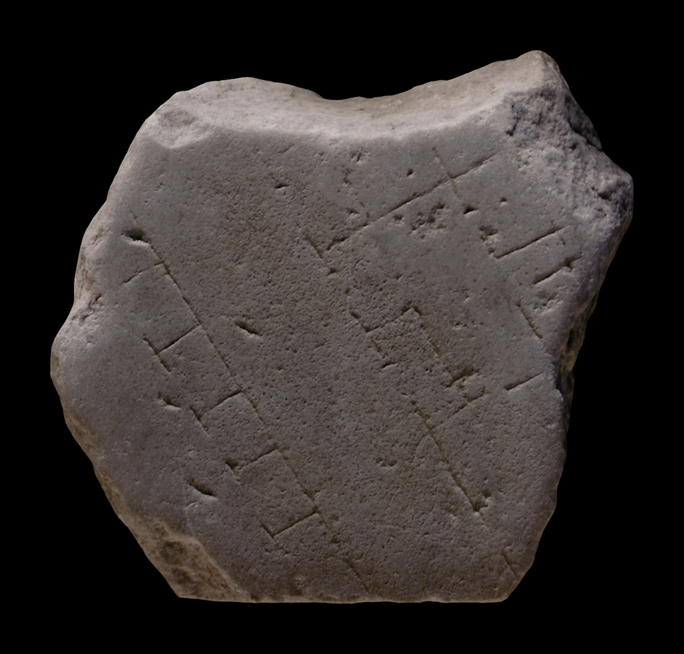
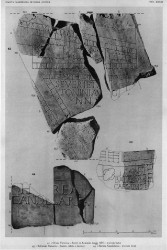
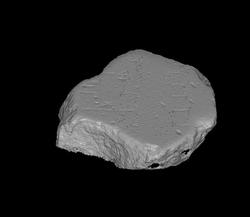
Description The fragment was part of a slab edge. Its surface is worn smooth, suggesting it became part of a pavement after the destruction of the Marble Plan. A street traverses the fragment at an oblique angle from top left to bottom right. On the left, a row of tabernae backs onto the street. On the right, a series of rooms of varying sizes opens onto the street. Some of these give access to other rooms behind them.
Location: Slab IX-5 The tentative placement of this and the joining frs. 5Abcd and fr. and 5Aa in slab IX-5 by the authors of PM 1960 (p. 110) has since been solidified by E. Rodríguez-Almeida (AG 1980, pp. 65-69). The location in slab IX-5 seems confirmed by a) the fragments are of same thickness as the securely placed frs. 5 in the left end of the same slab; b) the marble veining in this group is similar to those in the left side; c) clamp holes along the top of frs. 5Abcd and Aa match two clamp holes in the aula wall exactly; d) the street that runs obliquely from top left to bottom right in this and in fr. 5Ab coincides more or less with the clivus Scauri; e) the angle of the intersection between this oblique street and the one that traverses the fragments horizontally just above the bottom inscription coincides with the intersection between the clivus Scauri and an ancient street shown among other places in Colini 1944, pl. 11 (PM 1960, pp. 110-111). It has recently been proposed that certain inconsistensies between the architecture depicted in this fragment and the actual remains on the ground are caused by the same 21-degree skewing that characterizes the Templum Divi Claudi on the same slab (Insalaco 2003, p. 108).
Identification: Clivus Scauri The course of the street that runs obliquely from top left to bottom right in this and in fr. 5Abcd corresponds with the clivus Scauri that ran along the NW slope of the Caelian Hill (PM 1960, p. 111; AG 1980, p. 66). The name of the street is known from an inscription (CIL 6.9940) which was discovered in the nearby Via Appia (LTUR I, p. 286). The angle of the intersection between the clivus Scauri and the smaller, horizontal street in fr. 5Abcd, just above the bottom inscription, also aligns with remains of an ancient street depicted in Colini 1944, pl. 11 (PM 1960, p. 111, n.9).
Identification: SEVERI ET ANTONINI AUGG NN The rooms that flank the right side of the clivus Scauri in this fragment seem to belong to a larger courtyard structure, mainly visible in fr. 5Abcd (see reconstruction in PM 1960, p. 110 or AG 1980, pl. 3). An inscription, SEVERI ET ANTONINI AUGG NN, is placed inside this courtyard. To which building this inscription refers is disputed. Because the emperors Septimius Severus and Caracalla are here named in the genitive case, the inscription should refer to something they owned or built or were directly responsible for. The authors of PM 1960 suggest that the inscription refer to a building on the Plan that lies beyond the edges of the surviving fragments (PM 1960, p. 109). E. Rodríguez-Almeida has proposed that this inscription was part of the name of the horizontal street seen at top of fr. 5Abcd, reconstructing the full inscription as [CLI]VVS VICTORIAE SEVERI ET AN/TONINI AV[GG]/NN ("the street of victory of Severus and Antoninus, our emperors"). This was done, he argued, to distinguish this clivus Victoriae from the one on the Palatine (AG 1980 p. 68). Why the two inscribed parts would be placed so far apart when there was plenty of space above the clivus Victoriae section to complete a larger inscription, is not considered.
Since inscribed labels on the Plan generally are placed inside or immediately next to the feature they describe, it is more likely that the inscription refers to the triangular courtyard itself and/or to the arched or vaulted feature in the lower right corner of fr. d (suggestion by T. Najbjerg. 5/1/03). The arched/vaulted feature in the upper right corner of the courtyard perhaps represented a large triumphal arch or a monumental entrance to the triangular area, or it introduced a structure, built by Septimius Severus and his son, that backed onto the right side of the courtyard and presented a splendid facade towards the piazza in front of the neighboring Septizodium. This grand structure was possibly one of the means by which Septimius Severus monumentalized this area of Rome.
Significance Together with frs. 5Aa and 5Abcd, this fragment establishes the exact height of slab IX-5. The presence of the clivus Scauri and its join with the horizontal street in fr. 5Abcd furthermore locates this FUR group exactly at the bottom of the Caelian Hill. |
| Like the majority of FUR fragments, this piece was discovered in 1562 in a garden behind the Church of Saints Cosmas and Damian. Its worn surface suggests it was part of a pavement when discovered. The fragment was transferred to the Palazzo Farnese and stored there. It was not among the fragments that were reproduced in the Renaissance drawings that are now kept in the Vatican, but Giovanni Pietro Bellori included it in his 1673 publication. In 1742, the fragment was moved to the Capitoline Museums and exhibited with some of the other known fragments in wooden frames along the main staircase. Since then, it has been stored with the other FUR fragments in various places: the storerooms of the Capitoline Museums (1903-1924), the Antiquarium Comunale (1924-1939), the Capitoline Museums again (1939-1955), the Palazzo Braschi (1955-1998), and since 1998 in the Museo della Civiltà Romana in EUR under the auspices of the Sovraintendenza ai Beni Culturali del Comune di Roma. (This fragments history corresponds to Iter E as summarized in PM 1960, p. 56.)
Text by Tina Najbjerg
|
 Prev
Prev