ID AND LOCATION
| Stanford #
| 5Ae |
| AG1980 #
| 5Ae |
| PM1960 #
| 42 e |
| Slab #
| IX-5 |
| Adjoins
| 5Abcd |
CONDITION
| Located
| true |
| Incised
| true |
| Surviving
| false |
| Slab Edges
| 0 |
| Clamp Holes
| 0 |
| Tassello
| no | |
|
|
|
|
|
|
|
|
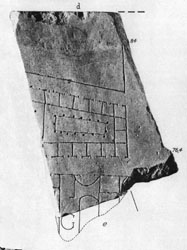
Cropped and masked detail of PM 1960,
pl. 33, which shows a redrawing of frs.
5Ade from Bellori 1673, pl. 18 | |
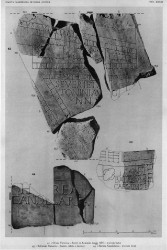
PM 1960 Plates: 33
AG 1980 Plates: 3
|
|
| IDENTIFICATION |
| Renaissance drawing: Section of unidentified building belonging to/built by Septimius Severus and Caracalla (SEVERI ET AN/TONINI AV[GG]/NN)
|
|
| INSCRIPTION
Epigraphic conventions used |
| Transcription |
| None; the fragment itself is lost
|
| Renaissance Transcription |
| [---]G[---]
|
| Reconstruction |
SEVERI ET AN/TONINI AV[GG]/NN (with fr. 5Aa: PM 1960)
[CLI]VVS VICTORIAE SEVERI ET AN/TONINI AV[GG]/NN (with fr. 5Aa: AG 1980) |
|
|
|
|
|
| ANALYSIS
|
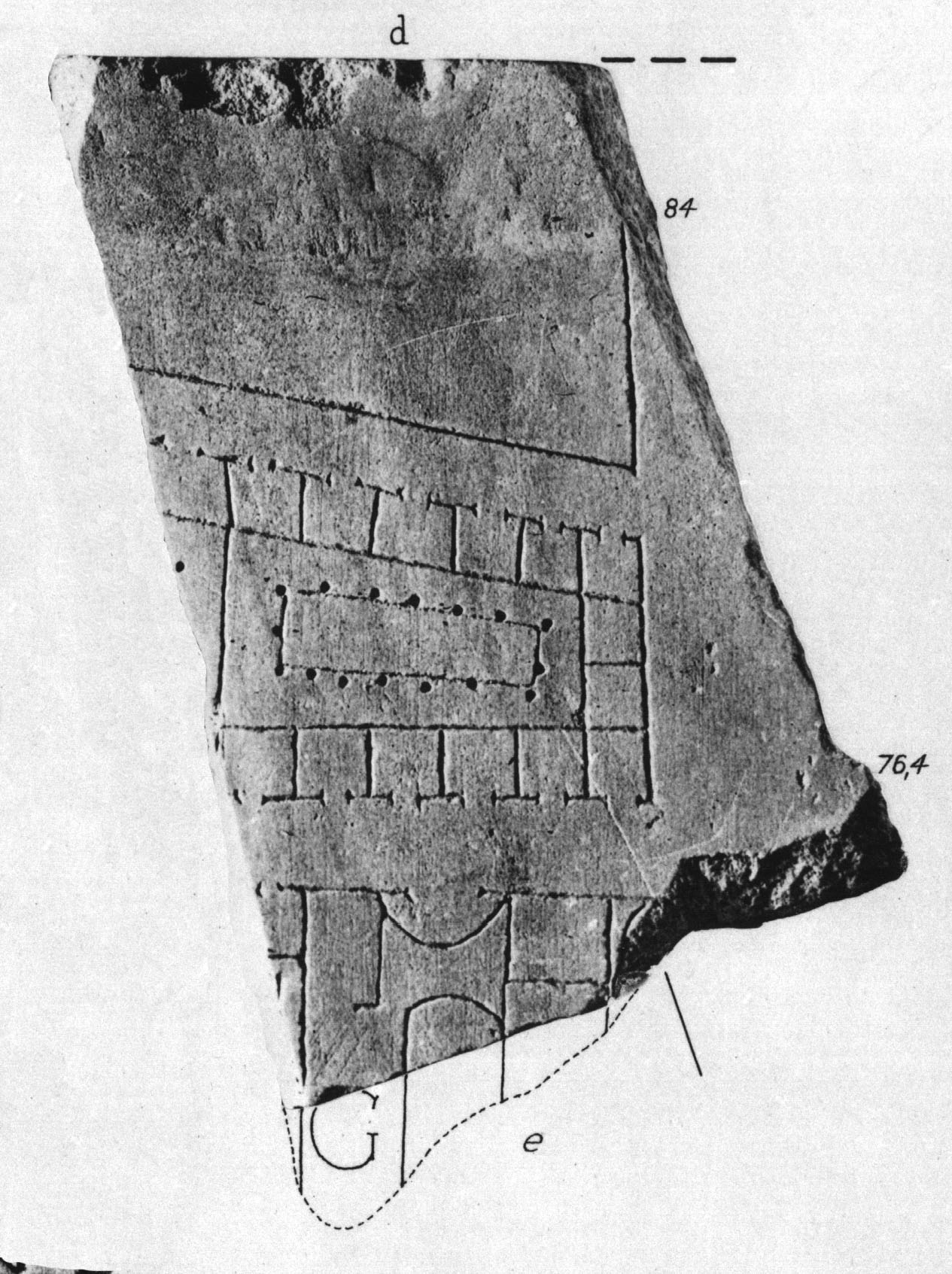
| Description This tiny fragment is missing, but a drawing from Giovanni Pietro Bellori's 1673 publication shows it as it looked when still joined with fr. 5Ad (see the detailed photo above, cropped from PM 1960, pl. 33, or click here to view the original drawing in Bellori's plate 18). The drawing makes it clear that the missing piece continued the four vertical lines at the bottom of fr. 5Ad and that a large letter G was inscribed between the two left lines.
Identification: SEVERI ET ANTONINI AUGG NN The small fragment depicted part of a building that is mainly visible in frs. 5Abcd and 5Af. It consisted of a large triangular or trapezoidal courtyard framed at top and on the left by tabernae. An arched feature at the top right corner of the building (visible in fr. 5Ad) may have provided a monumental entrance into this courtyard. The letter G in this fragment was part of an inscription, SEVERI ET ANTONINI AUGG NN, the main section of which is visible in fr. 5Abcd. To which building on the Plan this inscription refers is disputed. Because the emperors are named in the genitive case, the inscription should refer to something they owned or built or were directly responsible for. The authors of PM 1960 suggest that the inscription refer to a building on the Plan that lies beyond the edges of the surviving fragments (PM 1960, p. 109). E. Rodríguez-Almeida has proposed that this inscription was part of the name of the horizontal street in frs. 5Aa and 5Abcd, reconstructing the full inscription as [CLI]VVS VICTORIAE SEVERI ET AN/TONINI AV[GG]/NN ("the street of victory of Severus and Antoninus, our emperors"). This was done, he argued, to distinguish this clivus Victoriae from the one on the Palatine (AG 1980, p. 68). Why the two inscribed parts were placed so far apart when there was plenty of space above the clivus Victoriae section to complete a larger inscription, is not considered.
Hitherto overlooked is the possibility that the inscription refers to the triangular courtyard itself and/or to the arched or vaulted feature in the lower right corner of fr. d (slightly better exposed in this missing fragment)(T. Najbjerg, May 2003). Since inscribed labels on the Plan generally are placed inside or immediately next to the feature they describe, this would be the more logical solution. The arched/vaulted feature in the upper right corner of the courtyard perhaps represented a large triumphal arch or a monumental entrance to the triangular area, or it introduced a structure, built by Septimius Severus and his son, that backed onto the right side of the courtyard and presented a splendid facade towards the open space in front, like the neighboring Septizodium. This grand structure was possibly one of the means by which Septimius Severus monumentalized this area of Rome.
Significance The inscription in this fragment and in fr. 5Ab is key evidence for the date of the Plan. The inscription refers to Septimius Severus and his son Aurelius Antoninus (nicknamed Caracalla) as co-emperors. This was true between 198 CE, when Caracalla was created Augustus to rule alongside his father, and Feb. 4, 211 CE, when Septimius died. The inscription does not mention Septimius' younger son Geta, who was made Augustus in 209 and assassinated by his brother in 212. This additional detail may mean that the Plan was made before 209; however, the commonly accepted upper limit is 211 CE. Other fragments (7abcd, 8a, and 8bde) depict the Septizodium, built in 203 CE, so the Plan cannot be earlier than that. This window of 203-211 CE agrees with the Severan date of the wall that supported the Marble Plan (rebuilt after a fire in 192 CE extensively damaged the Templum Pacis), and with the lack of any monuments on the Plan later than this period (PM 1960, p. 213).
|
|
| HISTORY OF FRAGMENT |
| Upon its discovery in 1562 in a garden behind the Church of Saints Cosmas and Damian, this tiny fragment was part of a larger piece, fr. 5Ad. This fragment was transferred to the Palazzo Farnese and stored there. It was not among the fragments that were reproduced in the Renaissance drawings that are now kept in the Vatican, but Giovanni Pietro Bellori included it in his 1673 publication. At some point thereafter, this small section broke off from the bottom of 5Ad and was lost.
Text by Tina Najbjerg and Jen Trimble.
|
|
| KEYWORDS
|
| courtyard, tabernae, arch, monumental entrance |
|
 Prev
Prev