ID AND LOCATION
| Stanford #
| 5b |
| AG1980 #
| 5b |
| PM1960 #
| 5 b |
| Slab #
| IX-5 |
| Adjoins
| 4b |
CONDITION
| Located
| true |
| Incised
| true |
| Surviving
| true |
| Subfragments
| 1 |
| Plaster Parts
| 0 |
| Back Surface
| smooth |
| Slab Edges
| 1 |
| Clamp Holes
| 0 |
| Tassello
| no |
TECHNICAL INFO
|
|
|
|
|
|
BIBLIOGRAPHY
- AG 1980, pp. 26-27, 65, pl. 2
- Lloyd 1982
- LTUR I: Claudius, Divus, Templum (C. Buzzetti), pp. 277-78
- PM 1960, pp. 63-64, pls. 10, 16, 62
- Richardson 1992, pp. 87-88 (Claudius, Divus, Templum)
|
|
|
|
|
| ANALYSIS
|
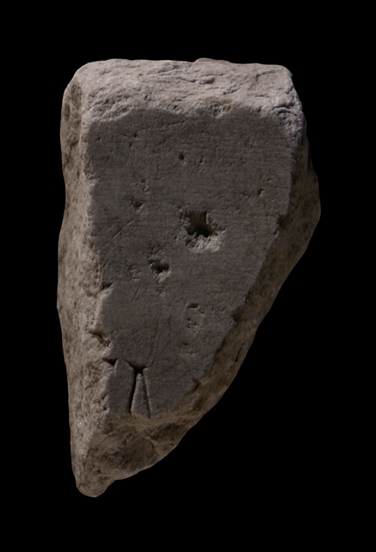
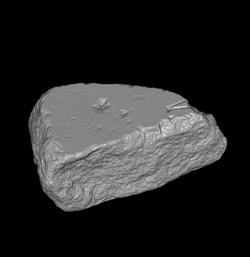
| Description According to PM 1960, pl. 16, the fragment was part of a slab edge. This is difficult to ascertain, however, even from Stanford's 3D model. The surface is mainly blank; at the bottom tip, parts of two letters are visible, of which the second is an M.
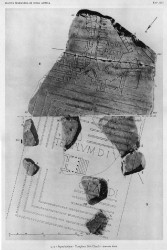
Identification: Templum divi Claudi The fragment has been identified as a section of the Temple of the Deified Claudius, including the inscription that labeled the building (PM 1960, p. 65). The other surviving fragments of the monument are
4b,
5a,
5dg,
5e,
5f,
5h. Fr.
5c
is missing but is reproduced in a Renaissance drawing. This temple was vowed shortly after Claudius' death in 54 CE but remained unfinished during the reign of Nero, who preferred to use the E side of the massive platform built for this purpose on the Caelian Hill as a monumental nymphaeum, part of his sprawling Domus Aurea. Sections of this platform are visible today along the Via Claudia. Nothing remains of the temple, which was not finished until the reign of Vespasian (Suet., Vespasian 9), and the missing FUR fr. 5c, reproduced in Cod. Vat. Lat. 3439, is our only evidence for its design. The drawing shows the temple as prostyle and pentastyle (although it surely had six columns in front, suggests C. Buzzetti in LTUR I, p. 277), oriented to the W, and with four steps in front providing access to its podium. The long, narrow strips that form clamp-shaped frames around the temple in center have been interpreted as hedges consisting of low bushes and flowering shrubs, similar to those excavated in the extensive gardens of the villa at Fishbourne in England (Lloyd 1982, pp. 94-95). Spaces in front of, behind, and at the bottom sides of the temple were left clear. This fragment belongs to the open area at the SE corner of the temple. Paths along the central N-S axis provided direct access through the hedges from the edges of the platform to the temple. Porticoes have been excavated around the outer wall, and Martial calls the building a porticus (Epig. 2.9-10), yet there is no trace of covered colonnades on the Marble Plan (LTUR I, p. 277).
Significance The depiction of the Temple of the Divine Claudius on this and other FUR fragments is crucial for our knowledge of the architecture and layout of the building of which little remains. Most significant, however, is the fact that the orientation of the temple complex on the FUR in relation to the Flavian amphitheater is shifted ca. 21% from its real position (AG 1980, p. 44). This was probably caused by the difficulty of mosaicking together the individual surveys of different sections of the city.
|
|
| HISTORY OF FRAGMENT |
| Like the majority of FUR fragments, this piece was discovered in 1562 in a garden behind the Church of Saints Cosmas and Damian. From here, it was transferred to the Palazzo Farnese and stored there. The fragment was later used as building material in the 17th-c. construction of the Farnese family's Giardino Segreto (Secret Garden) near the Via Giulia, and was rediscovered in 1888 or 1898 when the walls of the garden were demolished. Since then, it has been stored with the other known FUR fragments in various places: the storerooms of the Commissione Archeologica (1888/1898-1903), the Antiquarium Comunale (1924-1939), the Capitoline Museums (1939-1955), the Palazzo Braschi (1955-1998), and since 1998 in the Museo della Civiltà Romana in EUR under the auspices of the Sovraintendenza ai Beni Culturali del Comune di Roma. (This fragment's history corresponds to Iter E'' as summarized in PM 1960, p. 56.) N.B. PM 1960 does not reveal the whereabouts of the fragment between 1903 and 1924.
Text by Tina Najbjerg and Jennifer Trimble. |
|
| KEYWORDS
|
| temple, Claudius, platform, hedges, garden |
|
 Prev
Prev