ID AND LOCATION
| Stanford #
| 4b |
| AG1980 #
| 4b |
| PM1960 #
| 4 b |
| Slab #
| X-5 |
| Adjoins
| 4a 5b 5c 5dg |
CONDITION
| Located
| true |
| Incised
| true |
| Surviving
| true |
| Subfragments
| 1 |
| Plaster Parts
| 0 |
| Back Surface
| smooth |
| Slab Edges
| 1 |
| Clamp Holes
| 0 |
| Tassello
| no |
TECHNICAL INFO
|
|
|
|
|
|
BIBLIOGRAPHY
- AG 1980, pp. 26-27, pl. 2
- Bollmann 1998, Cat. no. A3
- Lloyd 1982
- LTUR I: Aqueductium (E. Rodriguez Almeida), pp. 73-74; Arcus Neroniani (Z. Mari), pp. 100-101; Claudius, Divus, Templum (C. Buzzetti), pp. 277-78
- PM 1960, p. 63, pl 16
- Richardson 1992, p. 27 (Arcus Neroniani); pp. 87-88 (Claudius, Divus, Templum)
|
|
|
|
|
| ANALYSIS
|
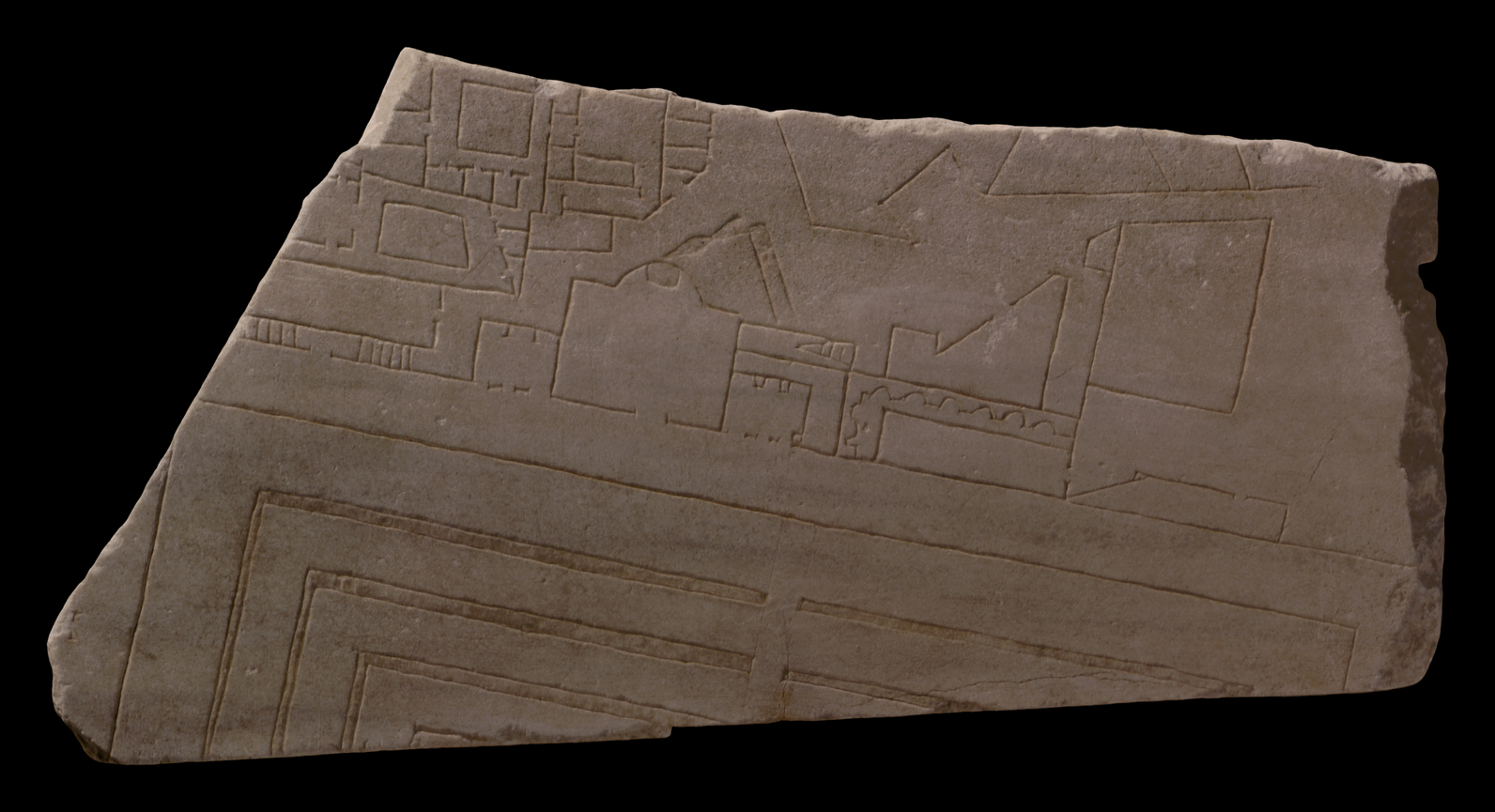
| Description The upper part shows a very different kind of topography from the lower. A street emerges from a large open space at upper right; it continues toward the center of the fragment between walled open spaces of irregular shapes. At the center of the fragment, this street opens into yet another large, irregularly shaped, open space. At the left side of this central piazza, two streets depart. One moves straight upward to the top of the fragment; on the adjoining fr. 4a, this street continues alongside an aqueduct, the arcus Neroniani. The second street continues in a zigzag pattern toward the left edge of the fragment and becomes a staircase or ramp at lower left before continuing off the fragment. At center, occupying much of the central piazza, is a curious feature shaped like a large, upside-down V. At upper left, above the zigzag street, is a complex that includes three rectangular courtyards of different shapes and sizes, each surrounded by smaller rooms. Since this complex lies parallel to the massive temple platform (see below), it may have been built at the same time as the platform, or later. Across the zigzag street and just below the central piazza, a series of structures is situated along the long boundary wall running left to right across the fragment and dividing the upper portion from the lower. These structures include a large room with a wide apse in the top wall; the doorway into this room is opposite the apse. At the center of this apse is a roughly rectangular shape that was carved recessed and originally filled with red paint, perhaps representing a statue base. On the right and left sides of this apsidal building stand smaller, rectangular rooms, each with an arcaded bottom wall with three entranceways, and two short piers or walls (or statue bases in the case of the room on the right?) jutting into the room from the top wall. The righthand room is surrounded by additional walls; a staircase is symbolized by the small V shape just above it. This staircase has four transverse bars; if Pedroni 1992 is correct, this may indicate four upper stories to the building at this point. The apsidal building and its two flanking buildings all open onto a long passageway running left to right across the fragment, just above the boundary wall that divides the lower part of the fragment from these features in the upper half. To the right of this trio of buildings is a long rectangular building; inside, a wavy line runs along two sides. This may be a latrine (compare the latrine in fr. 37a, behind the Portico of Pompey). It opens onto an offshoot of the large open space at the right side of the fragment.
The lower part of the fragment is separated from the upper by a single line demarcating a rectangular boundary wall. Two of its corners are visible. Inside this boundary, a series of thick, parallel lines cross the available space; they are recessed and were originally filled with red paint for heightened visibility. A narrow passage--marked out for the carvers by faint guidelines--separates these thick lines into two sets. The thick lines on the left turn a corner to remain parallel with the boundary wall.
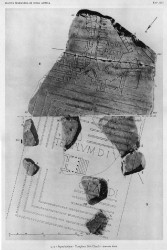
N.B. The bottom edge of this fragment is a slab edge, even though Renaissance drawing Cod. Vat. Lat. 3439 - fo 17r (reproduced in PM 1960, pl. 7) depicts the fragment with a larger area and an irregular outline here (PM 1960, p. 63, and confirmed by observation of the 3D model at Stanford). The slight jog along the fragment edge is thought to be the result of attempts to fit the fragment into the Capitoline reconstruction of 1742.
Identification: Arcus Neroniani Fr. 4a, which adjoins this fragment along its entire upper edge, shows an aqueduct running from top to bottom and ending precisely at the break. There is no question about the match between the two fragments, so there must be a topographic explanation for the apparent disappearance of the aqueduct; it may go underground at this point. The aqueduct's location just south of the templum Divi Claudi (see below) identifies it as a stretch of the arcus Neroniani, a 2 km long offshoot of the aqua Claudia which Frontinus (Aq. 1.20, 2.76 and 87) says ended at the templum Divi Claudi (LTUR I, pp. 63-65). From there, it supplied the Caelian Hill, the Palatine, the Aventine and Trastevere. It was built under Nero after the great fire of 64 CE to supply his nymphaeum along the E side of the platform intended for the Temple to Deified Claudius (but not finished as such until after Nero's reign), and also to supply the central lake of his Domus Aurea on the site of the later Flavian Amphitheater (Colosseum). A large, rectangular collecting tank of Severan date is known to have existed at the end of this portion of the aqueduct and is depicted in a 16th-c. plan of Rome, the Pianta Ligorio (LTUR I, p. 100), but it does not appear on this fragment among the buildings just beyond where the aqueduct seems to end or go underground (unless the strange upside down V in the central piazza is connected to the aqueduct).
Identification: Templum divi Claudi The lower half of the fragment depicts the S end of the Temple of the Deified Claudius; the other surviving fragments of the monument are
5a,
5b,
5dg,
5e,
5f,
5h;
5c
is missing but reproduced in a Renaissance drawing. This temple was vowed shortly after Claudius' death in 54 CE but remained unfinished during the reign of Nero, who preferred to use the E side of the massive platform built for this purpose on the Caelian Hill as a monumental nymphaeum, part of his sprawling Domus Aurea. Sections of this platform are visible today along the Via Claudia. Nothing remains of the temple, which was not finished until the reign of Vespasian (Suet., Vespasian 9), and the missing FUR fr. 5c, reproduced in Cod. Vat. Lat. 3439, is our only evidence for its design. The drawing shows the temple as prostyle and pentastyle (although it surely had six columns in front, suggests C. Buzzetti in LTUR I, p. 277), oriented to the W, and with four steps in front providing access to its podium. The long, narrow strips that form clamp-shaped frames around the temple in center have been interpreted as hedges consisting of low bushes and flowering shrubs, similar to those excavated in the extensive gardens of the villa at Fishbourne in England (Lloyd 1982, pp. 94-95). Spaces in front of and behind the temple were left clear, and paths along the central N-S axis provided direct access through the 'hedges' from the edges of the platform to the temple. Porticoes have been excavated around the outer wall, and Martial calls the building a porticus (Epig. 2.9-10), yet there is no trace of covered colonnades on the Marble Plan (LTUR I, p. 277). The stepped ramp in the upper left of this fragment and the steps behind the apsed building would have provided access to the sanctuary from the area below. The latrines along the S edge of the platform do not seem to be accessible from the temple platform; the only visible opening is from the large, open space below in the right side of the fragment. The arcus Neroniani probably supplied these latrines with water.
Identification: Seat of the collegium of the Augustales Claudiales? The apsidal building along the top boundary of the Templum has been identified as the urban seat of the Augustales Claudiales, attested in CIL 6.1984-1988 (LTUR I, p. 277; also Bollmann 1998, cat. no. A3). If the interpretation is correct, the rectangular, recessed rectangle in the rear of the building probably represented a statue base on which would have stood a statue of the deified emperor. The two smaller structures that flank the apsidal building on each side may also have held statuary and served cultic functions.
Significance The depiction of the Temple of the Divine Claudius on this and other FUR fragments is crucial for our knowledge of the architecture and layout of the building of which little remains. The stairs and ramps illustrate the incline of the Caelian Hill at this point. The depiction of the hedges, if that is what they are, would mark an exception to the general rule that only architectural features are depicted on the FUR. This might indicate that the hedges were framed by built edges. Most significant, however, is the fact that the orientation of the temple complex on the FUR in relation to the Flavian amphitheater is shifted ca. 21 degrees from its real position (AG 1980, p. 44). This was probably caused by the difficulty of mosaicking together the individual surveys of different sections of the city.
|
|
| HISTORY OF FRAGMENT |
| Like the majority of FUR fragments, this piece was discovered in 1562 in a garden behind the Church of Saints Cosmas and Damian. From here, it was transferred to the Palazzo Farnese and stored there. Renaissance engravers reproduced the fragment in 16th-c. drawings that are now kept in the Vatican (Cod. Vat. Lat. 3439), and Giovanni Pietro Bellori included it in his 1673 publication of the Plan. In 1742, it was moved to the Capitoline Museums and exhibited with some of the other known fragments in wooden frames along the main staircase. In 1903, museum curators included the piece in a reconstruction of the FUR mounted on a wall behind the Palazzo dei Conservatori (1903-1924). Since then, the fragment has been stored with the other known FUR fragments in various places: the storerooms of the Antiquarium Comunale (1924-1939), the Capitoline Museums again (1939-1955), the Palazzo Braschi (1955-1998), and since 1998 in the Museo della Civiltà Romana in EUR under the auspices of the Sovraintendenza ai Beni Culturali del Comune di Roma. (This fragments history corresponds to Iter A as summarized in PM 1960, p. 56.)
Text by Tina Najbjerg and Jennifer Trimble |
|
| KEYWORDS
|
| aqueduct, temple, Claudius, platform, garden, hedges, latrines, cult building, peristyle, statue bases, apse, piazza, courtyards, street, nymphaeum, hedges, sanctuary, temple platform, stairs, ramp, schola, latrines, cult building, steps, collegium, |
|
 Prev
Prev