ID AND LOCATION
| Stanford #
| 6e |
| AG1980 #
| 6e |
| PM1960 #
| 6 e |
| Slab #
| IX-4 |
| Adjoins
| 6bcdf 6c |
CONDITION
| Located
| true |
| Incised
| true |
| Surviving
| true |
| Subfragments
| 1 |
| Plaster Parts
| 0 |
| Back Surface
| rough |
| Slab Edges
| 0 |
| Clamp Holes
| 0 |
| Tassello
| no |
TECHNICAL INFO
|
|
|
|
|
|
|
|
|
|
|
| ANALYSIS
|
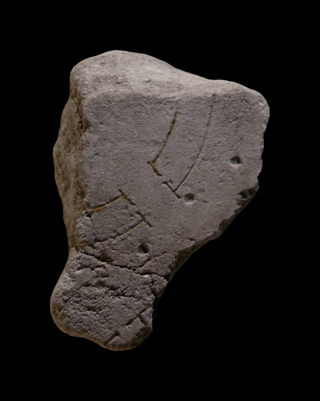
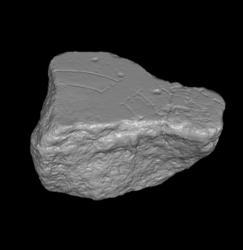
| Description The small fragment depicts the end of an oval or elliptical structure, perforated by a wide entrance. Narrow openings lead from the entrance into the curved spaces on either side. A straight colonnade and a row of rooms facing it appear outside the curved structure.
Identification: Ludus Magnus The fragment depicts the W end of the largest of the four gladiatorial training schools, the ludus Magnus, built by Domitian near the E end of the Flavian Amphitheater (Colosseum). The majority of the structure appears in fr. 6bcdf. The exact location of the ludus Magnus - situated by the Regionary Catalogues in Regio III - was confirmed by excavations in 1937 and 1960-61 that revealed its N half (LTUR III, p. 196, fig. 131). Based on these FUR fragments, on the excavated remains, and on the assumption that the building was symmetrical, A.M. Colini and L. Cozza were able to reconstruct its location and architecture. It was positioned immediately east of the Colosseum and just north of the axis of the amphitheater, between the ancient streets underneath the Via Labicana and Via dei SS. Quattro Coronati (AG 1980, fig. 19; LTUR III, fig. 131; Richardson 1992, fig. 52). The building consisted of an elliptically shaped arena surrounded by a cavea whose base was raised 2.75 m above the floor of the arena, and which was supported on brick-faced concrete walls and vaults. The seating area, which held ca. 3,000 spectators, was reached by four external stairs. As seen in this fragment, ceremonial entrances perforated the cavea at each end of the long axis, and box seats were placed at the ends of the short axis, thus closest to the action in the arena. A rectangular, two-storey colonnade surrounded the cavea, and triangular fountains occupied the corners of this porticus. A series of small, regular rooms for the gladiators and their gear opened onto all four sides of the colonnaded courtyard; stairs gave access to a second storey above. Excavations have revealed that in addition to the narrow entrance to the courtyard seen in the bottom row (north side) of fr. 6bcdf, there was a major entrance in the center of the row, granting access to the building from the Via Labicana (Richardson 1992, p. 237, fig. 52). An underground passage connected the ludus Magnus to the Colosseum (LTUR III, p. 197).
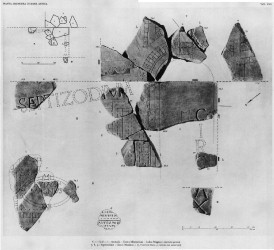
Significance Together with fr. 6bcdf, this fragment is key to reconstructing the architecture of the ludus Magnus. They also demonstrate the difficulty of piecing together the many surveys on which the map was based: on the map, the building is located ca. 15 m east of its correct position (AG 1980, p. 70, and fig. 19).
|
|
| HISTORY OF FRAGMENT |
| The fragment was probably discovered behind the church of SS. Cosmas and Damian in 1562 and transferred to the Palazzo Farnese. Unlike the other section of the Ludus Magnus (fr. 6bcdf), it was not reproduced by Renaissance engravers in 16th-c. drawings that are now kept in the Vatican (Cod. Vat. Lat. 3439). It was used, however, as building material in the 17th-c. construction of the Farnese familys "Giardino Segreto" (Secret Garden) near the Via Giulia. In 1888 or 1898, the fragment was rediscovered when the walls of the Garden were demolished, and it was recognized as belonging with fr. 6bcdf (PM 1960, p. 65). In 1903, museum curators included it in a reconstruction of the FUR mounted on a wall behind the Palazzo dei Conservatori (1903-1924). Since then, the fragment has been stored with the other known FUR fragments in various places: the storerooms of the Antiquarium Comunale (1924-1939), the Capitoline Museums again (1939-1955), the Palazzo Braschi (1955-1998), and since 1998 in the Museo della Civiltà Romana in EUR under the auspices of the Sovraintendenza ai Beni Culturali del Comune di Roma.
Text by Tina Najbjerg
|
|
| KEYWORDS
|
| gladiators, training school, rooms, colonnades, fountains, seats, arena, stairs, openings, arches?, cavea, seating area, |
|
 Prev
Prev