ID AND LOCATION
| Stanford #
| 8l |
| AG1980 #
| 8l |
| PM1960 #
| 482 |
| Slab #
| VIII-5 |
| Adjoins
| 8n 8o |
CONDITION
| Located
| true |
| Incised
| true |
| Surviving
| true |
| Subfragments
| 1 |
| Plaster Parts
| 0 |
| Back Surface
| smooth |
| Slab Edges
| 1 |
| Clamp Holes
| 1 |
| Tassello
| no |
TECHNICAL INFO
|
|
|
|
|
|
|
|
|
|
|
| ANALYSIS
|
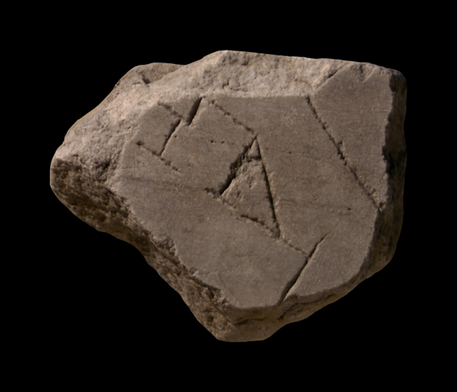
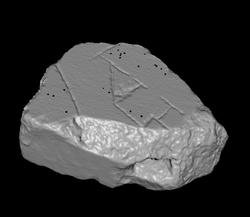
| Description The fragment was part of a slab edge and contains a clamp hole. It depicts the corner of a large space, perhaps open, with at least four rooms opening onto the open space along the top wall. The room closest to the corner is triangular. A straight line runs at a diagonal angle to the slab edge in the top right part of the fragment. It does not seem to be related to the building in the left side. A thick, blue veining line crosses the fragment at an angle that is almost parallel to the slab edge.
Identification In 1968, L. Cozza matched this fragment to frs. 8m, 8n, and 8o, and suggested that the building that extends across frs. 458 and 457, partially visible here, represented a small bath complex, a balneum (Cozza 1968, p. 22, fig. 14). A decade later, E. Rodríguez-Almeida was able to position the group in the top left corner of slab VIII-5 because the thickness, smooth back, and thick, blue veining line in this fragment matched other, securely positioned fragments in that slab (frs. 8a, 8b, and 8c) (Rodríguez-Almeida 1970-71, p. 127-129). The join located the proposed bath complex in the valley between the Caelian and the Palatine Hill, and at equidistance between the Septizodium and the Flavian Amphitheater (the Colosseum). It is tempting to suggest that the proposed baths were fed by the Neronian branch of the Aqua Claudia that passed nearby, a section of which is visible in fr. 8i (see AG 1980, pl. 6); judging from its architecture, however, the small, irregular bath building probably predates the aqueduct.
Significance If the positioning of this fragment is correct, it provides an interesting glimpse of the urban landscape between the Caelian and the Palatine, with a small bathing structure surrounded on all sides by imposing, imperial monuments such as the Septizodium, the Temple to the Deified Claudius, and the Colosseum.
|
|
| HISTORY OF FRAGMENT |
| Like the majority of FUR fragments, this piece was discovered in 1562 in a garden behind the Church of Saints Cosmas and Damian. From here, it was transferred to the Palazzo Farnese and stored there. The fragment was later used as building material in the 17th-c. construction of the Farnese familys "Giardino Segreto" (Secret Garden) near the Via Giulia, and was rediscovered in 1888 or 1898 when the walls of the garden were demolished. Since then, it has been stored with the other known FUR fragments in various places: the storerooms of the Commissione Archeologica (1888/1898-1903), the Antiquarium Comunale (1924-1939), the Capitoline Museums (1939-1955), the Palazzo Braschi (1955-1998), and since 1998 in the Museo della Civiltà Romana in EUR under the auspices of the Sovraintendenza ai Beni Culturali del Comune di Roma. (This fragments history corresponds to Iter E as summarized in PM 1960, p. 56.) N.B. PM 1960 does not reveal the whereabouts of the fragment between 1903 and 1924.
Text by Tina Najbjerg
|
|
| KEYWORDS
|
| bath?, balneum?, triangle |
|
 Prev
Prev