Stanford Digital Forma Urbis Romae Project

  • Home
  • Project
  • Map
  • Database
  • Slab Map
  • Glossary
  • Bibliography
  • People
  • Links

  • Page 1272 of 1273
    Prev Next
     ID AND LOCATION
    Stanford # ni975 (712)
    AG1980 # none
    PM1960 # none
    Slab # unknown
    Adjoins none

     CONDITION
    Located false
    Incised true
    Surviving true
    Subfragments 1
    Plaster Parts 0
    Back Surface smooth
    Slab Edges 0
    Clamp Holes 0
    Tassello no

     TECHNICAL INFO
    Scanner model15
    Search by:
    where value is:
    NOT
    AND OR
    Search by:
    where value is:
    NOT
     BIBLIOGRAPHY

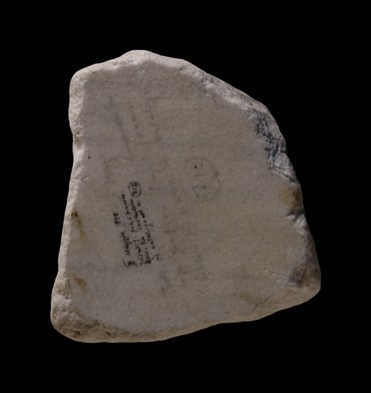
    Photograph (62 KB)
    Note about photographs

    PM 1960 Plates: None
    AG 1980 Plates: None
     
    IDENTIFICATION
    Not identified
    INSCRIPTION
    None

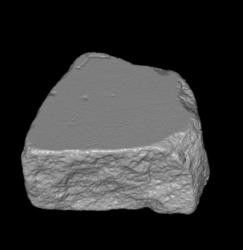
    3D Model Full model
    Download the viewer | Note about 3D models
    ANALYSIS
    Description This small fragment (ca. 11 x 11 cm) is approximately 60-63 mm thick, whitish in color, with at least 3 narrow parallel gray marble veins visible on the back surface. Most of the top surface is blank; however, in one corner of the fragment, a set of incisions depict a short line extending diagonally from what appears to be the corner of a small room partially visible along the border of the fragment.

    Identification Neither AG 1980 nor PM 1960 included this fragment because it was believed to be blank. In 1995, E. Rodríguez-Almeida observed the incised topography, and wrote a note in pencil on the back of the fragment: "5 maggio 1995. Identificato come frammento topografico tra i frammenti lisci. Nº provv. di catalogo, 712," evidently intending the fragment numbering to continue the series of 711 previously cataloged incised fragment groups (Rodríguez-Almeida 2001, pp. 70-71, fig. 23). Later, this note was rewritten on the back surface of the fragment in a more durable black ink.

    Significance Because this fragment was previously misclassified and grouped with the unincised fragments, this database represents the first widespread dissemination of the incised topography on the fragment's surface.

    HISTORY OF FRAGMENT
    The history of this fragment is not known. It may have been discovered with the majority of the fragments in 1562 behind the Church of Saints Cosmas and Damian (PM 1960, p. 145).

    Text by David Koller.


    Stanford Graphics | Stanford Classics | Sovraintendenza ai Beni Culturali del Comune di Roma

    Copyright © The Stanford Digital Forma Urbis Romae Project