ID AND LOCATION
| Stanford #
| ni233 |
| AG1980 #
| none |
| PM1960 #
| none |
| Slab #
| unknown |
| Adjoins
| ni087 |
CONDITION
| Located
| false |
| Incised
| false |
| Surviving
| true |
| Subfragments
| 1 |
| Plaster Parts
| 0 |
| Back Surface
| smooth |
| Slab Edges
| 1 |
| Clamp Holes
| 0 |
| Tassello
| no |
TECHNICAL INFO
|
|
|
|
|
|
|
|
|
|
|
| ANALYSIS
|
| Description
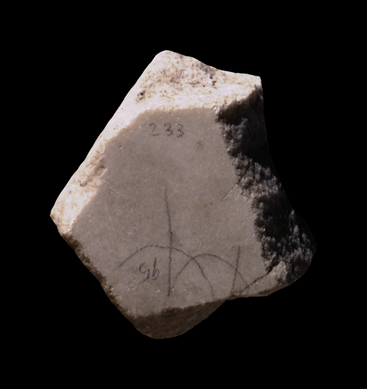
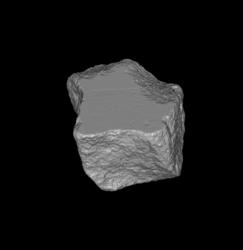
This blank fragment is 68mm thick and has a slab edge.
E. Rodríguez-Almeida joined this fragment with
ni087
on March 3, 1995
(Rodríguez-Almeida 2001, p. 69-70, figs. 16-18). The front surfaces of the two fragments exhibit some pink coloration typical of minium absorption.
Rodríguez-Almeida has made pencil markings across the fracture lines on both the front and back surfaces of the fragments to aid in their reunion. The marble characteristics, coloration, and thickness suggest that these fragments may belong with the same slab as fragments
ni019,
ni019b,
ni019c,
ni069,
and ni144.
Identification There were many blank areas on the Marble Plan, including the spaces occupied by the Tiber River (see fragment 24d), by gardens, arenas, temple precincts and courtyards--in short, any space devoid of architecture or human construction. In addition, several rows of large marble slabs occupied the entire lower part of the wall of the aula on which the Plan was placed, and probably also the other walls in the room. Blank fragments like this one could have originated from any of these areas.
Significance This database includes the first public presentation of 394 blank fragments from the Plan--they are not catalogued or illustrated in either of the two fundamental publications, PM 1960 and AG 1980. |
|
| HISTORY OF FRAGMENT |
| Blank fragments were not kept during the early centuries of the Marble Plan's rediscovery. Surviving pieces like this one probably come from excavations done since 1867 (PM 1960, p. 163).
Text by David Koller, Tina Najbjerg and Jennifer Trimble. |
|
 Prev
Prev