| Description
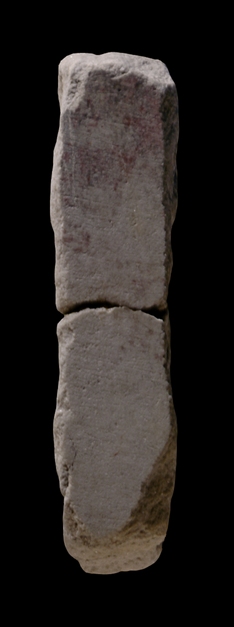
The fragment does not show any incisions or guidelines, but there are traces of red paint on the surface.
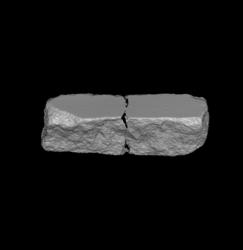
Identification: Red-painted street? The straight, elongated shape of the piece is peculiar. Neither of the long, parallel sides is smooth enough to have been the edge of a slab, and there are no saw marks to indicate that the fragment was sawn into this form for reuse as a building tile in post-Roman periods.
Certain clues may, however, explain its shape. Stanford experiments with breaking freshly incised slabs of marble show that slabs that are struck from the back with a heavy instrument (like a sledgehammer), tend to break along incised lines AND to break in lines that are perpendicular to the edge (click here to see photo essay on the experiment). It is thus highly likely that the slab or larger piece to which this fragment belonged was purposely broken into smaller bits, perhaps in Medieval times or perhaps in the 17th cent., when several FUR fragments were reused in the construction of the walls of the Secret Garden of the Farnese Palace. The blow made the slab or large fragment break along two closely parallel lines that probably were perpendicular to a slab edge. The red pigment visible in this fragment and the fact that certain streets on the Plan were painted red (see especially the recently discovered fr. fn9) indicate that these two parallel lines delineated a red-painted street.
Significance The red pigment and elongated shape of this fragment are significant. If our thesis that the shape of the piece is caused by incisions that delineated a street is correct, the notion that several streets on the Plan were painted red for emphasis must be considered.
This database includes the first public presentation of 394 blank fragments from the Plan--they are not catalogued or illustrated in either of the two fundamental publications, PM 1960 and AG 1980. Because there are no incisions to guide scholars, the blank fragments have so far not played any role in attempts to put the Plan back together. Digital 3D matching may now allow blank parts of the Plan to be reconstructed together with incised areas.
|
 Prev
Prev