ID AND LOCATION
| Stanford #
| 31b |
| AG1980 #
| 31b |
| PM1960 #
| 31 b |
| Slab #
| V-12 |
| Adjoins
| 31a 31c |
CONDITION
| Located
| true |
| Incised
| true |
| Surviving
| false |
| Slab Edges
| 1 |
| Clamp Holes
| 0 |
| Tassello
| no | |
|
|
|
|
|
BIBLIOGRAPHY
- AG 1980, p. 114, pl. 23
- PM 1960, pp. 91-93, pls. 10, 29
- LTUR I: Capitolium (Republik und Kaiserzeit) (C. Reusser), pp. 232-234.
|
|
|
Detail from Cod. Vat. Lat. 3439 - Fo 20r,
reproduced from PM 1960, pl. 10 | |
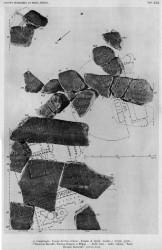
PM 1960 Plates: 10 29
AG 1980 Plates: 23
|
|
| IDENTIFICATION |
| Renaissance drawing: Large temple on the SW edge of the Capitoline hill (Capitolium)
|
|
| INSCRIPTION |
| None |
|
|
|
|
|
| ANALYSIS
|
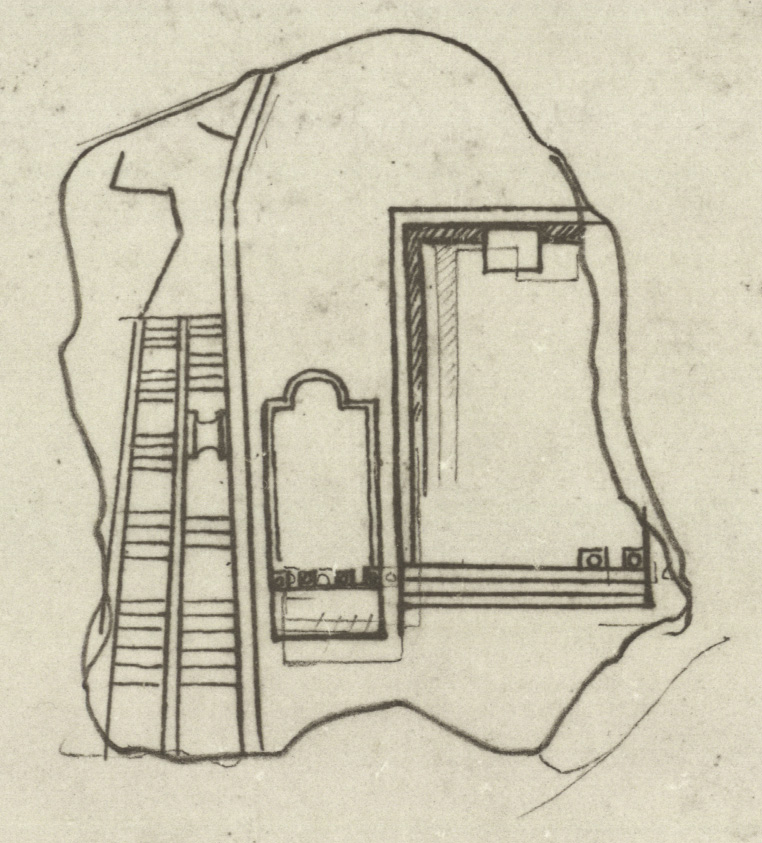
| Description Renaissance drawing Cod. Vat. Lat. 3439 - Fo 20r shows that the lost fragment b depicted part of a large temple (see detailed photo above or PM 1960, pl. 10, no. 7). The drawing seems incomplete: While the rectangular podium with a wide staircase in front is complete, only parts of the cella and the surrounding or frontal colonnade are included. The cella walls are rendered with recessed double lines, as is common on the Marble Plan. A small altar is placed along the rear wall of the cella. This part of the drawing was apparently corrected - an earlier pencil sketch is still visible below the inked lines. Two columns, rendered as dotted squares, are placed in the corner of the platform, along the frontal steps.
Identification: Temple on the Capitoline hill Together with fragments 31a and c, this missing piece was located in slab V-12 by L. Cozza on the basis of the thickness of the surviving fragments, their marble veining, and fr. 31a's position at the edge of slab (PM 1960, p. 91). This located the temple depicted in this lost fragment to the SW corner of the Capitoline Hill, right in the spot where the Centum Gradus, or 100 steps, gave access to the top plateau of the hill. A smaller temple, visible in frs. 31a and c, stood between this temple and the stairs. It is uncertain which of the Capitoline's many sacred structures the two temples represent.
Significance Together with frs. 31a and 31c this lost fragment provides our only surviving evidence for an otherwise unknown temple on the Capitoline Hill. |
|
| HISTORY OF FRAGMENT |
| Originally part of a much larger fragment, this piece was discovered in 1562 in a garden behind the Church of Saints Cosmas and Damian. From here, it was transferred to the Palazzo Farnese and stored there. Renaissance engravers reproduced the fragment in 16th-c. drawings that are now kept in the Vatican (for more information about the creation and accuracy of these drawings, see Cod. Vat. Lat. 3439), and Giovanni Pietro Bellori included it in his 1673 publication. Some time thereafter, the large fragment must have broken into three smaller sections, 31a, b, and c. While a and c survive, fr. c has been lost ever since. (This fragments history corresponds to Iter D as summarized in PM 1960, p. 56.)
Text by Tina Najbjerg
|
|
| KEYWORDS
|
| temple, Capitoline hill, steps, ramp, cella, altar, columns, platform |
|
 Prev
Prev