ID AND LOCATION
| Stanford #
| 31c |
| AG1980 #
| 31c |
| PM1960 #
| 31 c |
| Slab #
| V-12 |
| Adjoins
| 31a 31b |
CONDITION
| Located
| true |
| Incised
| true |
| Surviving
| true |
| Subfragments
| 1 |
| Plaster Parts
| 0 |
| Back Surface
| smooth |
| Slab Edges
| 0 |
| Clamp Holes
| 0 |
| Tassello
| no |
TECHNICAL INFO
|
|
|
|
|
|
BIBLIOGRAPHY
- AG 1980, p. 114, pl. 23
- PM 1960, pp. 91-93, pl. 29
- LTUR I: Centum Gradus (E. Rodríguez-Almeida), p. 259; Saxum Tarpeium (T. P. Wiseman), pp. 237-238; Capitolium (Republik und Kaiserzeit) (C. Reusser), pp. 232-234
- Richardson 1992, pp. 68-70 (Capitolium Mons), p. 80 (Centum Gradus), pp. 377-78 (Tarpeia Rupes)
|
|
|
|
|
| ANALYSIS
|
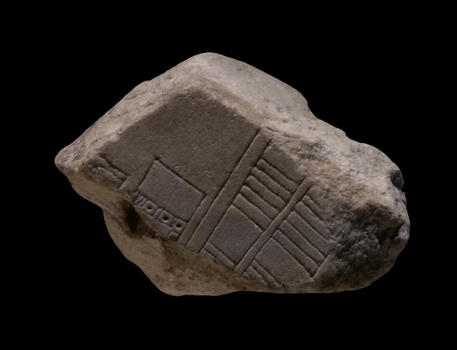
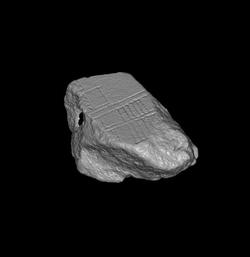
| Description A double line bisects this fragment from top to bottom. At left are visible the corners of two buildings, the nearer one including a line of four squares enclosing dots, representing columns and perhaps indicating that they stood on plinths. Examination of this fragment together with frs. 31a and 31b (now lost), shows that these two buildings were temples. The larger (whose front corner is represented at bottom left in the color photograph) is known mainly through the Renaissance drawing (see PM 1960, pl. 10, or fr. 31b). A broad flight of four steps led up to the podium temple; only two of its frontal columns were drawn, but their spacing suggests a hexastyle temple. Inside the cella, along the back wall, was a rectangular feature that was probably a base for the cult statue. The smaller, tetrastyle temple (whose front is visible on this fragment) was similarly built on a podium, although much narrower in proportions. A broad flight of stairs in the front led up to it, but the individual steps are not carved. A double line outlines the cella walls; the back wall includes an outward curve that would have formed a niche for the cult statue inside.
On the other side of the double line are portions of two flights of stairs. Examination together with frs. 31a and 31b shows that these flights doubled back on one another with a landing at the hairpin turn. A double line runs along one side of each flight, suggesting that these were retaining walls on the uphill side of the staircases and that the temples therefore stood at the top of a hill. Each flight alternates between groups of horizontal, parallel lines and unlined areas; these must be clusters of steps separated by short ramps. The upper flight included an arch (see fr. 31a and PM 1960, pl. 10).
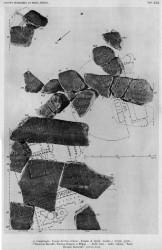
Identification: Centum Gradus? Fragments 31a, b and c were positioned on slab V-12 by L. Cozza on the basis of the thickness of the slab, the vein in the marble, and fr. 31a's position at the edge of slab (PM 1960, p. 91). Given this position on the Plan, these fragments must represent a complex of ramps and stairs on the SW slope of the Capitoline Hill. It has been argued that this is the Centum Gradus (one hundred steps), which was located below the Tarpeian Rock (Tac. Hist. 3.71; PM 1960, p. 91). However, this identification depends on the Tarpeian Rock having been at the SW corner of the Capitoline; given the ancient evidence that the Rock overlooked the Roman Forum, this is not at all certain (LTUR I, pp. 237-238). The double lines that separate the two flights of stairs and that border the upper flight are retaining walls rising up from each flight. At the bottom of the hill, this system of stairs and ramps surely led to one of the gates in the republican walls, but it is not certain which one. (E. Rodriguez-Almeida has suggested that this was the archaic Porta Carmentalis: LTUR I, p. 259). It will have formed an important passageway between the Capitoline and the markets and monuments below, including the Forum Holitorium, the Circus Flaminius and its surrounding victory temples, the Theater of Marcellus, and the riverfront.
Identification: Temples on the Capitoline Hill The two temples depicted here stood on the SW corner of the Capitoline at the top of the Centum Gradus. However, it is not known which of the Capitoline's many temples they represent.
Significance These fragments of the Forma Urbis--31a, 31b, 31c, and 499--are unique evidence for the ancient organization of this portion of the Capitoline. The fragments contribute valuable information about the relationship and movement between the Capitoline and the important sector of the city just below its SW slopes. These fragments also provide our only surviving evidence for three otherwise unknown temples on the Capitoline, one of which may be the Temple of Fides (see fr. 499). |
|
| HISTORY OF FRAGMENT |
| Like the majority of FUR fragments, this piece was discovered in 1562 in a garden behind the Church of Saints Cosmas and Damian. From here, it was transferred to the Palazzo Farnese and stored there. As shown by drawings made in the Renaissance and now kept in the Vatican (Cod. Vat. Lat. 3439), fo 2r), the piece was at that point still part of a larger fragment, that comprised frs. 31a, 31b (now lost) and 31c (see PM 1960, pl. 10, or fr. 31c).
Giovanni Pietro Bellori also included the entire fragment in his 1673 publication. The large fragment must have broken at some point there after, because this smaller piece was later used as building material in the 17th-c. construction of the Farnese family's Giardino Segreto (Secret Garden) near the Via Giulia, and was rediscovered in 1888 or 1898 when the walls of the garden were demolished. The Commissione Archeologica stored the piece until 1903, when curators of the Capitoline Museums included it in a reconstruction of the FUR mounted on a wall behind the Palazzo dei Conservatori (1903-1924). Since then, the fragment has been stored with the other known FUR fragments in various places: the storerooms of the Antiquarium Comunale (1924-1939), the Capitoline Museums again (1939-1955), the Palazzo Braschi (1955-1998), and since 1998 in the Museo della Civiltà Romana in EUR under the auspices of the Sovraintendenza ai Beni Culturali del Comune di Roma. (This fragment's history corresponds to Iter C as summarized in PM 1960, p. 56.)
Text by Tina Najbjerg and Jennifer Trimble |
|
| KEYWORDS
|
| temple, steps, Capitoline Hill |
|
 Prev
Prev